
info@mail.ucallm.com
Exosomes are extracellular vesicles that mediate cell-to-cell communication through the transfer of proteins, RNAs, lipids, and metabolites. They regulate cancer progression, immune responses, regeneration, and disease biomarker development.
We provide an end-to-end research platform — from exosome identification markers to cargo analysis and functional communication assays — enabling investigation of extracellular vesicle-mediated signaling networks.
Key Target Highlights
Core Molecular Targets in Exosome Research
Biological Process | Key Targets | Biological Significance | Research Applications |
Exosome biogenesis | ESCRT-0/I/II/III, ALIX, TSG101 | Controls intraluminal vesicle formation | Exosome production mechanisms |
Vesicle trafficking | Rab27A/B, Rab11, Rab35 | Regulates vesicle transport and secretion | Exosome release studies |
Exosome markers | CD9, CD63, CD81, Flotillin-1 | Defines exosome identity | EV characterization |
Cargo sorting | YBX1, hnRNPA2B1, sumoylated proteins | Determines selective cargo loading | RNA/protein packaging |
Lipid regulation | Ceramide, Sphingomyelinases | Controls membrane formation | EV biogenesis regulation |
Uptake mechanisms | Integrins, heparan sulfate proteoglycans | Mediates recipient-cell targeting | Cell communication studies |
RNA cargo function | miRNA, lncRNA, circRNA | Regulates gene expression | Disease mechanism studies |
Tumor-derived exosomes | PD-L1, TGF-β, oncogenic miRNAs | Promotes immune escape and metastasis | Cancer biology |
Key research trend:
Modern exosome research is moving beyond basic vesicle characterization toward functional extracellular communication networks, integrating cargo selection mechanisms, single-vesicle analysis, recipient-cell targeting, and engineered EV platforms. Emerging studies emphasize that exosomes act as dynamic signaling carriers linking tumor progression, immune regulation, metabolism, regeneration, and precision medicine applications.
Recommended Exosome Marker Strategy
Multi-Level Validation Framework
Detection Layer | Representative Markers | Scientific Purpose |
Exosome Identification | CD63, CD81, CD9 | Confirm EV/exosome enrichment |
ESCRT Pathway Validation | TSG101, ALIX | Analyze biogenesis mechanisms |
Endosomal Origin Confirmation | Rab27A, Rab11 | Evaluate secretion pathways |
Cargo Characterization | miRNA, lncRNA, mRNA, proteins | Define functional contents |
Membrane Composition | Flotillin-1, Annexin A2 | Assess EV membrane properties |
Functional Transfer | Recipient-cell signaling markers | Determine biological effects |
Disease-associated Cargo | PD-L1, VEGF, oncogenic factors | Investigate pathological roles |
Core Exosome Validation Strategy
"Golden Pair" Concept for Pathway Confirmation
Strategy | Marker Combination | Scientific Purpose | Application |
Golden Pair A: Exosome Identification | CD63 + CD81 | Confirm exosomal vesicle identity | EV characterization |
Golden Pair B: Biogenesis Mechanism | TSG101 + ALIX | Validate ESCRT-dependent formation | Mechanistic studies |
Golden Pair C: Secretion Regulation | Rab27A + CD63 | Evaluate exosome release pathway | Secretion studies |
Golden Pair D: Functional Communication | Exosomal cargo + recipient-cell response marker | Demonstrate biological signaling | Intercellular communication |
Competitive Technology Landscape
Exosome Research Workflow
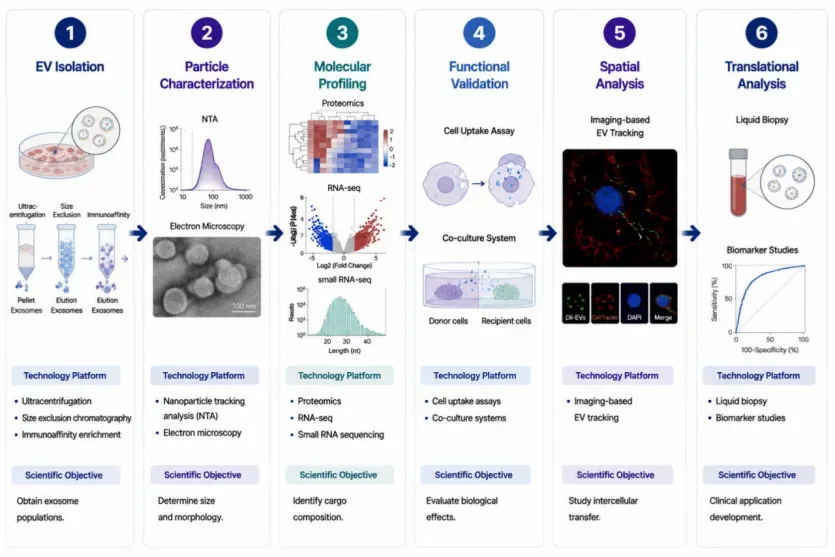
An integrated exosome research workflow combining EV isolation, particle characterization, molecular cargo profiling, functional validation, spatial tracking, and translational analysis to comprehensively define extracellular vesicle biology, intercellular communication, and clinical potential.
Pathway Overview
Exosomes are small extracellular vesicles that mediate intercellular communication through the transfer of proteins, nucleic acids, lipids, and metabolites. Their biogenesis, secretion, and functional activity are regulated by ESCRT machinery, Rab GTPases, tetraspanins, and cargo sorting mechanisms. Exosome signaling influences tumor progression, immune regulation, tissue regeneration, neurobiology, and biomarker discovery.
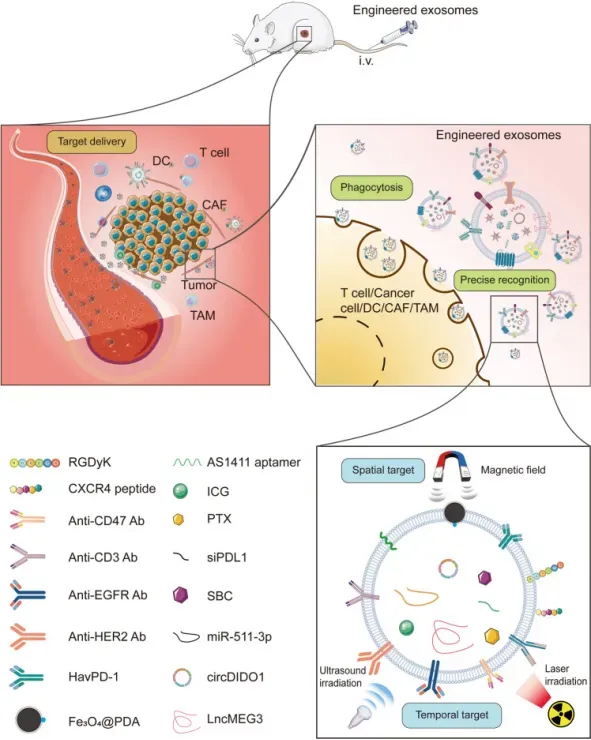
Schematic illustration of the engineered exosomes exhibiting antitumor effects on preclinical models. (PMID: 36922504)
Recommended Experimental Validation Workflow
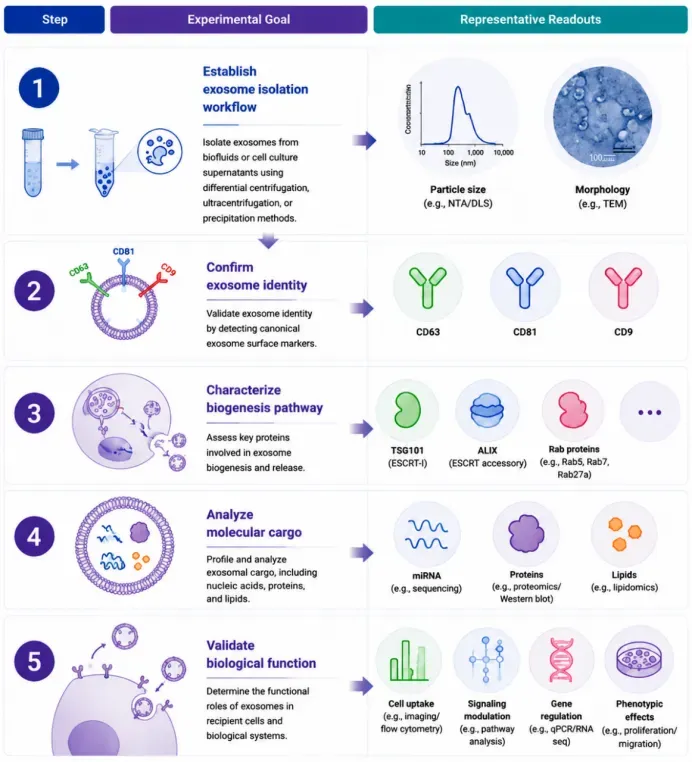
Step | Experimental Goal | Representative Readouts |
Step 1 | Establish exosome isolation workflow | Particle size, morphology |
Step 2 | Confirm exosome identity | CD63, CD81, CD9 |
Step 3 | Characterize biogenesis pathway | TSG101, ALIX, Rab proteins |
Step 4 | Analyze molecular cargo | miRNA, proteins, lipids |
Step 5 | Validate biological function | Recipient-cell signaling response |
Featured Research Application Examples
Research Area | Model System | Key Evaluation Parameters | Scientific Question |
Cancer biology | Tumor-derived exosomes | PD-L1, miRNAs, integrins | How do tumors remodel their microenvironment? |
Immunology | Immune-cell EVs | Cytokines, checkpoint molecules | How do EVs regulate immune responses? |
Regenerative medicine | Stem-cell-derived exosomes | Growth factors, regenerative miRNAs | How do EVs promote tissue repair? |
Cardiovascular disease | Endothelial EVs | Angiogenic cargo | How do EVs regulate vascular remodeling? |
Neurobiology | Neural EVs | Disease-associated proteins/RNAs | How do EVs influence neuronal communication? |
Frequently Asked Questions
Q1. Which markers should be used to confirm exosome identity and purity?
Exosome characterization requires a combination of positive and negative markers following extracellular vesicle guidelines. Common positive markers include CD9, CD63, CD81, TSG101, and ALIX, which indicate exosome/EV enrichment. Negative markers such as Calnexin, GM130, or Cytochrome c are used to exclude contamination from cellular compartments. Reliable exosome studies integrate particle analysis, morphology assessment, and molecular marker validation rather than relying on a single marker.
Q2. Which isolation methods provide reliable exosome preparation for downstream analysis?
Exosome isolation methods should be selected based on experimental objectives and required purity. Common approaches include ultracentrifugation, size exclusion chromatography (SEC), immunoaffinity enrichment, and precipitation-based methods. SEC and immunoaffinity approaches often provide improved purity, while ultracentrifugation enables higher recovery. Combining isolation with nanoparticle tracking analysis (NTA), electron microscopy, and marker validation ensures accurate exosome characterization.
Q3. How can exosome cargo and biological functions be comprehensively analyzed?
Exosome cargo analysis typically integrates proteomics, transcriptomics, small RNA sequencing, and lipid profiling to identify functional molecules. Biological effects can be evaluated using cell uptake assays, fluorescent EV tracking, co-culture systems, and functional phenotyping assays to determine how exosomes regulate recipient cell behavior, signaling pathways, and disease processes.
Q4. What are the most common challenges and pitfalls in exosome research?
Common challenges include inconsistent isolation efficiency, contamination with non-exosomal vesicles or proteins, lack of standardized characterization, and overinterpretation of functional effects. Researchers should apply multiple validation approaches, including particle size distribution, morphology analysis, canonical EV markers, and appropriate controls, to ensure reproducible and biologically meaningful conclusions.
Q5. How can exosome research be translated into disease mechanisms and clinical applications?
Advanced exosome studies combine multi-omics profiling, spatial imaging, liquid biopsy approaches, and biomarker validation to investigate their roles in cancer, immune regulation, neurodegeneration, cardiovascular disease, and regenerative medicine. Exosome-based analyses enable discovery of disease-associated signatures, intercellular communication mechanisms, and potential diagnostic or therapeutic strategies.
Key References
Ripoll L., Zickler A.M., Vader P., El Andaloussi S., Verweij F.J., van Niel G. (2026).
Biology and therapeutic potential of extracellular vesicle targeting and uptake.Nature Reviews Molecular Cell Biology. 27:358–376.Lee Y.J., Shin K.J., Chae Y.C. (2024).Regulation of cargo selection in exosome biogenesis and its biomedical applications in cancer.Experimental & Molecular Medicine. 56(4):877–889.
Di Bella M.A., Taverna S. (2024).Extracellular Vesicles: Diagnostic and Therapeutic Applications in Cancer.Biology. 13(9):716.
Manno M., Bongiovanni A., Margolis L., et al. (2025). The physico-chemical landscape of extracellular vesicles. Nature Reviews Bioengineering. 3:68–82.
Wang Z., Zhou X., Kong Q., et al. (2024). Extracellular Vesicle Preparation and Analysis: A State-of-the-Art Review. Advanced Science. 11:e2401069.
Kim H.I., Park J., Zhu Y., et al. (2024). Recent advances in extracellular vesicles for therapeutic cargo delivery. Experimental & Molecular Medicine. 56:836–849.
Kumar M.A., Baba S.K., Sadida H.Q., et al. (2024). Extracellular vesicles as tools and targets in therapy for diseases. Signal Transduction and Targeted Therapy. 9:27.
Carney R.P., Mizenko R.R., Bozkurt B.T., et al. (2024). Harnessing extracellular vesicle heterogeneity for diagnostic and therapeutic applications.Nature Nanotechnology. 20: 14–25 .
Buzás E.I. (2023). The roles of extracellular vesicles in the immune system. Nature Reviews Immunology. 23:236–250.