
info@ucallmlabs.com
The human stomach features a structurally sophisticated 3D glandular epithelium that can be anatomically and functionally partitioned into two discrete compartments. The gastric corpus (fundus) is the main region responsible for secreting gastric acid and digestive enzymes, while the gastric antrum (pylorus) is mainly populated by mucus-producing cells and hormone-secreting endocrine cells. Research on gastric disorders currently depends heavily on conventional animal models and two-dimensional cell culture platforms, neither of which can faithfully reconstruct the complex physiological microenvironment and immune responses of the human stomach. As an advanced stem cell-derived culture system, gastric organoids recapitulate the intrinsic three-dimensional microenvironment of human gastric tissue and support optimal cell survival and proliferation. These features allow gastric organoids to closely replicate the physiological traits of native human gastric tissue, supporting more precise disease modeling and pathological research. Benefiting from their elaborate structure and authentic functional phenotypes, gastric organoids hold prominent promise for fundamental biological studies and translational medicine. By recapitulating the in vivo gastric microenvironment, such organoid models enable thorough dissection of the cellular and molecular mechanisms governing stomach development and disease progression.
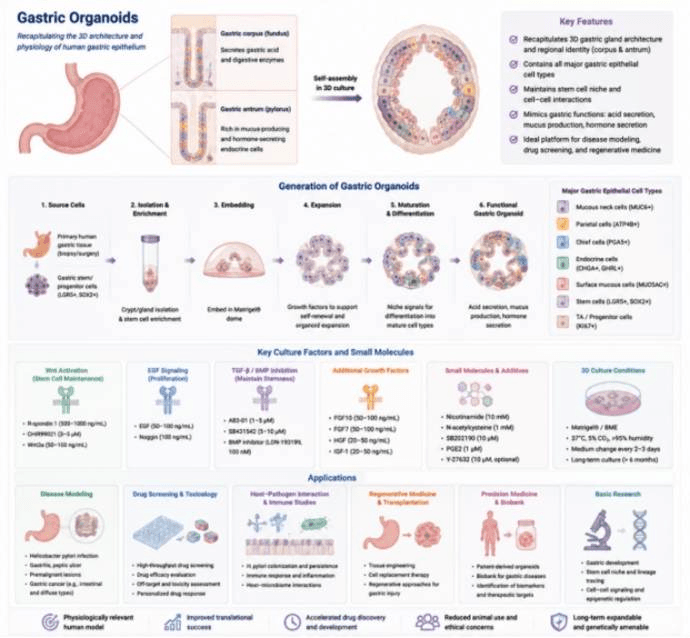
Gastric organoid cultures from different sources.
Common Reagents for Gastric Organoid Culture
Recommended Markers for Gastric Organoids
Data display.
(A) Organoid culture status (bright-field morphology)
(B) Multicolor immunofluorescence staining
(C) Post-translational modification proteomics
(D) Epigenetic profiling (ChIP-seq / ATAC-seq)
(E) Gene editing validation (CRISPR)