
info@ucallmlabs.com
Decoding Epigenetic Alterations and Molecular Classification — Empowering Precision Neuro-Oncology Research with Validated Biomarker Antibodies
Gliomas represent the most common primary malignant tumors of the central nervous system and exhibit remarkable molecular heterogeneity, diverse biological behaviors, and variable clinical outcomes. Traditional histopathological evaluation alone is insufficient to fully resolve glioma complexity, creating an increasing demand for reliable molecular biomarkers that enable accurate tumor classification and personalized therapeutic strategies.
We support next-generation glioma biomarker research by enabling comprehensive characterization of molecular subtypes, epigenetic alterations, tumor heterogeneity, genome stability, and tumor evolution. Validated biomarker solutions empower researchers to investigate key molecular drivers, define clinically relevant tumor states, identify therapeutic vulnerabilities, and uncover mechanisms underlying glioma progression and treatment resistance. Combined with advanced molecular profiling, single-cell analysis, spatial profiling, and multiplex biomarker imaging, glioma-focused research enables high-resolution investigation of cellular diversity, tumor–microenvironment interactions, and dynamic molecular changes within complex tumor ecosystems.
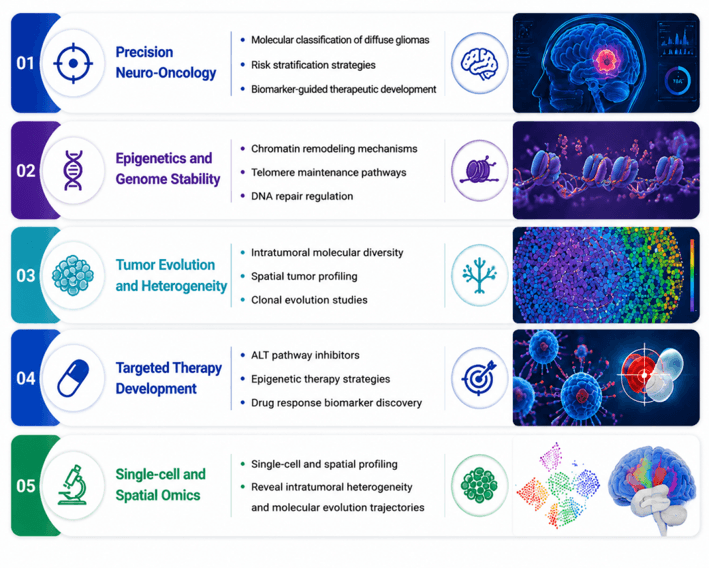
Glioma Biomarker Antibody Portfolio
——Comprehensive Solutions for Molecular Classification, Prognostic Evaluation and Therapeutic Research
Reliable glioma characterization requires integrated analysis of epigenetic alterations, driver mutations, lineage identity, tumor proliferation, and treatment response pathways. Our validated antibody portfolio enables researchers to establish standardized glioma immunophenotyping systems.
Biomarker Category | Representative Markers | Research Applications | Biological Significance |
Chromatin Remodeling Biomarkers | ATRX, H3K27me3,EZHIP,H3K27ac, H3K36me3 | Molecular classification, ALT pathway research, epigenetic studies | Regulates chromatin remodeling, DNA repair and telomere homeostasis |
Glioma Driver Mutation Biomarkers | IDH1 R132H / IDH2 | Glioma molecular typing and subclassification | Identifies common oncogenic driver mutations in diffuse gliomas |
Tumor Suppressor Pathway Markers | TP53/p53 Pathway Biomarkers | Astrocytoma characterization and genomic instability studies | Reflects abnormal DNA damage response and tumor evolution |
Glial Lineage Markers | GFAP, OLIG2 | Tumor lineage confirmation | Defines astrocytic differentiation and glial identity |
Proliferation Markers | Ki-67 (MKI67) | Tumor grading and aggressiveness evaluation | Indicates active cell cycle progression |
Histone Mutation Biomarkers | H3.3 G34R/V, H3 K27M | Pediatric diffuse glioma classification | Defines molecularly distinct pediatric tumor entities |
Oncogenic Signaling Markers | EGFR | Glioblastoma profiling and pathway studies | Associated with growth signaling activation and tumor progression |
DNA Repair Biomarkers | MGMT | Therapeutic response research | Predicts response to alkylating chemotherapy |
Standardized Glioma Immunophenotyping Panel
——Essential Biomarkers Supporting Molecular Neuropathology Research
Biomarker | Detection Purpose | Research Value |
ATRX | Detect nuclear expression loss | Identify ATRX-deficient astrocytoma-associated molecular patterns |
IDH1 R132H | Detect IDH mutation status | Define IDH-mutant glioma populations |
p53 | Evaluate TP53 pathway alteration | Support astrocytoma characterization |
Ki-67 | Quantify proliferation index | Evaluate tumor grade and growth activity |
GFAP | Confirm glial lineage | Establish astrocytic differentiation |
H3K27M / H3G34 | Detect histone alterations | Classify pediatric diffuse gliomas |
EGFR | Assess oncogenic activation | Characterize aggressive glioblastoma phenotypes |
MGMT | Evaluate DNA repair activity | Support therapeutic response studies |
Featured Research Solutions
——Integrated Biomarker Panels for Comprehensive Glioma Characterization
n Epigenetic Alteration and Chromatin Remodeling Panel
Key Markers
ATRX | H3K27M | H3K27me3 | EZHIP | H3K36me3 | H3K27ac |
n Glioblastoma Progression & Therapy Response Panel
EGFR | PTEN | Ki-67 | MGMT | p53 |
Key Markers
n Pediatric Diffuse Glioma Panel
Key Markers
H3K27M | H3K27me3 | H3.3 G34R/V | EZHIP | ATRX | ACVR1 |
Glioma Biomarker Research
——From Molecular Profiling to Precision Neuro-Oncology Discovery
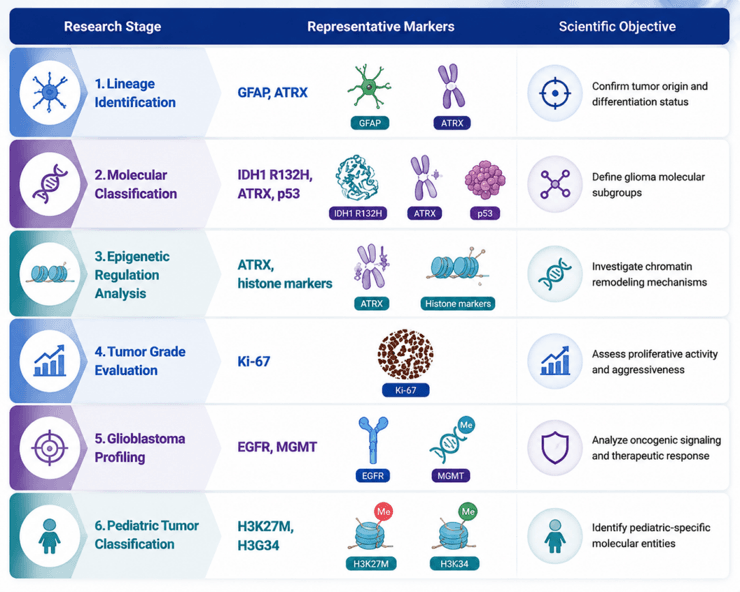
Glioma biomarker research integrates lineage characterization, molecular classification, epigenetic profiling, tumor grading, and therapeutic biomarker analysis to define tumor identity, progression, and treatment relevance. Key biomarkers enable comprehensive assessment of glioma subtypes, cellular origin, molecular mechanisms, and therapeutic response. This integrated workflow supports WHO CNS5-aligned classification, biomarker validation, and precision oncology development, accelerating discoveries from molecular understanding to translational neuro-oncology applications.
Why Researchers Choose Our Glioma Biomarker Solutions?
Validated Markers. Integrated Panels. Confident Neuro-Oncology Research.
Our antibody portfolio supports the complete glioma research workflow—from molecular classification and epigenetic investigation to therapeutic biomarker discovery.
Research Challenge | Our Solution |
How can I accurately classify glioma subtypes? | Integrated ATRX, IDH1, p53 and GFAP biomarker panels for molecular stratification |
How can I investigate chromatin remodeling mechanisms? | Validated ATRX antibodies for epigenetic and telomere biology research |
How can I evaluate tumor aggressiveness? | Ki-67, EGFR and molecular subtype markers for progression analysis |
How can I study treatment response mechanisms? | MGMT and pathway-specific biomarkers for therapeutic research |
How can I improve experimental reproducibility? | Application-validated antibodies optimized for IHC, IF and WB platforms |
Key References
1. Weller M., Wen P.Y., Chang S.M., et al. (2024).Glioma.Nature Reviews Disease Primers.10:33.
2. Reuss D.E., Sahm F., Schrimpf D., et al. (2023).Updates on the WHO diagnosis of IDH-mutant glioma.Journal of Neuro-Oncology.185:1–12.
3. Galbraith K., Snuderl M. (2024).Molecular Pathology of Gliomas. Clinics in Laboratory Medicine.44(2):149–159.
4. Chakrabarti I., Mazumder S. (2024).What Changed in CNS5? A Mini-Review on General Changes and Adult Diffuse Gliomas.Annals of African Medicine.23(3):255–261.
5. Meel M., Jindal A., Kumar M., et al. (2024).IDH1, ATRX, p53, and Ki67 Expression in Glioblastoma Patients: Their Clinical and Prognostic Significance.Asian Journal of Neurosurgery. 19(1):14–20.
6. Louis D.N., Perry A., Wesseling P., et al. (2021).The 2021 WHO Classification of Tumors of the Central Nervous System: a summary.Neuro-Oncology. 23:1231–1251.