
info@ucallmlabs.com
Hematological Cancer Stem Cells (HCSCs) are a distinct population of cells present in hematological malignancies that possess key stem cell-like properties, including self-renewal, long-term persistence, disease-initiating capacity, and therapy resistance. Similar to normal hematopoietic stem cells (HSCs), cancer stem cells occupy the apex of the malignant hematopoietic hierarchy and sustain the initiation and progression of leukemia and other blood cancers by continuously generating tumor cell populations with different stages of maturation.
Leukemia Stem Cells (LSCs) represent the classical model for studying hematological cancer stem cells. Studies have demonstrated that LSCs can originate from normal hematopoietic stem cells or early hematopoietic progenitor cells, which gradually acquire malignant stemness properties through the accumulation of genetic mutations, epigenetic alterations, and abnormalities in the bone marrow microenvironment. For example, in acute myeloid leukemia (AML), hematopoietic stem cells carrying key oncogenic mutations can transform into leukemia-initiating cells with sustained self-renewal capacity, thereby driving disease progression and relapse.
Hematological cancer stem cells maintain their malignant state through multiple mechanisms. These include aberrant activation of stemness-associated signaling pathways such as Wnt/β-catenin, Notch, Hedgehog, PI3K-AKT-mTOR, and JAK/STAT signaling. In addition, HCSCs evade chemotherapy and targeted therapies by maintaining a quiescent state, enhancing DNA damage repair capacity, altering metabolic programs, and remodeling the bone marrow microenvironment, making them a major source of disease recurrence.
Currently, research on hematological cancer stem cells has established a variety of experimental platforms, including fluorescence-activated cell sorting (FACS), single-cell RNA sequencing (scRNA-seq), functional transplantation assays, in vitro colony-forming assays, and drug sensitivity evaluation systems. Typical identification of LSCs involves the combined analysis of surface markers such as CD34, CD38, CD123, CD117, and CD90, together with functional assays to validate their long-term self-renewal capacity and leukemia-initiating potential.
With the advancement of precision medicine and targeted therapies, hematological cancer stem cell research has become an important direction for developing novel anti-cancer strategies. By targeting LSC-specific molecular pathways, stemness maintenance mechanisms, and interactions with the tumor microenvironment, it may become possible to precisely eliminate the root source of malignant clones, improve therapeutic responses, and reduce the risk of disease relapse.
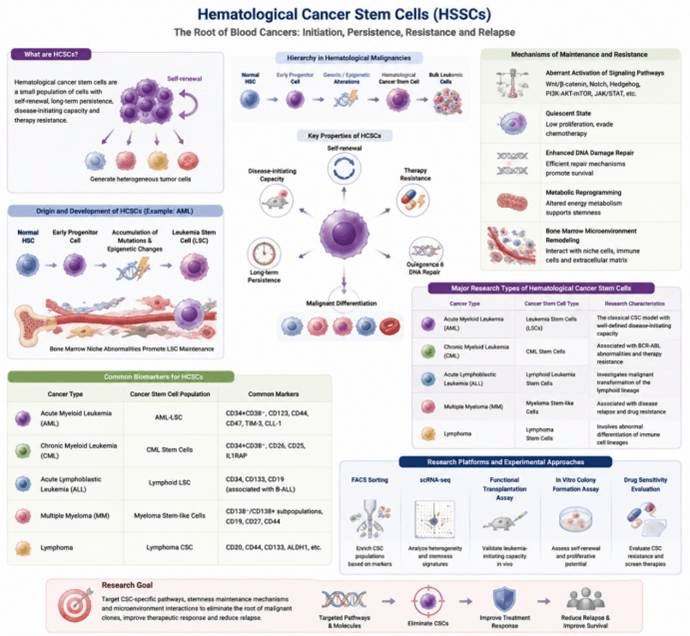
Hematological cancer stem cells (HCSCs) are a malignant cell population with self-renewal capacity, long-term persistence, disease-initiating ability, and therapeutic resistance. This schematic illustrates the origin and evolution of HCSCs, their key biological characteristics, maintenance mechanisms, disease-associated biomarkers, and commonly used research platforms. Through aberrant signaling activation, microenvironmental interactions, enhanced DNA damage repair, and metabolic reprogramming, HCSCs drive the initiation, progression, and relapse of hematological malignancies, providing an important foundation for cancer stem cell–targeted therapies and precision drug development.
Major Research Types of Hematological Cancer Stem Cells
| Cancer Type | Cancer Stem Cell Type | Research Characteristics |
| Acute Myeloid Leukemia (AML) | Leukemia Stem Cells (LSCs) | The classical CSC model with well-defined disease-initiating capacity |
| Chronic Myeloid Leukemia (CML) | CML Stem Cells | Associated with BCR-ABL abnormalities and therapy resistance |
| Acute Lymphoblastic Leukemia (ALL) | Lymphoid Leukemia Stem Cells | Investigates malignant transformation of the lymphoid lineage |
| Multiple Myeloma (MM) | Myeloma Stem-like Cells | Associated with disease relapse and drug resistance |
| Lymphoma | Lymphoma Stem Cells | Involves abnormal differentiation of immune cell lineages |
Biomarkers
| Cancer Type | Cancer Stem Cell Population | Common Markers |
| Acute Myeloid Leukemia (AML) | AML-LSC | CD34⁺CD38⁻, CD123, CD44, CD47, TIM-3, CLL-1 |
| Chronic Myeloid Leukemia (CML) | CML Stem Cells | CD34⁺CD38⁻, CD26, CD25, IL1RAP |
| Acute Lymphoblastic Leukemia (ALL) | Lymphoid LSC | CD34, CD133, CD19 (associated with B-ALL) |
| Multiple Myeloma (MM) | Myeloma Stem-like Cells | CD138⁻/CD138⁺ subpopulations, CD19, CD27, CD44 |
| Lymphoma | Lymphoma CSC | CD20, CD44, CD133, ALDH1, etc. |