
info@ucallmlabs.com
Hematopoietic Stem Cell–Derived Erythrocytes (HSC-derived Erythrocytes) represent an important research direction for in vitro modeling of human erythropoiesis. Erythrocytes are terminally differentiated blood cells continuously generated from hematopoietic stem cells (HSCs) in the bone marrow and are primarily responsible for oxygen transport and the removal of metabolic waste from tissues. According to the review “Blood in a dish: In vitro synthesis of red blood cells” by Migliaccio and Palis, advances in hematopoietic stem cell culture systems and cytokine-based regulation technologies have enabled the establishment of in vitro erythropoietic systems that mimic the bone marrow hematopoietic microenvironment, allowing directed differentiation of hematopoietic stem/progenitor cells into mature erythrocytes. This process typically starts from CD34⁺ hematopoietic stem/progenitor cells, which undergo a series of developmental stages under the coordinated regulation of key factors, including SCF (Stem Cell Factor), IL-3 (Interleukin-3), EPO (Erythropoietin), and glucocorticoids. The differentiation trajectory sequentially progresses through multipotent progenitors (MPPs), common myeloid progenitors (CMPs), megakaryocyte–erythroid progenitors (MEPs), burst-forming unit erythroid cells (BFU-E), colony-forming unit erythroid cells (CFU-E), proerythroblasts, different stages of erythroblasts, and reticulocytes, ultimately generating mature enucleated erythrocytes. During erythroid maturation, cells gradually acquire characteristic erythrocyte features, including increased expression of erythroid surface markers such as Glycophorin A (GYPA), CD71, and Band 3 (SLC4A1), enhanced hemoglobin synthesis, nuclear condensation, and terminal enucleation to form functional mature red blood cells capable of oxygen transport. The HSC-derived erythrocyte system provides a reliable in vitro model for studying erythropoiesis, hemoglobin regulation, and the mechanisms underlying erythroid disorders. Meanwhile, it has accelerated applications in the development of transfusion alternatives, genetic blood disease modeling, and drug screening. By integrating hematopoietic stem cell expansion with erythroid lineage-directed differentiation, this technology provides a critical foundation for the future large-scale production of functional erythrocytes and offers a potential solution to clinical blood supply limitations.
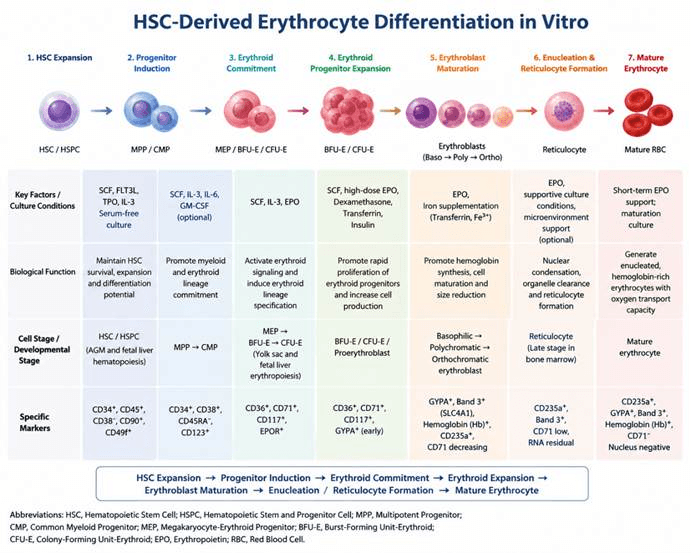
The complete process of in vitro directed differentiation of hematopoietic stem cells (HSCs) into mature erythrocytes. Starting from HSCs/HSPCs, cells are expanded under the support of cytokines including SCF, FLT3L, TPO, and IL-3, followed by sequential progression through developmental stages including multipotent progenitors (MPPs), common myeloid progenitors (CMPs), megakaryocyte–erythroid progenitors (MEPs), burst-forming unit erythroid cells (BFU-E), and colony-forming unit erythroid cells (CFU-E). Under the regulation of EPO, SCF, Dex, Transferrin, Insulin, and other erythroid-inducing signals, cells gradually undergo erythroid commitment, rapid expansion, erythroblast maturation, enucleation, and reticulocyte formation, ultimately generating enucleated, hemoglobin-rich mature erythrocytes with oxygen-transport capacity. This differentiation process recapitulates the bone marrow erythropoietic microenvironment and utilizes stage-specific markers, including CD34, CD36, CD71, GYPA (Glycophorin A), CD235a, and Band 3 (SLC4A1), for characterization and quality assessment. The platform provides an important technological foundation for in vitro erythrocyte production, blood disorder modeling, drug screening, and the future development of transfusion replacement products.
Differentiation Stage | Added Factors / Culture Conditions | Core Biological Function | Corresponding Cell Type / Developmental Stage | Stage-Specific Identification Markers |
Hematopoietic Stem Cell Expansion Stage | SCF (Stem Cell Factor), FLT3L, TPO, IL-3; serum-free culture system | Maintains survival of CD34⁺ hematopoietic stem/progenitor cells, promotes early hematopoietic cell expansion, and preserves differentiation potential | Hematopoietic Stem Cells (HSCs) / Hematopoietic Stem and Progenitor Cells (HSPCs); corresponding to embryonic HSC formation stages (AGM region and fetal liver hematopoiesis) | CD34⁺, CD45⁺, CD38⁻, CD90⁺, CD49f⁺ |
Myeloid/Erythroid Progenitor Induction Stage | SCF + IL-3 + IL-6 + GM-CSF (in some differentiation systems) | Promotes HSC commitment toward myeloid progenitors and erythroid–megakaryocyte progenitors, enhancing erythroid progenitor generation | Multipotent Progenitor (MPP) → Common Myeloid Progenitor (CMP) | CD34⁺, CD38⁺, CD45RA⁻, CD123⁺; CMP-associated phenotype: CD34⁺CD38⁺CD45RA⁻ |
Erythroid Commitment Stage | SCF + IL-3 + EPO (Erythropoietin) | EPO activates erythroid-specific signaling pathways and promotes differentiation of CMPs into erythroid progenitors (BFU-E/CFU-E) | Megakaryocyte-Erythroid Progenitor (MEP) → BFU-E → CFU-E; corresponding to embryonic yolk sac and fetal liver erythropoiesis stages | Decreased CD34 expression; increased CD36⁺, CD71⁺, CD117⁺, and EPO receptor (EPOR) expression |
Rapid Expansion of Erythroid Progenitors | SCF + high concentration EPO + glucocorticoid (Dex) + Transferrin + Insulin | Promotes extensive proliferation of BFU-E/CFU-E cells, improves in vitro erythrocyte production efficiency, and maintains immature erythroid cell proliferation | BFU-E / CFU-E / Proerythroblast | CD36⁺, CD71⁺, CD117⁺; initiation of Glycophorin A (GYPA) expression |
Erythroblast Maturation Stage | Continuous EPO stimulation; reduced SCF and proliferation factors; supplementation with iron sources (Transferrin, Fe³⁺) | Promotes hemoglobin synthesis, cell cycle exit, cell size reduction, and erythroid maturation | Basophilic erythroblast → Polychromatic erythroblast → Orthochromatic erythroblast | Gradual reduction of CD71; GYPA⁺, Band 3 (SLC4A1)⁺, Hemoglobin (Hb)⁺, CD235a⁺ |
Enucleation and Reticulocyte Formation Stage | EPO + supportive culture conditions; bone marrow-like microenvironment simulation (macrophage co-culture or matrix-supported systems can enhance maturation) | Promotes nuclear condensation, chromatin degradation, and organelle clearance, enabling transition from erythroblasts to reticulocytes | Reticulocyte; corresponding to late-stage erythropoiesis in the bone marrow | CD235a (Glycophorin A)⁺, Band 3⁺, low CD71 expression, residual RNA (reticulocyte characteristic) |
Mature Erythrocyte Stage | No SCF/IL-3; short-term EPO support; in vitro maturation culture | Completes terminal maturation to generate enucleated, hemoglobin-rich erythrocytes with oxygen transport capacity | Mature erythrocyte | CD235a⁺, GYPA⁺, Band 3⁺, Hemoglobin (Hb)⁺, CD71⁻, nucleus-negative |