
info@ucallmlabs.com
Megakaryocytes (Megakaryocytes, MKs) are key cells in the hematopoietic system responsible for platelet production. They are derived from hematopoietic stem cells (Hematopoietic Stem Cells, HSCs) and are generated through multiple stages of lineage commitment and terminal maturation. During normal hematopoiesis, HSCs first differentiate into multipotent progenitors (Multipotent Progenitors, MPPs), which further develop into common myeloid progenitors (Common Myeloid Progenitors, CMPs) and megakaryocyte-erythroid progenitors (Megakaryocyte-Erythroid Progenitors, MEPs), ultimately producing mature megakaryocytes. Mature megakaryocytes undergo cytoplasmic expansion, polyploidization (endomitosis), and proplatelet formation, releasing platelets into the circulation to maintain hemostasis and vascular repair functions.
The establishment of an HSC-derived Megakaryocyte Differentiation System in vitro enables the simulation of the natural human megakaryopoiesis process and provides an important model for studying hematopoietic regulation mechanisms, platelet production disorders, and hematological diseases. Using CD34⁺ hematopoietic stem/progenitor cells as the starting population, directional induction of HSCs toward the megakaryocyte lineage can be achieved through optimization of cytokine combinations and culture conditions. Among these factors, thrombopoietin (Thrombopoietin, TPO) and its receptor c-MPL signaling axis represent the core regulatory pathway controlling megakaryocyte fate determination, maturation, and platelet production. In addition, supporting factors such as SCF, IL-3, IL-6, and IL-11 promote hematopoietic progenitor expansion and megakaryocyte lineage development.
During in vitro culture, HSC-derived megakaryocytes undergo a continuous developmental process from early CD34⁺ hematopoietic progenitor cells, to CD41a⁺/CD61⁺ megakaryocyte progenitors, and finally to CD42b⁺ mature megakaryocytes. Mature megakaryocytes exhibit typical characteristics including large cell size, polyploid nuclei, and abundant platelet-producing structures, and can further generate proplatelet structures to release functional platelets. Therefore, the HSC-derived megakaryocyte system not only provides a valuable platform for investigating megakaryocyte development and platelet biogenesis mechanisms, but also serves as an important research tool for modeling thrombocytopenia, inherited platelet function disorders, and bone marrow hematopoietic diseases.
With advances in stem cell culture technologies, three-dimensional culture systems, and bioengineering approaches, HSC-derived megakaryocytes have become an important platform for artificial platelet production, hematological disease drug screening, and precision medicine research. Establishing standardized systems for megakaryocyte induction, maturation, and functional evaluation will further promote the development of cell therapy, blood substitute products, and next-generation blood biomanufacturing technologies.
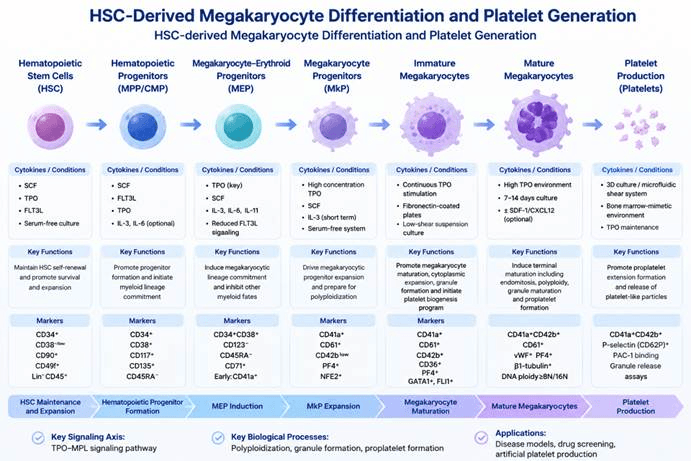
Schematic diagram of HSC-derived megakaryocyte differentiation process.
HSCs undergo sequential differentiation into hematopoietic progenitors, megakaryocyte–erythroid progenitors (MEPs), megakaryocyte progenitor cells (MkPs), and mature megakaryocytes under the regulation of cytokines such as TPO, SCF, and FLT3L. Mature megakaryocytes subsequently undergo polyploidization, granule maturation, and proplatelet formation to release functional platelets. This in vitro differentiation system recapitulates the natural megakaryopoiesis process and provides an important research platform for studying platelet generation mechanisms, modeling hematological diseases, drug screening, and artificial platelet production.
Differentiation Stage | Added Factors / Culture Conditions | Core Biological Function | Corresponding Cell Type / Developmental Stage | Stage-specific Identification Markers |
HSC Maintenance and Expansion Stage | Serum-free culture system; SCF (Stem Cell Factor), TPO (Thrombopoietin), FLT3L; IMDM/SFEM basal medium | Maintains HSC self-renewal capacity, promotes survival and expansion of hematopoietic stem/progenitor cells, and provides a cellular source for subsequent myeloid differentiation | Hematopoietic Stem Cells (HSCs); corresponding to the establishment stage of embryonic hematopoiesis (AGM region and fetal liver hematopoiesis) | CD34⁺, CD38⁻/low, CD90⁺, CD49f⁺, Lin⁻, CD45⁺ |
Hematopoietic Progenitor Formation Stage | SCF + FLT3L + TPO; some systems supplemented with IL-3 and IL-6 | Promotes HSC transition into multipotent hematopoietic progenitor state, enhances proliferation, and initiates myeloid lineage commitment | Multipotent Progenitors (MPPs); Common Myeloid Progenitors (CMPs) | CD34⁺, CD38⁺, CD45RA⁻, CD117⁺, CD135⁺ |
Megakaryocyte-Erythroid Progenitor (MEP) Induction Stage | TPO (core factor), SCF, IL-3, IL-6, IL-11; reduced FLT3L signaling | TPO activates the MPL receptor-mediated JAK2/STAT5 pathway to promote megakaryocyte lineage commitment while suppressing alternative myeloid fates | Megakaryocyte-Erythroid Progenitors (MEPs); corresponding to the myeloid differentiation stage during embryonic hematopoiesis | CD34⁺CD38⁺CD123⁻CD45RA⁻CD71⁺; early megakaryocyte marker CD41a⁺ |
Megakaryocyte Progenitor (MkP) Expansion Stage | High concentration of TPO; SCF; short-term IL-3 supplementation; serum-free system or serum substitute | Drives megakaryocyte lineage expansion, promotes cell-cycle progression, and prepares cells for polyploidization | Megakaryocyte Progenitor Cells (MkPs) | CD41a (ITGA2B)⁺, CD61 (ITGB3)⁺, CD42b low expression, PF4⁺, NFE2⁺ |
Immature Megakaryocyte Formation Stage | Continuous TPO stimulation; fibronectin-coated culture plates; low-shear suspension culture | Promotes megakaryocyte maturation, cytoplasmic expansion, granule formation, and activation of endogenous platelet production programs | Immature Megakaryocytes | CD41a⁺, CD61⁺, CD42b⁺, CD36⁺, PF4⁺, GATA1⁺, FLI1⁺ |
Mature Megakaryocyte Stage | High TPO environment; 7–14 days of culture; some systems supplemented with SDF-1/CXCL12 to enhance migration and platelet release | Induces terminal maturation, including endomitosis, polyploidization, granule maturation, and proplatelet formation | Mature Megakaryocytes; bone marrow platelet-producing cells | CD41a⁺CD42b⁺, CD61⁺, vWF⁺, PF4⁺, β1-tubulin⁺; DNA ploidy ≥8N/16N |
Platelet Production Stage (Thrombopoiesis) | 3D culture systems, microfluidic shear-force platforms, bone marrow-mimicking environments; TPO maintenance | Promotes megakaryocyte proplatelet extension formation and release of platelet-like particles | Platelet-producing Megakaryocytes → Platelets | CD41a⁺CD42b⁺ platelets, P-selectin (CD62P), PAC-1 binding, platelet granule release functional assays |