
info@ucallmlabs.com
Hematopoietic Stem Cells (HSCs) are the core cell population responsible for maintaining blood system homeostasis throughout life. Through a series of stepwise lineage commitment processes, HSCs continuously generate various mature blood cell populations. Among these, the myeloid lineage represents a major component of the hematopoietic system and includes monocytes, macrophages, neutrophils, dendritic cells (DCs), and other granulocyte populations. According to the classical hematopoietic differentiation model, HSCs progressively differentiate through intermediate stages including multipotent progenitors (MPPs), common myeloid progenitors (CMPs), and granulocyte-macrophage progenitors (GMPs), ultimately undergoing myeloid lineage specification and functional maturation under the regulation of specific cytokines and microenvironmental signals.
Based on in vitro directed differentiation systems of HSCs, precise modulation of key growth factors and culture conditions, including SCF, FLT3L, TPO, IL-3, GM-CSF, M-CSF, and G-CSF, enables the simulation of the native hematopoietic niche and efficient induction and expansion of diverse myeloid cell populations from HSCs. Through stage-specific phenotypic characterization and functional validation, this platform generates HSC-derived myeloid cell models with typical myeloid marker expression and immune functional properties, including HSC-derived monocytes, macrophages, neutrophils, and dendritic cells.
HSC-derived myeloid cell models provide stable and reproducible research platforms for investigating myeloid cell development mechanisms, inflammatory and immune disease modeling, hematological disease studies, drug screening, and cell therapy applications. Combined with flow cytometry analysis, single-cell sequencing, and functional assessment systems, this technology platform enables comprehensive dissection of lineage commitment mechanisms during myeloid cell generation, providing critical support for precision medicine and regenerative medicine research.
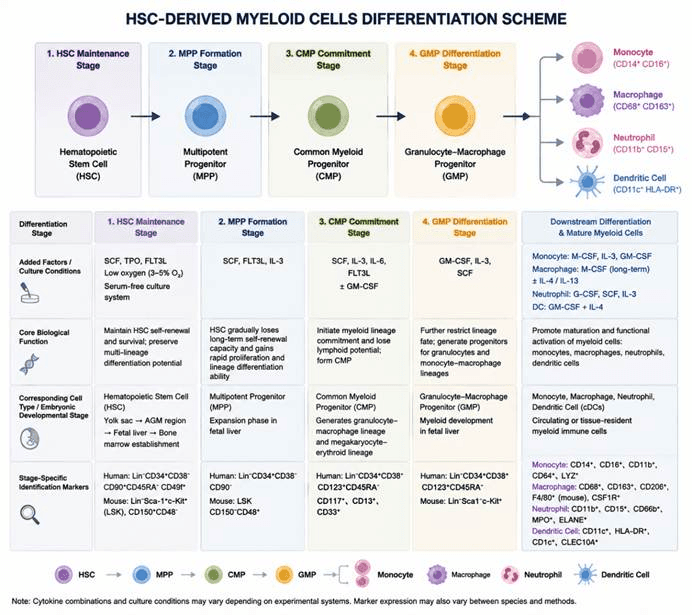
HSC-derived Myeloid Cells Differentiation Scheme.
HSCs undergo a series of key developmental stages, including multipotent progenitors (MPPs), common myeloid progenitors (CMPs), and granulocyte-macrophage progenitors (GMPs), under the regulation of specific cytokines and culture conditions, progressively achieving myeloid lineage commitment and functional maturation. During different differentiation stages, a combination of cytokines including SCF, TPO, FLT3L, IL-3, IL-6, GM-CSF, M-CSF, and G-CSF is applied for lineage-directed induction, promoting the differentiation of HSCs into mature myeloid cell types such as monocytes, macrophages, neutrophils, and dendritic cells (DCs). The schematic also illustrates the biological functions, developmental stages, and specific identification markers associated with each differentiation stage, including surface markers of the HSC/MPP/CMP/GMP populations and functional markers of mature myeloid cells. This platform provides a reference for establishing in vitro HSC-derived myeloid cell differentiation systems and for studying myeloid cell development and functional characterization.
Differentiation Stage | Added Factors / Culture Conditions | Core Biological Function | Corresponding Cell Type / Developmental Stage | Stage-specific Identification Markers |
Hematopoietic Stem Cell Maintenance Stage | SCF (Stem Cell Factor), TPO (Thrombopoietin), FLT3L, hypoxic culture (3–5% O₂), serum-free culture system | Maintains HSC self-renewal capacity, promotes HSC survival, and preserves multipotent differentiation potential | Hematopoietic Stem Cells (HSCs); embryonic hematopoietic development: yolk sac → aorta-gonad-mesonephros (AGM) region → fetal liver → adult bone marrow hematopoiesis | Human: Lin⁻CD34⁺CD38⁻CD90⁺CD45RA⁻CD49f⁺; Mouse: Lin⁻Sca-1⁺c-Kit⁺ (LSK), CD150⁺CD48⁻ |
Multipotent Progenitor (MPP) Formation Stage | SCF + FLT3L + IL-3 to promote HSC proliferation and activation | HSCs gradually reduce long-term self-renewal capacity and acquire rapid proliferation and lineage differentiation ability | Multipotent Progenitors (MPPs); corresponding to fetal liver expansion stage during embryonic hematopoiesis | Human: Lin⁻CD34⁺CD38⁻CD90⁻; Mouse: LSK CD150⁻CD48⁺ |
Common Myeloid Progenitor (CMP) Commitment Stage | SCF + IL-3 + IL-6 + FLT3L; some systems include GM-CSF to promote myeloid bias | Initiates myeloid lineage specification, eliminates lymphoid potential, and generates common myeloid progenitors | Common Myeloid Progenitors (CMPs); precursors for granulocyte-macrophage lineage and megakaryocyte-erythroid lineage | Human: Lin⁻CD34⁺CD38⁺CD123⁺CD45RA⁻; CD117⁺, CD13⁺, CD33⁺ |
Granulocyte-Macrophage Progenitor (GMP) Differentiation Stage | GM-CSF, IL-3, SCF; promotes granulocyte and monocyte lineage differentiation | Further restricts CMP lineage potential and generates common progenitors for granulocytes and monocyte/macrophage lineages | Granulocyte-Macrophage Progenitors (GMPs); corresponding to fetal liver myeloid development stage | Human: Lin⁻CD34⁺CD38⁺CD123⁺CD45RA⁺; Mouse: Lin⁻Sca1⁻c-Kit⁺ |
Monocyte Differentiation Stage | M-CSF (CSF1), IL-3, GM-CSF | Promotes GMP differentiation toward monocytes and activates monocyte-associated transcriptional programs | Monocytes; circulating blood myeloid immune cells | CD14⁺, CD16⁺, CD11b⁺, CD64⁺, LYZ⁺ |
Macrophage Maturation Stage | Long-term M-CSF culture; M-CSF + IL-4/IL-13 for alternative activation phenotype induction | Promotes monocyte maturation into tissue-like macrophages with phagocytic and immune regulatory functions | Macrophages; derived from embryonic yolk sac macrophages and HSC-derived macrophages | CD68⁺, CD163⁺, CD206⁺, F4/80⁺ (mouse), CSF1R⁺ |
Granulocyte Differentiation Stage | G-CSF, SCF, IL-3 | Activates granulopoiesis programs and promotes neutrophil maturation | Neutrophils and granulocytes; corresponding to fetal liver and bone marrow granulopoiesis | CD11b⁺, CD15⁺, CD66b⁺, MPO⁺, ELANE⁺ |
Dendritic Cell (DC) Induction Stage | GM-CSF + IL-4 (classical DC differentiation system) | Promotes differentiation of myeloid progenitors toward antigen-presenting cell lineages | Conventional Dendritic Cells (cDCs); derived from GMPs | CD11c⁺, HLA-DR⁺, CD1c⁺, CLEC10A⁺ |