
info@ucallmlabs.com
Natural Killer Cells (NK cells) are important effector cells of the innate immune system, possessing the ability to rapidly recognize and eliminate tumor cells and virus-infected cells. Hematopoietic Stem Cells (HSCs) serve as the natural source of NK cells and undergo a multi-stage lineage differentiation process in vivo to generate mature functional NK cells. By utilizing in vitro hematopoietic microenvironment simulation technologies, CD34⁺ hematopoietic stem cells can be directionally induced toward the NK lineage through the combined regulation of key cytokines, including SCF, FLT3L, IL-7, IL-15, and IL-2.
The HSC-derived NK cell differentiation system recapitulates the natural developmental process of NK cells, including HSC maintenance, lymphoid lineage commitment, NK progenitor formation, immature NK cell generation, and acquisition of mature functional characteristics. Under the regulation of critical signaling pathways such as IL-15-mediated signaling, induced NK cells gradually acquire typical phenotypic markers (CD3⁻CD56⁺, CD16⁺, NKG2D⁺, KIR⁺) and functional properties, including cytotoxic granule release, Granzyme B/Perforin expression, and IFN-γ secretion capacity.
Compared with peripheral blood-derived NK cells, HSC-derived NK cells offer advantages including a stable cell source, strong expansion potential, high batch-to-batch consistency, and suitability for scalable manufacturing. They provide an important cellular platform for studying NK cell developmental mechanisms, tumor immunotherapy, and next-generation cell therapy product development. Furthermore, combined with genetic engineering technologies, HSC-derived NK cells can be further engineered to generate universal immune cell products such as CAR-NK cells, providing a novel therapeutic platform for immunotherapy of hematological malignancies and solid tumors.
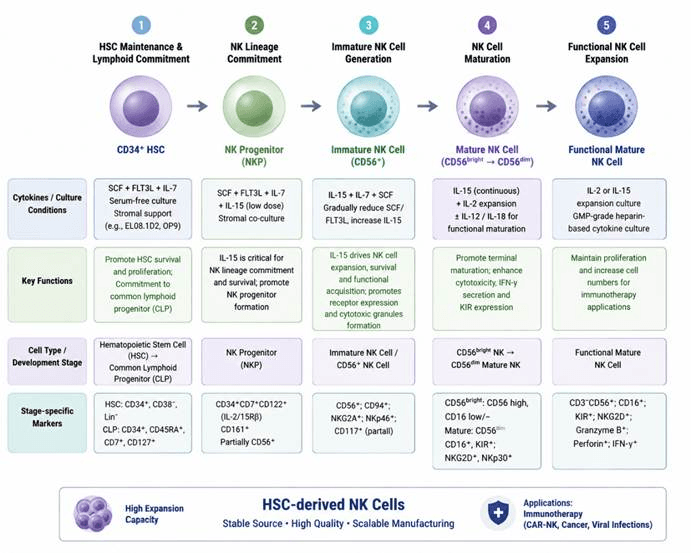
Schematic representation of the in vitro differentiation and expansion process of HSC-derived NK cells. HSCs undergo multiple developmental stages under the regulation of cytokines and specialized microenvironments, including lymphoid lineage commitment, NK progenitor formation, immature NK cell generation, maturation, and functional expansion, gradually acquiring characteristic NK cell phenotypes and anti-tumor effector functions. Different developmental stages are regulated by the coordinated action of key cytokines, including SCF, FLT3L, IL-7, IL-15, and IL-2, accompanied by dynamic changes in the expression of functional markers such as CD56, CD16, KIR, NKG2D, Granzyme B, and Perforin. HSC-derived NK cells exhibit advantages including a stable cell source, strong expansion capacity, and tunable functional properties, making them valuable for CAR-NK cell therapy, tumor immunotherapy, and antiviral infection research.
Differentiation Stage | Added Factors / Culture Conditions | Core Biological Function | Corresponding Cell Type / Developmental Stage | Stage-specific Identification Markers |
1. HSC Maintenance and Lymphoid Lineage Initiation | SCF + FLT3L + IL-7; serum-free hematopoietic culture system; stromal cell support (e.g., EL08.1D2, OP9) can be included | Promotes CD34⁺ HSC survival and expansion, and induces commitment toward Common Lymphoid Progenitors (CLPs); FLT3L promotes lymphoid progenitor expansion, while IL-7 supports lymphoid development | CD34⁺ Hematopoietic Stem Cell (HSC) → Common Lymphoid Progenitor (CLP) | HSC: CD34⁺, CD38⁻, Lin⁻; CLP: CD34⁺, CD45RA⁺, CD7⁺, CD127⁺ |
2. NK Lineage Commitment Stage | SCF + FLT3L + IL-7 + low-dose IL-15; stromal cell co-culture to enhance differentiation efficiency | IL-15 serves as a key cytokine for NK lineage specification and survival; promotes NK progenitor formation and initiates NK-specific transcriptional programs | NK Progenitor (NKP) | CD34⁺CD7⁺CD122⁺ (IL-2/15Rβ); CD161⁺; partial CD56 expression |
3. Immature NK Cell Generation Stage | IL-15 + IL-7 + SCF; gradually decrease SCF/FLT3L ratio and increase IL-15 stimulation | IL-15 drives NK cell expansion, survival, and functional acquisition; promotes NK receptor expression and cytotoxic granule formation | Immature NK Cell / CD56⁺ NK Cell | CD56⁺; CD94⁺; NKG2A⁺; NKp46⁺; CD117⁺ (partially expressed) |
4. NK Cell Maturation Stage | Continuous IL-15 stimulation + IL-2 expansion; some systems use IL-12/IL-18 to enhance functional maturation | Promotes terminal NK cell maturation, enhances cytotoxic activity, IFN-γ secretion capacity, and KIR expression | CD56^bright NK Cell → CD56^dim Mature NK Cell | CD56^bright NK: high CD56 expression, CD16 low/negative; Mature NK: CD56^dimCD16⁺, KIR⁺, NKG2D⁺, NKp30⁺ |
5. Functional Mature NK Cell Expansion Stage | IL-2 or IL-15 expansion culture; GMP-grade culture systems may use heparin-based cytokine culture | Maintains mature NK cell proliferation and increases cell yield for immunotherapy applications | Functional Mature NK Cell | CD3⁻CD56⁺; CD16⁺; KIR⁺; NKG2D⁺; Granzyme B⁺; Perforin⁺; IFN-γ⁺ |