
info@mail.ucallm.com
Immune-related protein–protein interactions are widely involved in immune regulation, autoimmune diseases and tumor immunity, and represent key research areas for antibody and small-molecule drug discovery. KeyTec® TR-FRET Binding Assay covers autoimmune targets, immune checkpoints and a variety of novel drug targets, enabling protein–protein interaction detection, binding validation, blockade assessment and candidate drug screening.
1 Coverage of Key Targets in Autoimmunity and Tumor Immunity
For autoimmune-related targets, TL1A/DR3 and TL1A/DcR3 Binding Kits are available. These kits support research on protein binding and regulatory effects between TL1A and its receptors, as well as blocker screening against this interaction.
In tumor immunity research, classic immune checkpoint interaction systems such as PD-1/PD-L1 and PD-1/PD-L2 are covered. By measuring TR-FRET signals generated upon ligand–receptor binding, the assay can assess the capacity of antibodies or other candidate molecules to block immune checkpoint interactions, offering a direct molecular-level detection tool for immune checkpoint drug screening.
2 Binding and Blockade Studies for Novel Drug Targets
Beyond classic immune targets, multiple novel targets with drug discovery value are available, including KRAS G12D/SOS1, KRAS G12D/RAF1, STING, SMARCA2, SMARCA4 and CD40/CD40L.
For different target systems, protein binding validation, competitive binding and blockade assays can be performed according to research objectives. By testing antibodies, small molecules or other candidate molecules at serial concentrations and comparing TR-FRET signal changes, researchers can evaluate the binding or blockade activity of candidates and further establish concentration-effect relationships to support lead compound screening and optimization.
3 From Protein Interaction Detection to Candidate Drug Screening
KeyTec® TR-FRET Binding Assay links target binding validation with drug screening. When target proteins bind to their ligands, the Donor and Acceptor are brought within the effective detection distance to generate a TR-FRET signal. After adding candidate antibodies, small molecules or other competing molecules, the TR-FRET signal will change accordingly if these compounds disrupt the target protein interaction.
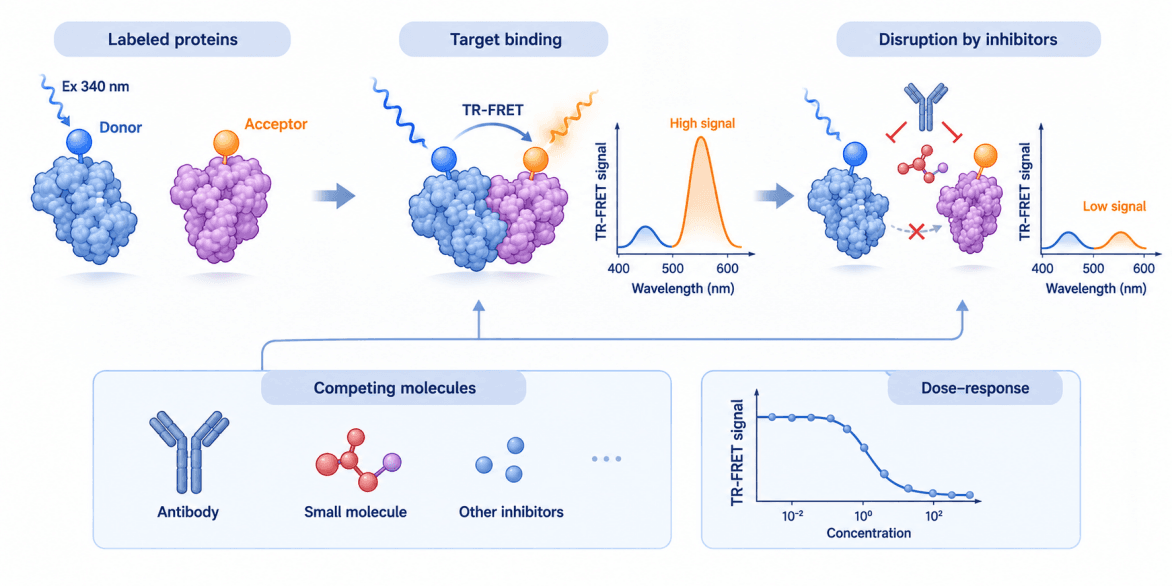
Principle of KeyTec® TR-FRET Binding Assay. Target protein and partner molecules are labeled with a TR-FRET Donor and Acceptor, respectively. Upon target binding, the Donor and Acceptor are brought into close proximity, enabling energy transfer and generating a measurable TR-FRET signal. Addition of competing antibodies, small molecules, or other inhibitors disrupts the interaction, resulting in a reduced TR-FRET signal. The assay enables quantitative evaluation of target binding, competition, and inhibitory activity.
Binding assays, competition assays and concentration-gradient analysis enable a continuous research workflow: protein–protein interaction confirmation → candidate molecule blockade assessment → activity comparison → dose–effect analysis, providing molecular-level screening tools for the discovery of immune therapeutics and novel target drugs.
4 Product Coverage of KeyTec® Immune Target Binding Assays
Binding Assay | Main Application | |
Autoimmune Target | TL1A/DR3 Binding Kit | Binding and blockade studies of TL1A–DR3 |
Autoimmune Target | TL1A/DcR3 Binding Kit | Binding and blockade studies of TL1A–DcR3 |
Immune Checkpoint | PD-1/PD-L1 Binding Assay | Binding and blockade screening of immune checkpoint |
Immune Checkpoint | PD-1/PD-L2 Binding Assay | Binding and blockade screening of immune checkpoint |
Novel Drug Target | KRAS G12D/SOS1 Binding Assay | Protein-protein interaction and candidate molecule screening |
Novel Drug Target | KRAS G12D/RAF1 Binding Assay | Protein-protein interaction and candidate molecule screening |
Novel Drug Target | STING Binding Assay | STING-related binding studies and drug screening |
Novel Drug Target | SMARCA2 Binding Assay | Target binding and candidate drug screening |
Novel Drug Target | SMARCA4 Binding Assay | Target binding and candidate drug screening |
Immune Regulatory Target | CD40/CD40L Binding Assay | Binding and blockade studies of CD40–CD40L |
5 Advantages of KeyTec® TR-FRET Immune Target Assays
- Broad coverage of immune and novel drug targets: ranging from autoimmune targets and immune checkpoints to novel targets including KRAS, STING and SMARCA.
- Direct detection of protein interactions: target binding assessed based on TR-FRET signal changes.
- Compatible with blockade and competition assays: suitable for activity evaluation of antibodies, small molecules and other candidate molecules.
- Optimized for drug screening: supports concentration-gradient testing, dose–effect analysis and candidate molecule comparison.
- Extends from target validation to candidate drug assessment: meets requirements for protein interaction research, mechanistic studies and early-stage drug discovery.
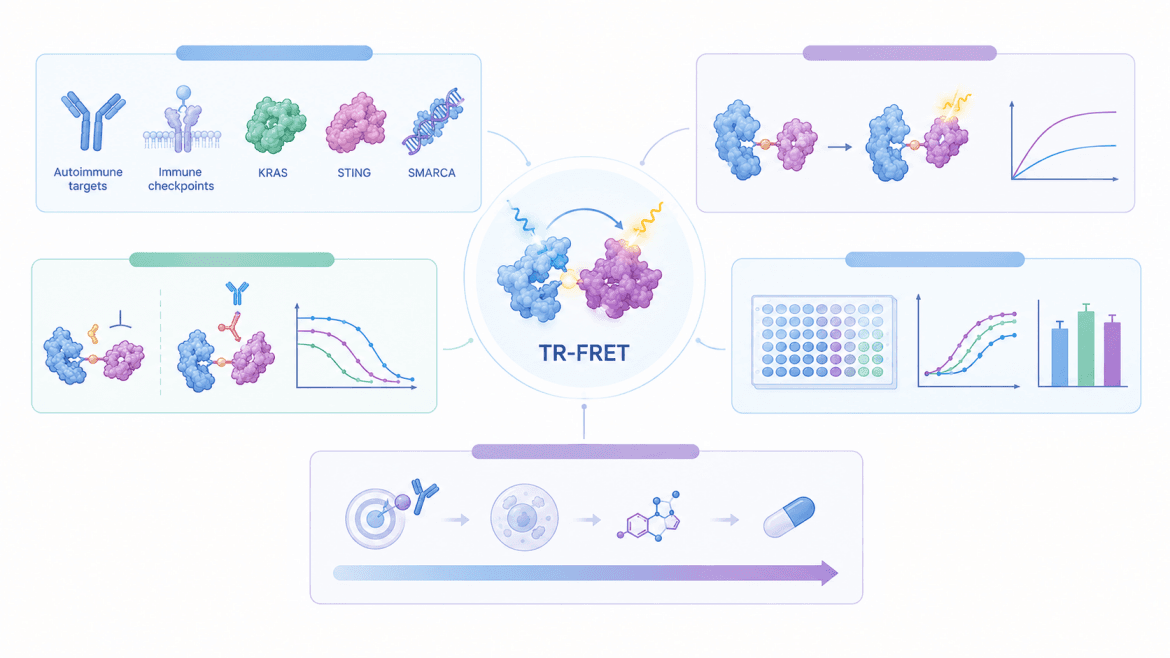
Overview of TR-FRET technology for molecular interaction analysis and drug screening. Widely applied in multiple disease targets including autoimmune targets, immune checkpoints, KRAS, STING and SMARCA. The platform supports binding affinity measurement, competitive inhibition assays, high-throughput screening and functional quantification, accelerating the whole drug discovery pipeline from target validation to lead compound and drug development.
KeyTec® TR-FRET Binding Assay is built upon protein-protein interaction detection and covers a wide range of immune and novel drug targets, enabling researchers to implement the full workflow from target binding validation and blockade assessment to candidate drug screening.
Explore Products | Technical Support | Custom TR-FRET Assay