
info@ucallmlabs.com
The inner ear mainly consists of the cochlea and vestibule, which are responsible for auditory perception and body balance regulation respectively. Inner ear hair cells and sensory neurons are highly vulnerable to external damage and can be impaired by multiple factors including genetic variations, long-term noise exposure, ototoxic drug stimulation and aging. Epidemiological data indicate that more than 1.5 billion people worldwide suffer from varying degrees of hearing impairment, among whom approximately 30% require clinical intervention. Meanwhile, 7.4% of the population will experience vestibular vertigo during their lifetime. At present, research progress on regenerative therapies for inner ear function is relatively slow. The key bottleneck lies in the lack of stable and efficient pathophysiological models to meet the requirements of preclinical validation before clinical translation. Conventional ex vivo inner ear tissue and cell models derived from animals have obvious limitations, such as morphological differences across species, low cell induction efficiency and inconsistent genomic characteristics. In addition, harvesting inner ear tissue is technically challenging; the procedure tends to cause irreversible damage to surrounding structures, and non-invasive imaging techniques cannot support refined and visualized observation. Against this research backdrop, organoid technology, with its unique strengths, has gradually emerged as a promising novel research tool in inner ear studies.
Inner ear organoids are generated from stem cells or progenitor cells. They faithfully recapitulate the biological features of native inner ear tissues in multiple dimensions, including gene expression profiles, cellular composition, tissue architecture and physiological functions. This model can mimic the in vivo extracellular microenvironment and modulate the proliferation and differentiation of stem and progenitor cells via specific inducing factors to directionally generate specialized inner ear functional cells. Using the inner ear organoid system, researchers can observe the complete and dynamic developmental process of the inner ear in vitro and successfully construct functional human hair cells together with neural connections. To date, numerous studies have adopted stem/progenitor cell-derived inner ear organoids to deeply dissect the pathological mechanisms of inner ear neural injury and screen active compounds capable of counteracting drug ototoxicity and facilitating the repair and regeneration of hair cells. The establishment and application of inner ear organoid models provide innovative strategies and a reliable experimental platform for mechanistic investigation, diagnosis and clinical treatment of vestibular vertigo and sensorineural hearing loss.
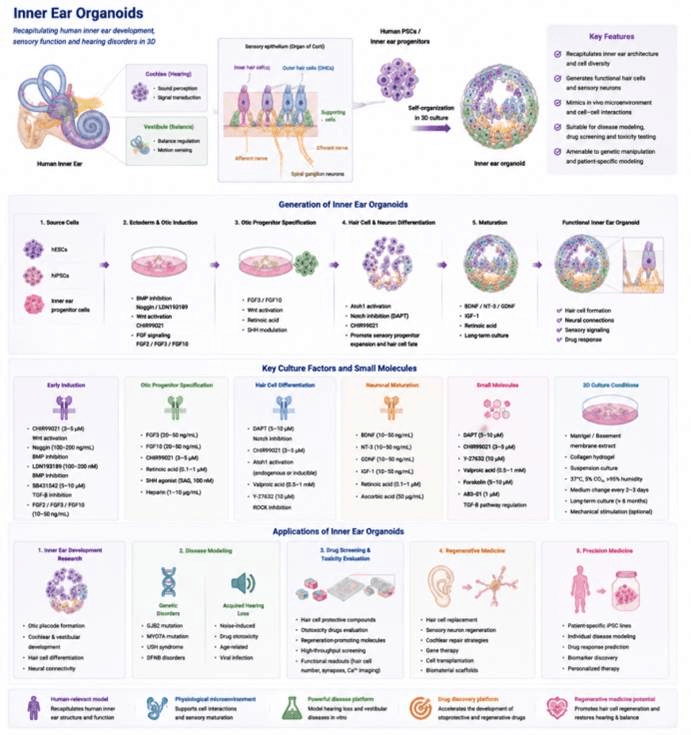
Generation, Culture, and Applications of Inner Ear Organoids.
Data display.
(A) Organoid culture status (bright-field morphology)
(B) Multicolor immunofluorescence staining
(C) Post-translational modification proteomics
(D) Epigenetic profiling (ChIP-seq / ATAC-seq)
(E) Gene editing validation (CRISPR)