
info@mail.ucallm.com
Kinase Activity and Inhibitor Screening (Explore our Recombinant Proteins)
Protein kinases regulate cell proliferation, differentiation, metabolism, cell cycle and multiple signaling pathways via phosphorylation. They serve as critical drug targets for therapeutic research in oncology, immunology, inflammation, metabolic disorders and neurological diseases. Kinase activity assays are applied not only to investigate the catalytic function of kinases themselves, but also constitute essential experimental tools for kinase inhibitor discovery, potency evaluation, dose-response analysis and comparison of candidate compounds.
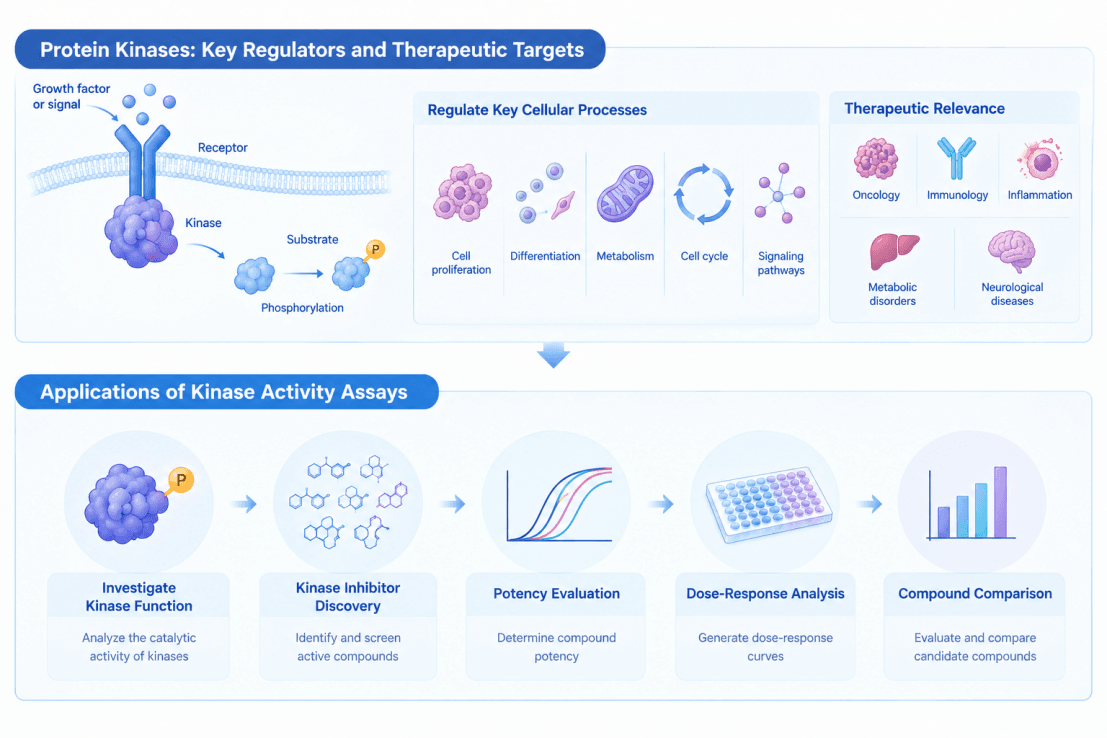
The TR-FRET Kinase Assay quantifies kinase activity by detecting specific signal changes upon substrate phosphorylation catalyzed by kinases. In a reaction system consisting of kinase, ATP and specific substrate, the kinase catalyzes substrate phosphorylation. After reaction completion, phosphorylated substrates are detected via TR-FRET signals, converting kinase catalytic activity into quantifiable fluorescence readouts. By further adding candidate compounds at varied concentrations, dose-response relationships can be established to evaluate compound inhibition against target kinase activity.
1 Principle of Kinase Activity Assay
The KeyTec® TR-FRET Kinase Assay combines kinase reactions with homogeneous fluorescence detection, suitable for kinase activity analysis and inhibitor screening.
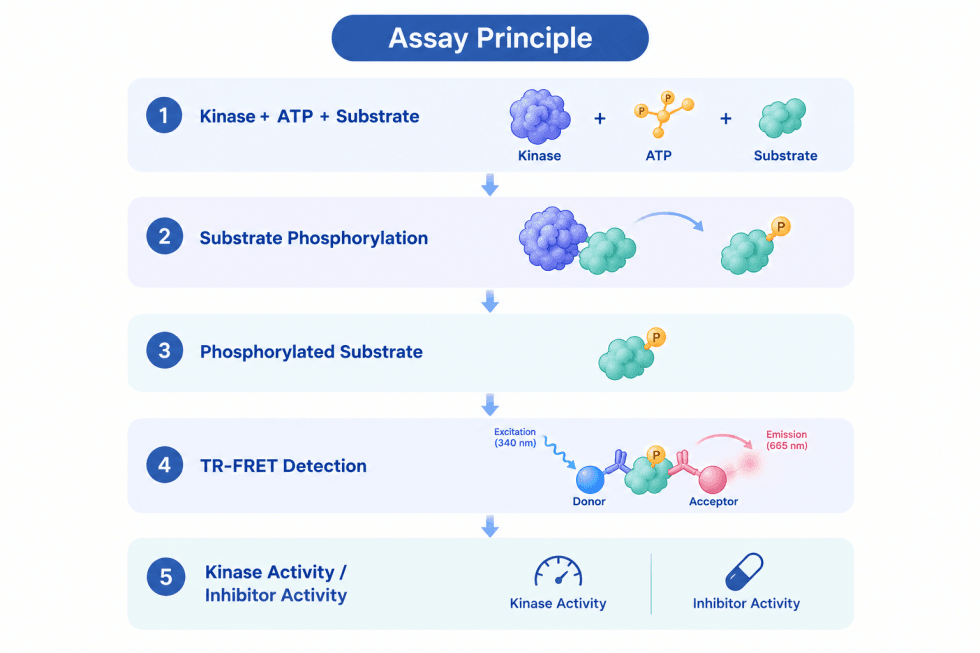
Principle of KeyTec® TR-FRET Kinase Assay. Kinase catalyzes the phosphorylation of a substrate in the presence of ATP, generating a phosphorylated substrate that is subsequently detected by TR-FRET. The resulting TR-FRET signal reflects the extent of substrate phosphorylation and can be used to quantify kinase activity or evaluate inhibitor-mediated changes in kinase activity.
In the absence of inhibitors, kinases catalyze efficient substrate phosphorylation and generate strong assay signals. Upon addition of candidate inhibitors, the level of substrate phosphorylation decreases, accompanied by changes in TR-FRET signals. By comparing signals under different treatment conditions, alterations in kinase activity can be determined, and key parameters such as inhibition rate, dose-response curves and IC₅₀ can be further calculated.
2 Diverse Kinase Assay Panel Coverage
Different kinases exhibit distinct substrate specificities and catalytic properties, so kinase activity assays require matched kinases, substrates and reaction systems. We have developed TR-FRET assay products covering multiple families including Tyrosine Kinases (TKs), Serine/Threonine Kinases (STKs) and Cyclin-Dependent Kinases (CDKs), with additional assays available for selected individual kinases and lipid kinases.
- TKs|Tyrosine Kinases
KeyTec® TKs portfolio includes the universal TKs Kinase Kit and substrate systems for BTKs, JAKs, FGFRs, EGFRs, METs and others, supporting activity profiling and inhibitor screening of various tyrosine kinases.
Main Applications:
Ø TKs kinase activity assay
Ø Tyrosine kinase inhibitor screening
Ø Target research of EGFR / FGFR / JAK / BTK / MET and other kinases
Ø Potency comparison of candidate compounds
Ø Dose-response and IC₅₀ analysis
- STKs|Serine/Threonine Kinases
For serine/threonine kinase research, KeyTec® offers the STK Discovery Kinase Kit, STK S1, STK S2, STK S3 Kinase Kits and corresponding biotinylated substrates, providing flexible assay options for diverse STK systems.
Main Applications:
Ø STK kinase activity assay
Ø Serine/Threonine kinase inhibitor screening
Ø Research on kinase substrate phosphorylation
Ø Potency evaluation of candidate inhibitors
Ø Kinase signaling pathway research
- CDKs|Cyclin-Dependent Kinases
CDKs represent critical kinase targets for cell cycle and transcriptional regulation research. KeyTec® provides substrate assay systems such as Rb(S780) and ATF2(T71), applicable to CDK activity analysis and CDK inhibitor screening.
Main Applications:
Ø CDK activity assay
Ø CDK inhibitor screening
Ø Cell-cycle related kinase research
Ø Compound potency evaluation
- Specific Kinases and Lipid Kinases
In addition to common TKs, STKs and CDKs, KeyTec® also provides the ActRIIA Kinase Kit, ActRIIB Kinase Kit, PI3Kα and PI3Kγ Lipid Kinase Kits, expanding the portfolio to research on selected receptor kinases and lipid kinases.
3 From Kinase Activity Assay to Inhibitor Screening
The KeyTec® TR-FRET Kinase Assay can be used not only for basic kinase activity measurement, but also directly for potency evaluation of candidate compounds.
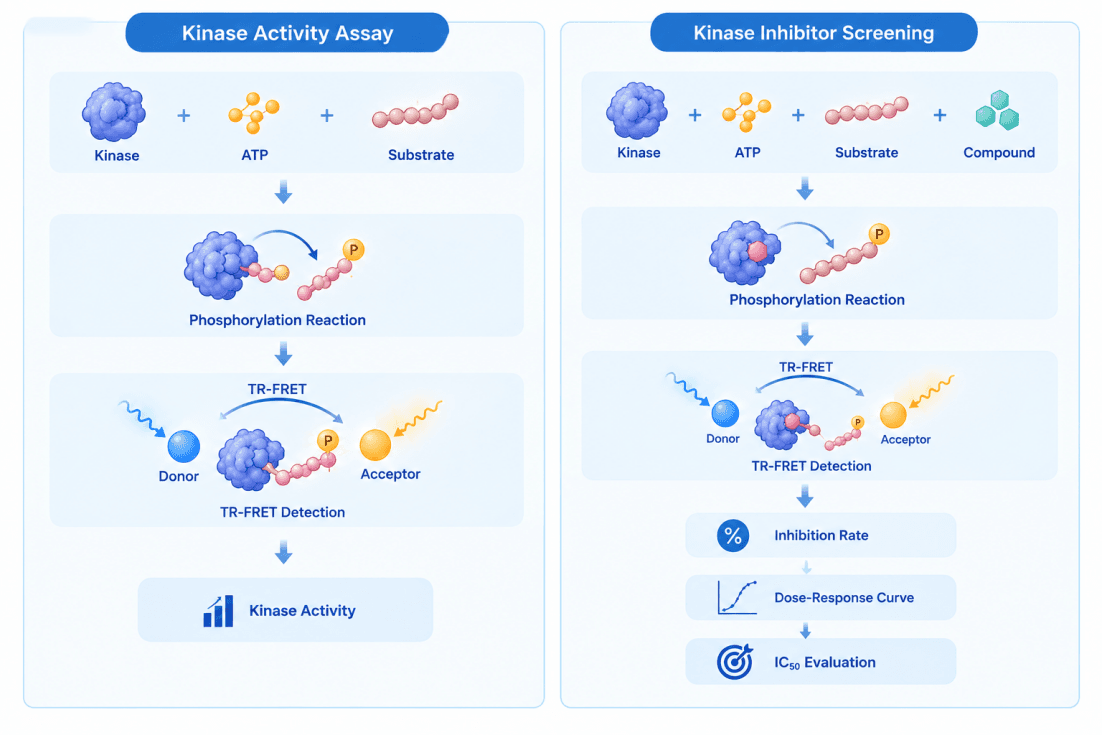
Principle of KeyTec® TR-FRET Kinase Activity and Inhibitor Screening Assays. In the kinase activity assay, the kinase catalyzes phosphorylation of a substrate in the presence of ATP, and the phosphorylated product is quantified by TR-FRET detection. For inhibitor screening, candidate compounds are introduced into the phosphorylation reaction, and changes in TR-FRET signal are used to calculate inhibition rates and generate dose–response curves for IC₅₀ evaluation.
By testing candidate compounds at varied concentrations, full dose-response curves can be obtained, allowing comparison of the inhibitory potency of different compounds against the same kinase target. For candidate molecules with potential activity, further validation with serial concentration gradients, cross-kinase panel comparison and mechanism-of-action studies can be carried out.
4 Complete Product Portfolio for Kinase Screening Assays
For kinase activity assays and inhibitor screening, we supply not only diverse Kinase Assay Kits and biotinylated substrates, but also supporting reagents compatible with the assay systems. These products help researchers accomplish the entire experimental workflow, ranging from assay establishment to compound evaluation.
Representative Product | Main Application | |
TKs Kinase | TKs Kinase Kit | Tyrosine kinase activity assay and inhibitor screening |
TKs Substrate | BTKs / JAKs / FGFRs / EGFRs / METs Substrate | Substrate detection for corresponding kinase systems |
STK Kinase | STK Discovery Kinase Kit | STK activity assay and inhibitor screening |
STK Kinase | STK S1 / S2 / S3 Kinase Kit | Assays for diverse STK systems |
STK Substrate | Biotinylated STK Substrates | Detection of kinase substrate phosphorylation |
CDK Substrate | Rb(S780) | CDK activity assay and inhibitor screening |
CDK Substrate | ATF2(T71) | CDK activity assay and inhibitor screening |
Specific Kinase | ActRIIA Kinase Kit | ActRIIA kinase activity research |
Specific Kinase | ActRIIB Kinase Kit | ActRIIB kinase activity research |
Lipid Kinase | PI3Kα Lipid Kinase Kit | PI3Kα activity assay and inhibitor screening |
Lipid Kinase | PI3Kγ Lipid Kinase Kit | PI3Kγ activity assay and inhibitor screening |
Assay Reagents | Kinase Assay Buffer | Setup of kinase reaction systems |
Detection Reagents | Detection Buffer | TR-FRET signal measurement |
Binding Reagents | Binding Buffer | Assembly and optimization of assay systems |
5 Covering the Experimental Workflow from Assay Establishment to Screening
Kinase products can be flexibly combined according to research requirements to build a complete experimental workflow ranging from basic activity assays to drug screening.
Step 1 Assay Setup
| Step 2 Kinase Activity Detection
| Step 3 Compound Screening
| Step 4 Dose-Response Analysis
| Step 5 Compound Comparison
| Step 6 Mechanism Study
|
Select the target kinase, corresponding substrate and matched buffer system to establish the kinase reaction system.
| Optimize experimental parameters including kinase concentration, ATP concentration, substrate concentration and reaction duration to obtain stable readouts for kinase activity measurement.
| Add candidate compounds at various concentrations to evaluate their effects on target kinase activity.
| Conduct serial concentration gradient experiments to establish dose-response relationships and calculate compound inhibition rates and IC₅₀ values.
| Compare potency across different candidate compounds and screen lead molecules with strong inhibitory activity.
| Combine multiple kinase panels and experimental conditions for further investigation of target selectivity and mechanism of action of candidate compounds.
|
6 Advantages of KeyTec® TR-FRET Kinase Assay
- Broad Kinase Coverage: Covering TKs, STKs and CDKs, further extended to specific kinase systems including ActRIIA, ActRIIB, PI3Kα and PI3Kγ.
- Flexible Substrate Selection: A variety of substrates for different kinase systems are available. Users can select matched assay systems according to research targets.
- From Activity Assay to Inhibitor Screening: The same assay platform supports kinase activity analysis, candidate compound screening, dose-response analysis and IC₅₀ evaluation.
- Complete Supporting Reagents: Supplied with supporting products such as Kinase Assay Buffer, Detection Buffer, Binding Buffer and corresponding substrates, reducing the complexity of assay setup and optimization.
- Suitable for Drug Discovery Workflows: Applicable to kinase target research, inhibitor screening, potency comparison of candidate compounds and early-stage drug discovery evaluation.
From kinase activity measurement to candidate inhibitor screening, KeyTec® TR-FRET Kinase Assay delivers assay kits and supporting reagents targeting multiple kinase families. It enables researchers to rapidly establish stable and flexible kinase assay systems, providing comprehensive experimental solutions for kinase target research and drug screening.
Explore Products | Get Technical Support | Custom TR-FRET Assay