
info@mail.ucallm.com
1. Overview
Langya henipavirus (LayV) is a member of the genus Henipavirus within the family Paramyxoviridae. It is a recently discovered zoonotic virus. It is an enveloped, negative-sense, single-stranded, non-segmented RNA virus with pleomorphic virions.
LayV was first identified in 2018 in Shandong and Henan provinces of China through active surveillance of febrile patients. The virus is closely related to Nipah virus (NiV) and Hendra virus (HeV), but is phylogenetically closer to Mojiang virus (MojV). Unlike the bat-borne NiV and HeV, LayV is thought to have spilled over from shrews. To date, 35 cases of acute LayV infection have been detected, of which 26 cases had only LayV detected without other pathogens. The main symptoms in patients include fever, fatigue, cough, anorexia, myalgia, headache, nausea, and vomiting. Currently, no specific vaccine or antiviral drug is approved for LayV, and treatment is supportive.
2. Background Information
2.1 What is LayV?
LayV is an enveloped, negative-sense, single-stranded, non-segmented RNA virus belonging to the family Paramyxoviridae and genus Henipavirus. Its genome is approximately 18 kb and encodes six major structural proteins. LayV belongs to the genus Henipavirus along with NiV and HeV, but is phylogenetically classified within the Parahenipavirus branch, which includes MojV, Gamak virus (GAKV), and Daeryong virus (DARV), all of which originate from rodents or shrews.
A 2025 study published in Science Advances resolved the cryo-EM structure of the helical N-RNA filament from LayV, identifying vertical interactions crucial for assembly and showing that assembly efficiency is sequence-dependent and prefers 5′-genomic sequences. The study also revealed that N within nucleocapsids may undergo local conformational changes, switching between closed and open states, to temporarily allow access to the encapsidated RNA without nucleocapsid disruption.
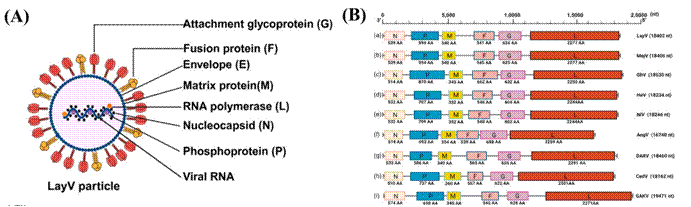
Virion architecture and genomic features of Langya virus (PMID: 42541310)
2.2 LayV Genome & Classification
The LayV genome is a negative-sense single-stranded RNA of approximately 18.2 kb, encoding six structural proteins in the order 3′-N-P-M-F-G-L-5′. The genome organization is highly similar to other henipaviruses, although the genome length of LayV is slightly longer.
2.3 What Are LayV Structural Proteins?
LayV encodes six major structural proteins:
Protein | Full name | Main Function |
N | Nucleoprotein | Encapsidates the viral RNA genome, forming ribonucleoprotein complexes (RNPs); can switch between closed and open conformations within the assembled state to regulate polymerase access to RNA |
P | Phosphoprotein | Polymerase cofactor, involved in viral transcription and replication |
M | Matrix protein | Inner envelope protein, mediates viral assembly and budding |
F | Fusion protein | Class I fusion protein; exists in a metastable prefusion conformation and is cleaved into F1 and F2 subunits; mediates fusion of the viral envelope with the host cell membrane |
G | Attachment glycoprotein | Type II homotetrameric transmembrane protein; mediates viral binding to host cell receptors; primary target of neutralizing antibodies |
L | Large protein | RNA-dependent RNA polymerase (RdRp), catalyses viral genome replication and transcription |
2.4 Mechanism of Cell Entry and Replication
2.4.1 Viral Attachment and Receptor Recognition
LayV cell entry is mediated by the cooperative action of the attachment glycoprotein G and the fusion protein F. LayV-G cannot bind the ephrin-B2/B3 receptors used by NiV and HeV. A 2026 computational study indicated that LayV-G shows a preference for interactions with ephrin-A2, with a binding free energy of approximately −70.97 kcal/mol, suggesting that class A ephrins may serve as alternative receptors for LayV.
2.4.2 Viral Entry
The LayV F and G glycoproteins promote membrane fusion with human, mouse, and hamster target cells using a different, yet unknown, receptor than NiV and HeV, and NiV- and HeV-elicited monoclonal and polyclonal antibodies do not cross-react with LayV F and G. Receptor binding by the G protein triggers a series of conformational changes in the F protein, enabling virus entry into cells.
2.4.3 Viral RNA Replication
LayV has a pattern of replication similar to other henipaviruses, with a 6-gene RNA genome, and potentially suppresses host innate immune responses. After release into the cytoplasm, the L protein (RdRp) initiates genome transcription and replication. The LayV N protein, within the assembled nucleocapsid, undergoes local conformational changes between closed and open states to temporarily allow the polymerase to access the encapsidated RNA without nucleocapsid disruption.
2.4.4 Viral Assembly and Release
Newly synthesized N protein associates with progeny genomic RNA to form RNPs. The M protein recruits RNPs to the cell membrane, and the virus acquires its envelope by budding from the host cell membrane, releasing new virions.
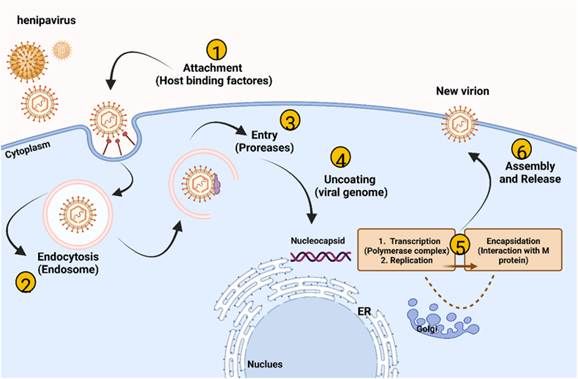
Cell cycle and replication of Henipavirus (PMID: 41141920)
2.5 Symptoms and Treatment
2.5.1 Clinical Symptoms
The clinical manifestations of LayV infection include:
l Fever (the most common symptom)
l Fatigue
l Cough
l Anorexia
l Myalgia
l Headache
l Nausea, vomiting
Some patients may develop severe pneumonia. Among the 35 detected cases, most were farmers and factory workers. Currently, there is no evidence of human-to-human transmission.
2.5.2 Antiviral Treatment
Currently, no specific antiviral therapy is approved for LayV. Treatment is primarily supportive. Due to significant antigenic differences between LayV and NiV/HeV, vaccines or antibody therapies developed against NiV/HeV may be ineffective against LayV. Therefore, tailored antiviral research is urgently needed.
2.6 Targets for Intervention
2.6.1 Viral Targets
Target | Protein | Biological Role |
G | Attachment glycoprotein | Receptor binding |
F | Fusion protein | Membrane fusion |
N | Nucleoprotein | RNP formation, genome packaging |
L | RNA polymerase | RNA replication |
2.6.2 Host Receptors & Entry Factors
Host Target | Type | Role in Infection |
ephrin-A2 (putative) | Receptor | Computational study suggests alternative receptor for LayV, binding free energy ~−70.97 kcal/mol |
Unknown receptor | Receptor | LayV uses a different unknown receptor from NiV/HeV for host cell entry |
2.6.3 Host Signaling Pathways
Pathway | Key Targets | Biological Role |
Innate immune pathway | — | potentially suppresses host innate immune responses |
2.7 Vaccine Types and Development Progress
Currently, no LayV vaccine is licensed worldwide. Due to the low sequence homology between LayV and HeV/NiV-G (approximately 24%), existing candidate vaccines and antibody drugs targeting HeV/NiV are unlikely to protect against LayV.
2.7.1 Multi-Epitope Vaccine (Computational Design)
A 2026 study published in Computers in Biology and Medicine designed three multi-epitope vaccine candidates (VCa, VCb, VCc) targeting LayV's glycoproteins and fusion protein using immunoinformatics tools. VCb emerged as the lead candidate:
l Solubility: 0.846
l Instability index: 28.8 (indicating structural stability)
l TLR4 binding energy: −336.5 kcal/mol
l β-strand content: 20.8%
l Simulated immune response: IgG1 ~24,000 ng/ml; IFN-γ ~5,000 ng/ml
l Codon optimization: CAI >0.95, GC 52–55%, confirming feasibility of an E. coli expression system
A 2025 study published in Springer also designed a multi-epitope vaccine against LayV using an integrated bioinformatics and immunoinformatics approach focusing on the attachment glycoprotein and fusion protein.
2.7.2 Other Vaccine Directions
Over 40 vaccine candidates against henipaviruses are currently in development, but most are based on HeV/NiV-G and may offer limited protection against LayV. Given the 86% sequence identity between LayV-G and MojV-G, vaccine strategies targeting MojV may provide a reference for LayV vaccine development.
2.8 Drugs
Currently, no specific small-molecule antiviral is approved for LayV.
2.8.1 Virus-Targeted Drugs
Target/mechanism | Drug/candidate | Mechanism | Stage |
G protein | Monoclonal antibodies (LayG-1069/1133) | Target two distinct epitopes on the LayV-G head domain; exhibit ADCC/ADCP activities | Preclinical |
Andrographolide | Computational simulations show efficacy against LayV target proteins with non-toxic properties | Computational screening | |
Pterygospermin | Computational simulations show efficacy against LayV target proteins | Computational screening | |
Salidroside | Computational simulations show efficacy against LayV target proteins | Computational screening |
2.9 Epidemiology
l First identified: 2018, Shandong and Henan provinces, China
l Geographic distribution: eastern China; LayV Korea (LayV KOR) was detected in Ussuri white-toothed shrews (Crocidura lasiura) in South Korea in 2024; LayV-like virus was also detected in rural communities in Bangladesh
l Natural reservoir: shrews are considered the natural reservoir of LayV
l Case numbers: 35 cases of acute infection have been detected in China, of which 26 had only LayV detected
l High-risk populations: patients were mainly farmers and factory workers, suggesting occupational exposure
l Transmission routes: currently thought to be transmitted through direct or indirect contact with infected shrews; no evidence of human-to-human transmission
l 2022 NEJM report: A correspondence article published in the New England Journal of Medicine by Prof. Liu Wei, Prof. Fang Liqun of the Institute of Microbiology and Epidemiology, Academy of Military Medical Sciences, and Prof. Wang Linfa of Duke-NUS Medical School first reported the discovery of LayV
The natural transmission cycle of WEEV(PMID: 41178425)
2.10 Diagnosis
Diagnosis of LayV infection relies on laboratory testing:
l Virus isolation: isolation of LayV from clinical material (requires high-containment laboratory)
l Nucleic acid testing (NAT) : detection of LayV RNA in clinical material
Ø A recombinase polymerase amplification (RPA) -based on-site visual assay has been developed for efficient and rapid detection of LayV
Ø A reverse transcription real-time PCR (RT-qPCR) method has been developed
Ø An HRP-integrated CRISPR-Cas12a biosensor has been developed for rapid point-of-care detection of LayV RNA without pre-amplification
l Serology: indirect ELISA methods based on NiV and LayV proteins have been developed for detecting antibodies in animals
2.11 Prevention
l Vaccination: no licensed LayV vaccine is currently available
l Avoid contact: avoid unnecessary contact or interaction with animals, especially shrews and other wild rodents; wash hands often with soap and water, especially after being around animals
l Personal protective measures: wear appropriate personal protective equipment (PPE) when potential contact with wildlife may occur
l Surveillance and reporting: strengthen LayV case surveillance and reporting, and conduct active surveillance worldwide in an open and collaborative manner to reduce the likelihood of this new virus causing a health crisis
l One Health strategy: strengthen animal-human interface surveillance based on the One Health framework for early detection of novel zoonotic viruses
3. Related Products & Services
l Recombinant Antigens & Receptors
l Antibodies
l Detection Kits
l Recombinant Protein Expression Services
l Antibody Development Services
4. Resources
5. References
1. Zhang, X. A., Li, H., Jiang, F. C., et al. (2022). A Zoonotic Henipavirus in Febrile Patients in China. The New England journal of medicine, 387(5), 470–472.
2. Thien, D. H., Tran, H. B., Uyen, N. N. P., et al. (2024). A comprehensive review of Langya virus and framework for future zoonotic disease control. Reviews in medical virology, 34(1), e2520.
3. Adesola, R. O., Miranda, A. V., Tran, Y. S. J., et al. (2023). Langya virus outbreak: current challenges and lesson learned from previous henipavirus outbreaks in China, Australia, and Southeast Asia. Bulletin of the National Research Centre, 47(1), 87.
4. Natasha, A., Pye, S. E., Park, K., et al. (2025). Detection and characterization of Langya virus in Crocidura lasiura (the Ussuri white-toothed shrew), Republic of Korea. One health (Amsterdam, Netherlands), 20, 101017.
5. Shafaati, M., Zandi, M. (2025). Langya henipavirus (LayV) as an emerging zoonotic disease: a mini-review. New microbes and new infections, 68, 101643.
6. Jayachandran, R. B., Quignon, E., Renner, M. (2026). Open and closed forms of assembled henipavirus nucleoprotein suggest structural basis of genome access. Science advances, 12(20), eaed8300.
7. Samia P, T., Norine D. An in silico exploration of class A ephrins as alternative receptors for Mojiang and Langya viruses: Insights into emerging Henipavirus entry mechanisms. (2026). In Silico Research in Biomedicine, 2, 100317.
8. Li, W., Wu, S., Gui, Q., et al. (2025). Structure and function of a pair of non-competing monoclonal antibodies against Langya henipavirus attachment glycoprotein. Cell reports, 44(10), 116407.
9. Ahmad, S., Nazarian, S., Alizadeh, A., et al. (2024). Computational design of a multi-epitope vaccine candidate against Langya henipavirus using surface proteins. Journal of biomolecular structure & dynamics, 42(20), 10617–10634.
10. Fahira, A., Amin, R. S., Arshad, U., et al. (2023). Chimeric vaccine design against the epidemic Langya Henipavirus using immunoinformatics and validation via immune simulation approaches. Heliyon, 9(6), e17376.
11. Rana, S., Pattanaik, S., Thakur, R., et al. (2026). Computational design and validation of a multi-epitope vaccine candidate against structural proteins of Langya virus. Letters in Drug Design & Discovery, 22(12), 100296.
12. He, W., Ma, T., Wang, Y., et al. (2024). Development and evaluation of a quadruple real-time fluorescence-based quantitative reverse transcription polymerase chain reaction assay for detecting Langya, Mojiang, Nipah, and Cedar viruses. Biosafety and health, 6(2), 80–87.
13. Wu, X., Xiang, R., Yang, D., et al. (2024). HRP-integrated CRISPR-Cas12a biosensor for rapid point-of-care detection of Langya henipavirus. iScience, 27(12), 111466.
14. Shen, L., Tong, Y., Chai, W., et al. (2026). Parahenipavirus langyaense (Langya virus): Spillover ecology, noncanonical receptor-mediated entry, and future control strategies. One health (Amsterdam, Netherlands), 23, 101521.