
info@ucallmlabs.com
Neural Stem Cells (NSCs) are neural progenitor cells with self-renewal capacity and multipotent differentiation potential. They can be used to recapitulate neural developmental processes in vitro and generate neurons with mature structural and functional characteristics through stage-specific induction protocols. Classical studies have demonstrated that NSCs can be maintained and expanded in the presence of EGF (epidermal growth factor) and FGF2 (basic fibroblast growth factor), and subsequently enter neuronal differentiation programs through withdrawal of proliferative factors and supplementation with neurotrophic factors. During this process, NSCs undergo a continuous developmental transition from neural progenitor cells to immature neurons and finally to mature functional neurons.
During neuronal induction, neurotrophic factors including BDNF (brain-derived neurotrophic factor), NGF (nerve growth factor), NT-3 (neurotrophin-3), and GDNF (glial cell line-derived neurotrophic factor) activate Trk receptor-associated signaling pathways to promote neuronal fate specification, axonal extension, synapse formation, and neuronal maturation. Studies have shown that BDNF significantly enhances neuronal differentiation and neurite outgrowth of NSC-derived neural progenitors, while combined treatment with BDNF and NGF further increases the proportion of βIII-tubulin-positive neurons and promotes neuronal phenotype establishment.
NSC-derived neurons generated through optimized differentiation systems typically express neuron-specific markers, including early neuronal markers βIII-tubulin (TUJ1) and Doublecortin (DCX), as well as mature neuronal markers MAP2, NeuN, Synapsin-1, and PSD95. These cells exhibit functional characteristics such as neurite formation, synaptic connectivity, and electrophysiological activity. This platform provides an important cellular model for studying neural development mechanisms, constructing neurodegenerative disease models, performing drug screening, and investigating neural injury repair strategies.
Currently, NSC-derived neurons are widely applied in studies of neurological disorders, including Parkinson’s disease, Alzheimer’s disease, and spinal cord injury, as well as in neurotoxicity evaluation, neural network construction, and cell replacement therapy development. Through precise regulation of developmental signaling pathways, specific neuronal subtypes such as dopaminergic neurons, motor neurons, and cortical neurons can be generated, providing highly controllable cellular resources for disease mechanism studies and regenerative medicine applications.
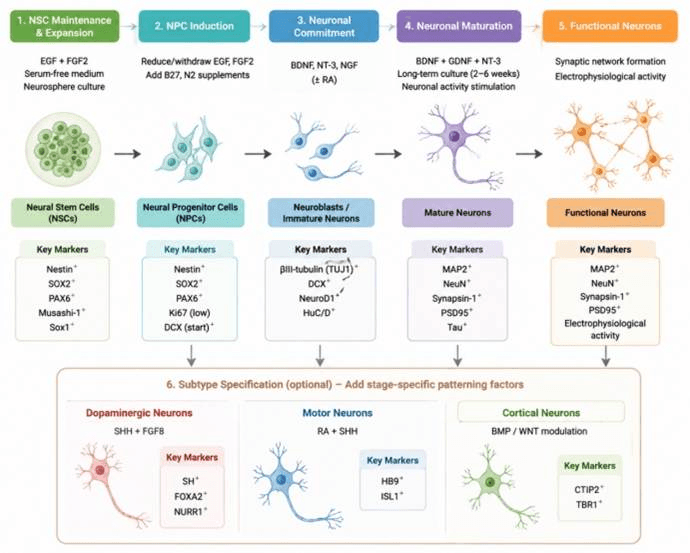
Schematic diagram of the in vitro directed differentiation process of neural stem cell (NSC)-derived neurons. NSCs are expanded under EGF and FGF2 maintenance conditions, followed by withdrawal of proliferative factors and supplementation with neurotrophic factors to sequentially undergo neural progenitor induction, neuronal fate specification, and neuronal maturation. The differentiated cells ultimately develop into mature neurons with synaptic connectivity and electrophysiological functions. Different differentiation stages can be characterized by stage-specific markers, including Nestin, SOX2, TUJ1, DCX, MAP2, NeuN, Synapsin-1, and PSD95. Furthermore, by combining specific patterning factors (such as SHH/FGF8, RA/SHH, or BMP/WNT signaling modulation), distinct neuronal subtypes including dopaminergic neurons, motor neurons, and cortical neurons can be generated, providing valuable cellular models for neural development studies, disease modeling, and regenerative medicine applications.
| Differentiation Stage | Added Factors / Culture Conditions | Core Biological Functions | Corresponding Cell Type / Developmental Stage | Stage-specific Identification Markers |
| NSC Maintenance and Expansion Stage | EGF + FGF2 (bFGF); serum-free medium; neurosphere culture system | Activates EGFR and FGFR signaling pathways to promote NSC self-renewal and proliferation while maintaining an undifferentiated state | Neural Stem Cells (NSCs) | Nestin⁺, SOX2⁺, PAX6⁺, Musashi-1⁺, SOX1⁺ |
| Neural Progenitor Cell Induction Stage | Reduced/withdrawn EGF and FGF2; supplemented with neural differentiation support factors (such as B27 and N2 supplements) | Releases proliferative status, promotes cell-cycle exit, and initiates neural lineage commitment | Neural Progenitor Cells (NPCs) | Nestin⁺, SOX2⁺, PAX6⁺, reduced Ki67 expression; DCX initiation |
| Neuronal Fate Specification Stage | BDNF, NT-3, NGF; RA (retinoic acid, depending on differentiation system) | Activates Trk receptor signaling pathways to promote neuronal survival, axon formation, and neuronal gene expression | Early Neuronal Progenitors (Neuroblasts / Immature Neurons) | βIII-tubulin (TUJ1)⁺, DCX⁺, NeuroD1⁺, HuC/D⁺ |
| Neuronal Maturation Stage | BDNF + GDNF + NT-3; long-term culture (2–6 weeks); neuronal activity stimulation | Promotes synapse formation, dendritic maturation, and establishment of electrophysiological functions | Mature Neurons | MAP2⁺, NeuN⁺, Synapsin-1⁺, PSD95⁺, Tau⁺ |
| Specific Neuronal Subtype Induction Stage (Optional) | Addition of subtype-specific patterning factors: SHH + FGF8 (dopaminergic neurons); RA + SHH (motor neurons); BMP/WNT modulation (cortical neurons) | Recapitulates embryonic neural developmental signals to achieve directed differentiation into specific neuronal subtypes | Dopaminergic neurons, motor neurons, cortical neurons, and other neuronal subtypes | Dopaminergic neurons: TH⁺, FOXA2⁺, NURR1⁺ Motor neurons: HB9⁺, ISL1⁺ Cortical neurons: CTIP2⁺, TBR1⁺ |