
info@ucallmlabs.com
Oligodendrocytes (OLs) are key glial cells in the central nervous system (CNS) responsible for myelin formation and axonal protection. By wrapping around neuronal axons to form myelin sheaths, oligodendrocytes enhance the speed of neural signal transmission and maintain the stability of neural networks. Neural Stem Cells (NSCs), as neural progenitor cells with self-renewal capacity and multilineage differentiation potential, can recapitulate embryonic neural development processes in vitro and gradually differentiate into mature oligodendrocytes through the oligodendrocyte progenitor cell (OPC) stage.
Based on the regulatory mechanisms of oligodendrocyte development, NSC-derived oligodendrocyte differentiation systems typically achieve lineage-specific induction by mimicking ventral neural tube development. Initially, signaling pathways activated by SHH (Sonic Hedgehog) and RA (Retinoic Acid) promote the transition of NSCs toward ventral neural progenitor identities and induce the expression of oligodendrocyte lineage-determining factor OLIG2. Subsequently, the addition of PDGF-AA, IGF-1, T3, and other maturation-supporting factors promotes the generation of PDGFRα⁺/NG2⁺ oligodendrocyte progenitor cells (OPCs). These OPCs further undergo maturation induction to generate functional oligodendrocytes expressing myelin-associated proteins, including MBP, MOG, and PLP1.
NSC-derived oligodendrocytes generated in vitro exhibit typical lineage-specific developmental characteristics and can be identified using stage-specific markers, including neural stem cell markers Nestin and SOX2, oligodendrocyte lineage initiation markers OLIG2 and NKX2.2, OPC markers PDGFRα, CSPG4 (NG2), and O4, as well as mature oligodendrocyte markers MBP, MOG, PLP1, and CNPase. This differentiation system closely recapitulates the in vivo oligodendrogenesis process and provides a stable and reliable cellular model for studying myelin formation mechanisms, establishing demyelination disease models, investigating neural injury repair, and performing drug screening. Currently, NSC-derived oligodendrocytes are widely used in research on multiple sclerosis (MS), spinal cord injury, white matter injury, and neurodegenerative diseases. They also provide an important technological platform for exploring strategies aimed at neural regeneration and myelin repair.
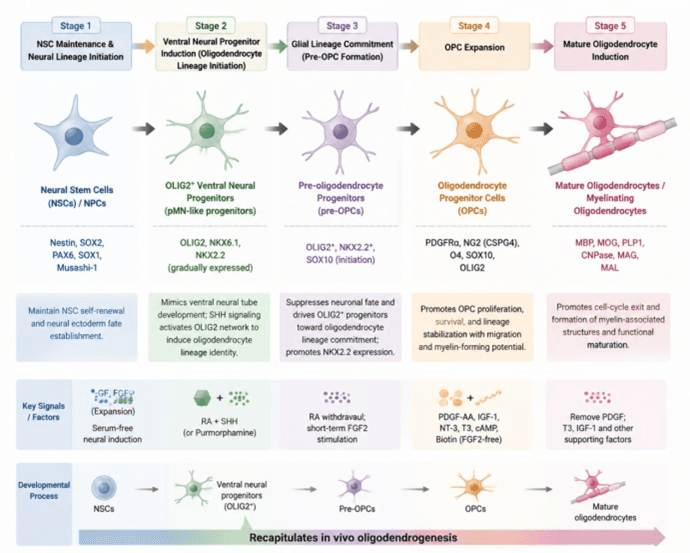
Neural stem cells (NSCs) undergo stepwise induction in vitro to recapitulate the process of oligodendrocyte development in vivo. Through neural lineage maintenance, ventral neural progenitor induction, and oligodendrocyte progenitor cell (OPC) formation and expansion, NSCs ultimately differentiate into mature oligodendrocytes expressing myelin-associated proteins. This differentiation system provides a stable cellular model for studying myelin formation, demyelinating disease mechanisms, and neural repair.
| Differentiation Stage | Added Factors / Culture Conditions | Core Biological Function | Corresponding Cell Type / Developmental Stage | Stage-Specific Identification Markers |
| Stage 1: Neural Stem Cell Maintenance and Neural Lineage Initiation | NSC culture system; EGF and FGF2 for expansion maintenance; serum-free neural induction conditions | Maintains NSC self-renewal capacity and promotes neural ectoderm fate establishment, providing a cellular source for subsequent glial lineage differentiation | Neural Stem Cells (NSCs) / Neural Progenitor Cells (NPCs) | Nestin, SOX2, PAX6, SOX1, Musashi-1 |
| Stage 2: Ventral Neural Progenitor Induction (Oligodendrocyte Lineage Initiation) | Retinoic acid (RA) + Sonic Hedgehog (SHH) or Purmorphamine | Mimics embryonic ventral neural tube development; activates the OLIG2 transcriptional network through SHH signaling, enabling neural progenitors to acquire oligodendrocyte lineage identity | OLIG2⁺ ventral neural progenitors / pMN-like progenitors | OLIG2, NKX6.1, NKX2.2 (gradually expressed) |
| Stage 3: Glial Lineage Commitment (Pre-OPC Formation) | RA withdrawal; short-term FGF2 stimulation to promote gliogenesis, followed by FGF2 reduction | Suppresses neuronal differentiation programs, drives OLIG2⁺ progenitors toward oligodendrocyte lineage commitment, and promotes NKX2.2 expression | Pre-oligodendrocyte progenitor cells (pre-OPCs) | OLIG2⁺, NKX2.2⁺, SOX10 initiation |
| Stage 4: Oligodendrocyte Progenitor Cell Expansion (OPC) | PDGF-AA, IGF-1, NT-3, T3, cAMP, Biotin; culture under FGF2-free conditions | Promotes OPC proliferation, survival, and lineage stabilization, enabling migration and myelin-forming potential | Oligodendrocyte Progenitor Cells (OPCs) | PDGFRα, NG2 (CSPG4), O4, SOX10, OLIG2 |
| Stage 5: Mature Oligodendrocyte Induction | Removal of PDGF and other proliferation factors; maturation culture conditions with T3, IGF-1, and other supporting factors | Promotes OPC cell-cycle exit and formation of myelin-associated structures and functional characteristics | Mature oligodendrocytes / Myelinating oligodendrocytes | MBP, MOG, PLP1, CNPase, MAG, MAL |