
info@mail.ucallm.com
Neurovascular & Blood–Brain Barrier
From Model Modeling to Functional & Mechanistic Insight
Integrated research solutions for establishing physiologically relevant BBB models, assessing barrier function, characterizing neurovascular biology, and decoding disease-associated BBB dysfunction.
The blood–brain barrier (BBB) is a dynamic neurovascular interface that regulates molecular transport between the circulation and the central nervous system. BBB properties are shaped by coordinated interactions among brain endothelial cells, pericytes, astrocytes, neurons, microglia, and the vascular extracellular matrix.
Understanding BBB biology therefore requires an integrated approach that connects model establishment, functional assessment, molecular validation, neurovascular unit (NVU) characterization, disease mechanisms, and brain-targeted delivery.
Build the Barrier→Measure Function→Validate Molecular Features→Characterize the NVU→Decode BBB Dysfunction
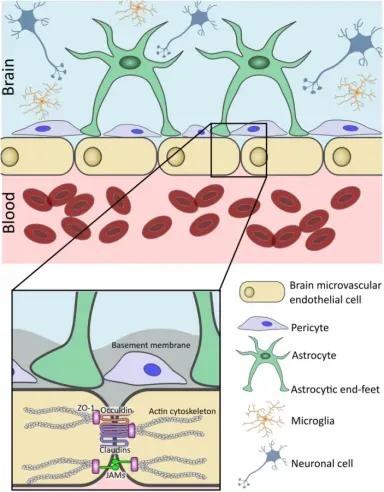
Structure and cellular components of the human blood-brain barrier (BBB) (PMID: 41126959).
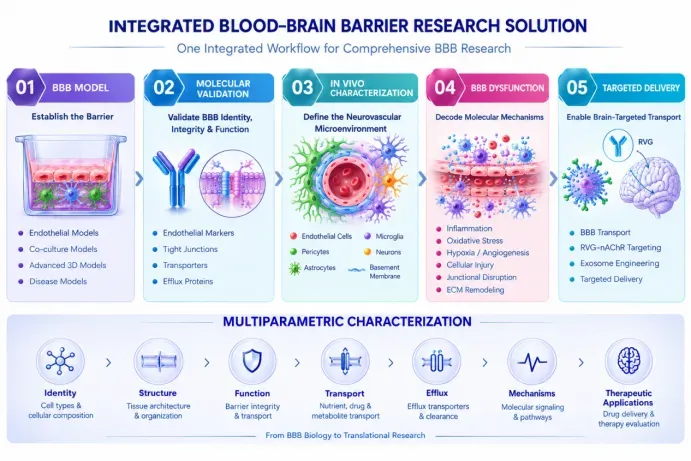
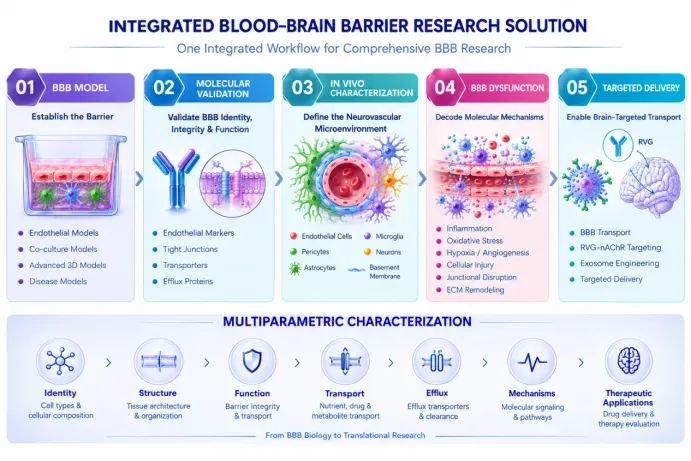
Integrated blood–brain barrier research solution
One Integrated Workflow for Comprehensive BBB Research
We integrate BBB model systems, functional readouts, validated antibody panels, neurovascular profiling, disease-mechanism analysis, and brain-targeted delivery research to support investigation across the full BBB research workflow.
BUILD→MEASURE→VALIDATE→CHARACTERIZE→DECODE→TRANSLATE
| Research Stage | Core Research Question | Key Research Focus |
|---|---|---|
| 01 | Model Establishment | Can we build a relevant BBB model? | Endothelial models · Co-culture · 3D BBB · BBB-on-a-chip · Disease models |
| 02 | Functional Assessment | Is the barrier functionally competent? | TEER · Permeability · Transport · Efflux |
| 03 | Molecular Validation | Is the BBB phenotype established and structurally intact? | Endothelial identity · Junctional integrity · Transporters · Efflux proteins |
| 04 | NVU Characterization | How do vascular and neural cells interact? | Endothelium · Pericytes · Astrocytes · Microglia · Neurons · ECM |
| 05 | Mechanistic Profiling | What drives BBB dysfunction? | Inflammation · Oxidative stress · Hypoxia · Cellular injury · ECM remodeling |
| 06 | Targeted Delivery | How can BBB transport be investigated? | BBB permeability · Neural targeting · Exosome engineering · Delivery strategies |
01 | BBB Model
Establish a relevant and reproducible BBB research model
Select model systems according to the biological question—from endothelial barrier properties to multicellular NVU interactions and disease-associated BBB dysfunction.
Representation of spheroid and organoid three-dimensional (3D) in vitro models of the blood-brain barrier (BBB) (PMID: 41126959).
BBB Model Systems
| Model Category | Representative Models | Primary Research Applications |
|---|---|---|
| Endothelial Models | Brain microvascular endothelial cells · Primary brain endothelial cells | Endothelial identity · Barrier formation · Transport |
| Endothelial–Pericyte Models | Endothelial cells + Pericytes | Vascular stabilization · Barrier integrity |
| Endothelial–Astrocyte Models | Endothelial cells + Astrocytes | BBB support · Neurovascular signaling |
| Multicellular NVU Models | Endothelium + Pericytes + Astrocytes ± Neural Cells | NVU interactions · BBB physiology |
| 3D BBB Models | Spheroids · Organoids | 3D architecture · Cellular interactions |
| Advanced BBB Platforms | Transwell · BBB-on-a-Chip · Microfluidic BBB | Permeability · Transport · Drug screening |
| Disease Models | Neuroinflammation · Neurodegeneration · Ischemia · Brain Tumor | Disease-associated BBB dysfunction |
Representative Ready-to-Use BBB Model Platform
PharmaCo-Cell BBB Kit™
Multicellular BBB models designed for barrier function, permeability, drug transport, and disease-modeling research.
| Model | Cellular composition | Primary research application |
|---|---|---|
| MBT-24 | Monkey brain endothelial cells + rat pericytes + rat astrocytes | BBB permeability · Drug transport |
| RBT-24 | Rat brain endothelial cells + rat pericytes + rat astrocytes | BBB permeability · Large-molecule / cell transport |
| RBE-12 | Rat brain endothelial cells + rat pericytes + rat astrocytes | BBB physiology · Disease modeling · Permeability |
https://www.pharmacocell.co.jp/en/
Research focus
BBB development | Barrier integrity | Neurovascular unit | Disease modeling | Therapeutic evaluation
02 | Molecular Validation
Validate BBB Identity, Integrity and Function
A focused antibody portfolio for molecular characterization of the blood–brain barrier (BBB)—from endothelial identity and junctional organization to transporter expression and barrier function.
Endothelial Identity
Define BBB endothelial cell identity and characterize the vascular phenotype of in vitro and in vivo BBB models.
| Marker | Research application |
|---|---|
| CD31 | Endothelial identification |
| VWF | Endothelial characterization |
| VE-cadherin | Endothelial junction integrity |
| EMCN | Microvascular endothelial characterization |
Junctional Integrity
Assess tight-junction organization, continuity and localization—key molecular features underlying BBB paracellular barrier function.
| Marker | Research application |
|---|---|
| Claudin-5 | BBB tight junction integrity |
| Occludin | Tight junction organization |
| ZO-1 | Junctional structure and localization |
| JAM-A | Endothelial junction regulation |
Transporter & Efflux
Characterize the selective transport and drug-efflux properties that distinguish the BBB from peripheral vascular barriers.
| Marker | Research application |
|---|---|
| P-gp / ABCB1 | ATP-dependent drug efflux |
| BCRP / ABCG2 | Drug and xenobiotic efflux |
| MRP1 / ABCC1 | Multidrug efflux and barrier protection |
| GLUT1 / SLC2A1 | Glucose transport |
| LAT1 / SLC7A5 | Large neutral amino acid transport |
| MCT1 / SLC16A1 | Monocarboxylate transport |
03 | Neurovascular Unit Characterization
Define the cellular architecture and microenvironment of the BBB
BBB function is not determined by endothelial cells alone. The neurovascular unit (NVU) integrates vascular, glial, neuronal, and extracellular-matrix components that collectively shape BBB integrity and neurovascular function.
Multicellular BBB models provide a functional context for studying endothelial–pericyte–astrocyte interactions within the neurovascular unit. (https://www.pharmacocell.co.jp/en/)
Key NVU Components
| NVU Component | Core Markers | Research Focus |
|---|---|---|
| Endothelial Cells | CD31 · VWF · CLDN5 | Barrier formation · Vascular identity |
| Pericytes | PDGFRβ · NG2/CSPG4 · Desmin | Perivascular coverage · vascular stabilization · BBB integrity |
| Astrocytes | GFAP · AQP4 · S100B | Astrocyte endfeet · water homeostasis · BBB support |
| Microglia | Iba1 · TMEM119 · CD68 | Microglial identity · activation · neuroinflammation |
| Neurons | NeuN · MAP2 · βIII-Tubulin | Neuronal identity · neuronal integrity · neurovascular signaling |
| Basement Membrane | Laminin · Collagen IV · Fibronectin | ECM organization · vascular integrity · barrier remodeling |
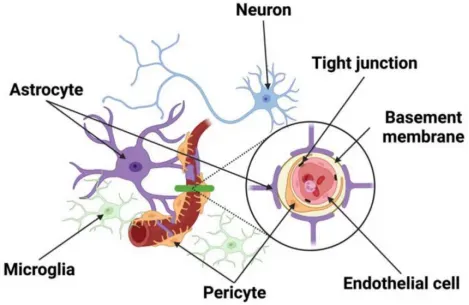
Schematic of the NVU. (PMID: 36139398)
From Cellular Architecture to BBB Pathology
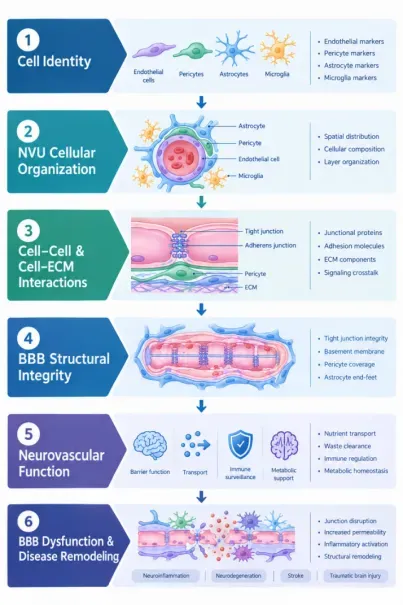
From cellular identity and neurovascular unit (NVU) organization to cell–cell/ECM interactions, BBB structural integrity, neurovascular function, and disease-associated remodeling, a multidimensional approach enables comprehensive characterization of BBB architecture, function, and pathological changes.
SPATIAL NVU PROFILING
Multiplex IF/IHC · Spatial Imaging · Cellular Neighborhood Analysis
Resolve vascular cells, glial states, neuronal populations, pathological features, and extracellular-matrix organization within their native spatial context.
04 | BBB Dysfunction Research
From Barrier Disruption to Molecular Mechanisms
BBB dysfunction results from interconnected changes in inflammatory signaling, oxidative stress, hypoxia, endothelial injury, junctional disruption, and extracellular-matrix remodeling.
A multidimensional profiling strategy enables researchers to connect pathological signaling with changes in barrier integrity, permeability, transport, and neurovascular function.
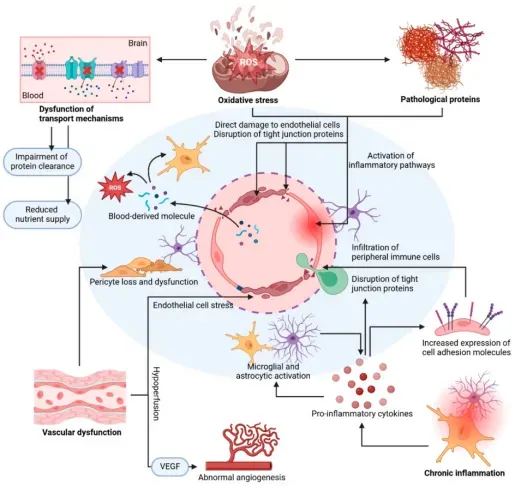
Mechanism of BBB disruption in the brain. (PMID: 39860392)
Key Pathological Mechanisms
| Mechanism | Core Markers | Research Focus |
|---|---|---|
| Inflammation & Endothelial Activation | NF-κB · ICAM-1 · VCAM-1 · IL-6 · TNF-α | Endothelial activation · leukocyte adhesion · inflammatory signaling |
| Oxidative Stress & Antioxidant Response | Nrf2 · HO-1 · 4-HNE | ROS accumulation · oxidative damage · cellular defense |
| Hypoxia & Angiogenic Remodeling | HIF-1α · VEGF · VEGFR1 · VEGFR2 | Hypoxic response · angiogenic signaling · vascular remodeling |
| Apoptosis & Cellular Injury | Cleaved Caspase-3 · Bax · Bcl-2 · γH2AX | Apoptosis · DNA damage · endothelial and NVU injury |
| Barrier & Junctional Disruption | Claudin-5 · Occludin · ZO-1 · VE-Cadherin | Tight/adherens junction integrity · paracellular permeability |
| ECM & Basement Membrane Remodeling | Laminin · Collagen IV · Fibronectin · MMP-2 · MMP-9 | Basement membrane degradation · vascular remodeling |
Featured Products
| Catalog No. | Product Name | Reactivity | Validated Applications |
|---|---|---|---|
| WR4153 | U-Blot® β Catenin Rabbit mAb | Human, Mouse, Rat | WB, IHC, IF, IP, ELISA |
| WR5115 | U-Blot® Catenin-α1 Rabbit mAb | Human, Mouse, Rat | WB, IHC, IF, IP, ELISA |
| WR4077 | U-Blot® N Cadherin Rabbit mAb | Human, Mouse, Rat | WB, IHC, IF, ELISA |
| WR5027 | U-Blot® Angiopoietin 1 Rabbit mAb | Human, Mouse, Rat | WB, IHC, IF, ELISA |
| WR5451 | U-Blot® Human CD309/KDR/VEGFR-2 Rabbit mAb | Human | ELISA |
| WR4498 | U-Blot® VEGF Receptor 2 Rabbit mAb | Human, Mouse, Rat | WB, IHC, IF, IP, ELISA |
| WR5442 | U-Blot® Human VEGFA Rabbit mAb | Human | ELISA, FCM |
| WR4318 | U-Blot® VEGFA Rabbit mAb | Human, Mouse, Rat, Pig | WB, IHC, IF, ELISA |
| WR5030 | U-Blot® ANGP2 Rabbit mAb | Human, Mouse, Rat | WB, IHC, IF, ELISA |
| WR5094 | U-Blot® AQP4 Rabbit mAb | Human, Mouse, Rat | WB, IHC, IF, IP, ELISA |
| WR4103 | U-Blot® EAAT1 Rabbit mAb | Human, Mouse, Rat | WB, IHC, IF, ELISA |
| WR4275 | U-Blot® Connexin 43 Rabbit mAb | Human, Mouse, Rat | WB, IHC, IF, IP, ELISA |
| WR8058 | U-Blot® Glial Fibrillary Acidic Protein (GFAP) Rabbit mAb (Ready to Use) | Human, Rat | IHC |
| WR4151 | U-Blot® GFAP Rabbit mAb | Human, Mouse, Rat | WB, IHC, IF, IP, ELISA |
| WR4271 | U-Blot® S100B Rabbit mAb | Human, Mouse, Rat | WB, IHC, IF, ELISA |
| WR8103 | U-Blot® S100 Rabbit mAb (Ready to Use) | Human, Mouse, Rat | IHC |
| WR4285 | U-Blot® MMP9 Rabbit mAb | Mouse, Rat | WB, IHC, IF, IP, ELISA |
| WR4423 | U-Blot® MMP2 Rabbit mAb | Human, Mouse, Rat | WB, IF, ELISA |
| WR4286 | U-Blot® LAMB1 Rabbit mAb | Human, Mouse, Rat | WB, IHC, IF, ELISA |
| WR4283 | U-Blot® Fibronectin Rabbit mAb | Human, Mouse, Rat | WB, IHC, IF, ELISA |
| WR6088 | U-Blot® COL4A1 Rabbit mAb | Human, Mouse, Rat | WB, IF, ELISA |
| WR4053 | U-Blot® Collagen IV Rabbit mAb | Human | WB, IHC, IF, ELISA |
| WR5318 | U-Blot® Wnt5b Rabbit mAb | Human, Mouse, Rat | WB, IHC, IF, ELISA |
| WR5809 | U-Blot® FOXC1 Rabbit mAb | Human, Mouse, Rat | WB, IHC, IF, IP, ELISA |
| WR4081 | U-Blot® KLF4 Rabbit mAb | Human, Mouse, Rat | WB, IHC, IF, ELISA |
| WR5054 | U-Blot® NSE Rabbit mAb | Human, Mouse, Rat | WB, IHC, IF, ELISA |
| WR8138 | U-Blot® Neuron-Specific Enolase(NSE) Rabbit mAb (Ready to Use) | Human, Mouse, Rat | IHC |
| WR4350 | U-Blot® Albumin Rabbit mAb | Human, Mouse, Rat | WB, IHC, IF, IP, ELISA |
| WR4620 | U-Blot® ApoE Rabbit mAb | Human, Mouse, Rat | WB, IHC, IF, IP, ELISA |
| WR5139 | U-Blot® VE-Cadherin Rabbit mAb | Human | WB, IF, IP, ELISA |
| WR4346 | U-Blot® VE Cadherin Rabbit mAb | Mouse, Rat | WB, IHC, IF, IP, ELISA |
| WR4009 | U-Blot® VEGF Receptor 1 Rabbit mAb | Human, Mouse, Rat | WB, IHC, IF, IP, ELISA |
| WR4059 | U-Blot® CD31 Rabbit mAb | Human, Monkey | WB, IHC, IF, ELISA |
| WR4185 | U-Blot® CD31 Rabbit mAb | Human, Mouse, Rat | WB, IHC, IF, ELISA |
| WR4594 | U-Blot® Glut1 Rabbit mAb | Human, Mouse, Rat | WB, IHC, IF, ELISA |
| WR8060 | U-Blot® GLUT-1 Rabbit mAb (Ready to Use) | Human, Mouse, Rat | IHC |
| WR5218 | U-Blot® VWF Rabbit mAb | Human, Mouse, Rat | WB, IHC, IF, IP, ELISA |
| WR4006 | U-Blot® NLRP3 Rabbit mAb | Human, Mouse, Rat | WB, IHC, IF, IP, ELISA |
| WR4187 | U-Blot® NF-κB p65 Rabbit mAb | Human, Mouse, Rat, Pig | WB, IHC, IF, IP, ELISA |
| WR4298 | U-Blot® STAT3 Rabbit mAb | Human, Mouse, Rat, Pig | WB, IHC, IF, ELISA |
| WR4272 | U-Blot® NF-κB1 p105/p50 Rabbit mAb | Human, Mouse, Rat, Pig | WB, IHC, IF, IP, ELISA |
| WR4568 | U-Blot® VCAM1 Rabbit mAb | Human, Mouse, Rat | WB, IHC, IF, IP, ELISA |
| WR6083 | U-Blot® CD54 Rabbit mAb | Mouse | WB, IHC, IF, IP, ELISA |
| WR8032 | U-Blot® CD54 Rabbit mAb (Ready to Use) | Human | IHC |
| WR4054 | U-Blot® ICAM1 Rabbit mAb | Human | WB, IHC, IF, IP, ELISA |
| WR4845 | U-Blot® IL-6 Rabbit mAb | Mouse | WB, IF, IP, ELISA |
| WR4280 | U-Blot® TNF α Rabbit mAb | Human, Mouse, Rat | WB, IHC, IF, IP, ELISA |
| WR5130 | U-Blot® NOTCH3 Rabbit mAb | Human, Rat | WB, IF, IP, ELISA |
| WR8003 | U-Blot® Actin, smooth muscle (SMA) Rabbit mAb (Ready to Use) | Human, Mouse, Rat | IHC |
| WR8114 | U-Blot® Actin, Muscle Specific Rabbit mAb (Ready to Use) | Human, Mouse, Rat, Bovine, Pig, Chicken | IHC |
| WR4021 | U-Blot® α smooth muscle actin Rabbit mAb | Human, Mouse, Rat | WB, IHC, IF, IP, ELISA |
| WR4225 | U-Blot® CD146 Rabbit mAb | Human, Mouse, Rat | WB, IHC, IF, ELISA |
| WR4565 | U-Blot® Desmin Rabbit mAb | Human, Mouse, Rat | WB, IHC, IF, ELISA |
| WR8051 | U-Blot® Desmin Rabbit mAb (Ready to Use) | Human, Mouse, Rat | IHC |
| WR4385 | U-Blot® PDGFR-β Rabbit mAb | Human, Mouse, Rat | WB, IHC, IF, IP, ELISA |
| WR4570 | U-Blot® RAGE Rabbit mAb | Human, Mouse, Rat | WB, IHC, IF, ELISA |
| WR4124 | U-Blot® LRP1 Rabbit mAb | Human, Mouse, Rat | WB, IHC, IF, IP, ELISA |
| WR5967 | U-Blot® CD98 Rabbit mAb | Human | WB, IHC, IF, IP, ELISA |
| WR5048 | U-Blot® IGF-IR Receptor β Rabbit mAb | Human, Mouse, Rat | WB, IF, IP, ELISA |
| WR4468 | U-Blot® Insulin Receptor β Rabbit mAb | Human, Mouse, Rat, Pig | WB, IHC, IF, IP, ELISA |
| WR4597 | U-Blot® IGF1R (Phospho Tyr1135/1136)/Insulin Receptor β (Phospho Tyr1150/1151) Rabbit mAb | Human, Mouse, Rat | WB, IF, ELISA |
| WR4189 | U-Blot® Transferrin Receptor Rabbit mAb | Human, Mouse, Rat | WB, IHC, IF, IP, ELISA |
| WR5333 | U-Blot® JAM-A Rabbit mAb | Human | WB, IHC, IF, ELISA |
| WR4290 | U-Blot® OCLN Rabbit mAb | Human, Mouse, Rat | WB, IHC, IF, IP, ELISA |
| WR4420 | U-Blot® ZO1 Rabbit mAb | Human, Mouse, Rat, Pig | WB, IHC, IF, ELISA |
| WR4177 | U-Blot® Claudin 1 Rabbit mAb | Human, Mouse, Rat | WB, IHC, IF, IP, ELISA |
| WR5184 | U-Blot® Claudin-11 Rabbit mAb | Human, Mouse, Rat | WB, IF, ELISA |
| WR4354 | U-Blot® Caveolin-1 Rabbit mAb | Human, Mouse, Rat | WB, IHC, IF, IP, ELISA |
| WR4182 | U-Blot® Rab7 Rabbit mAb | Human, Mouse, Rat | WB, IHC, IF, ELISA |
| WR4850 | U-Blot® ABCG2 Rabbit mAb | Human, Mouse, Rat | WB, IHC, IF, ELISA |
| WR5225 | U-Blot® LAT1 Rabbit mAb | Human, Mouse, Rat | WB, IHC, IF, IP, ELISA |
| WR5266 | U-Blot® MCT 1 Rabbit mAb | Human, Mouse, Rat | WB, IHC, IF, ELISA |
| WR4825 | U-Blot® MRP1 Rabbit mAb | Human, Mouse | WB, IHC, IF, IP, ELISA |
| WR8117 | U-Blot® MDR1 Rabbit mAb (Ready to Use) | Human, Mouse | IHC |
Mechanistic Research Framework
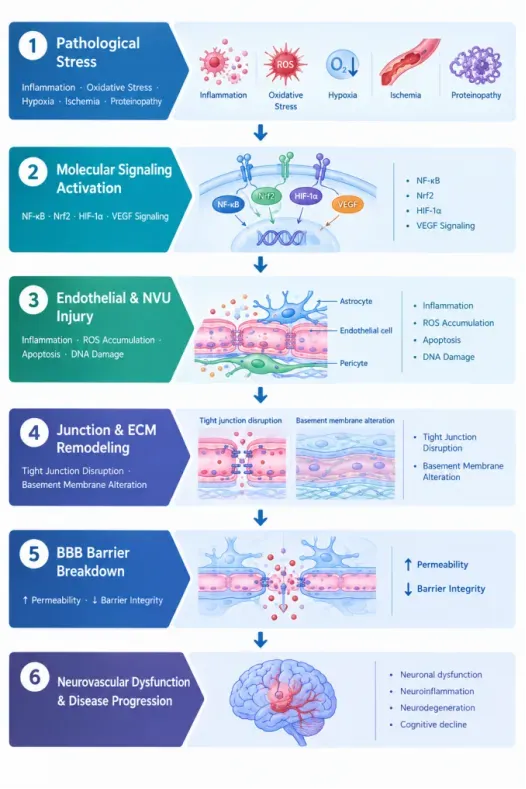
We provide validated antibodies and research solutions spanning BBB cell identity, barrier integrity, signaling pathways, cellular injury, and disease remodeling, enabling mechanistic investigation from molecular events to spatial and functional validation.
05 | BBB Transport & Targeted Delivery
From BBB Permeability to Brain-Targeted Delivery
The selective permeability of the BBB presents a major challenge for CNS drug delivery. Understanding transport pathways, receptor-mediated processes, efflux mechanisms, and barrier integrity provides a foundation for investigating brain-targeted delivery strategies.
RVG is a rabies virus glycoprotein-derived targeting peptide that has been investigated for interaction with nicotinic acetylcholine receptors (nAChRs) and their potential role in CNS-targeting strategies.
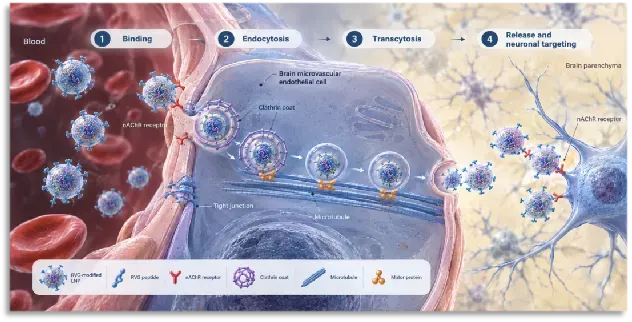
Schematic of the RVG peptide-mediated BBB penetration mechanism
RVG Lipid-Anchor Kit
A Tool for Neural-Targeted Exosome Engineering
RVG Lipid-Anchor Kit enables efficient exosome surface engineering through a PEG–cholesterol-conjugated FAM–RVG targeting peptide. The cholesterol moiety integrates into the exosomal phospholipid membrane, anchoring RVG onto the exosome surface and facilitating BBB transport, neuronal targeting, and brain-directed delivery studies. This convenient lipid-anchor strategy provides a practical tool for engineering and evaluating targeted exosome delivery systems.
Research Applications
| Application | Research Objective |
|---|---|
| BBB Transport | Investigate molecular transport across BBB models |
| Brain-Targeted Delivery | Explore strategies for directing functional cargo toward neural tissues |
| Neurodegeneration | Investigate targeted-delivery strategies in disease models |
| Brain Tumor Research | Explore delivery approaches in brain tumor models |
| Neuroinflammation & Brain Injury | Investigate targeted delivery in inflammatory and ischemic models |
| Neuroinfection | Support CNS-targeted delivery research |
Core Components of the RVG Lipid-Anchor Kit
| Component | Specification | Storage Condition |
|---|---|---|
| RVG lipid-anchor targeting peptide | 5 mg/vial | –20 °C |
| Coincubation Reaction Buffer | 40 mL/bottle | 4 °C |
| Wash Buffer (for ultrafiltration) | 250 mL×3 bottles | Room temperature |
Example Data
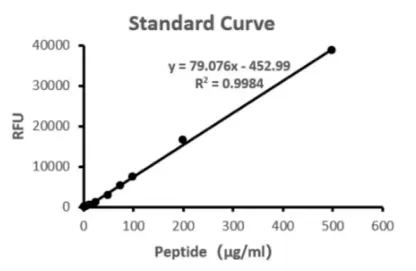
Fluorescence quantitative standard curve for the lipid-anchored targeting peptide.
Example calculation of exosome loading after lipid-anchoring reaction and purification using the fluorescence quantitative standard curve.
| Fluorescence value (10-fold dilution) | Concentration (ug/mL) | Targeted peptide amount (ug) | BCA concentration (ug/mL) | Capacity (nmol/mg) |
|---|---|---|---|---|
| 357 | 10.24 | 25.61 | 835.83 | 19.16 |
Multiparametric BBB Characterization
Connect Structure, Function, Transport and Molecular Mechanisms
A multiparametric characterization strategy integrates BBB identity, barrier structure, functional integrity, transport activity, pathological signaling and neurovascular unit composition to generate a multidimensional view of BBB phenotype and function.
Integrated Research Dimensions
| Dimension | Core Research Question | Representative Markers / Readouts |
|---|---|---|
| Identity | Is the BBB endothelial phenotype established? | CD31 · VWF · VE-Cadherin |
| Structure | Is the barrier structurally intact? | Claudin-5 · Occludin · ZO-1 |
| Function | Is the barrier functionally competent? | TEER · Permeability |
| Transport | Which molecules are transported across the BBB? | GLUT1 · LAT1 · MCT1 |
| Efflux | Which molecules are actively excluded from the brain? | P-gp · BCRP · MRP1 |
| Dysfunction | What molecular mechanisms drive barrier failure? | NF-κB · Nrf2 · HIF-1α · p16/p21 · Cleaved Caspase-3 |
| NVU | How is the BBB microenvironment regulated? | PDGFRβ · GFAP · AQP4 · Iba1 |
Core Solution Advantages
01 | Integrated Research Workflow
From Model Establishment to Mechanistic Insight
Connect BBB models, functional assays and molecular validation within a unified workflow to characterize barrier phenotype, function and molecular mechanisms.
02 | Multidimensional BBB Characterization
From Identity to Function — From Transport to Dysfunction
Integrate identity, structure, function, transport, efflux, signaling and NVU composition for comprehensive BBB characterization beyond single-marker analysis.
03 | Flexible, Application-Driven Panels
Designed for Different Models, Mechanisms and Research Questions
Build focused antibody panels according to BBB model systems, disease mechanisms and experimental objectives, supporting:
WB · IHC · IF · ICC · Flow Cytometry · Multiplex Imaging
04 | From BBB Biology to Targeted Delivery
Connect Barrier Mechanisms with Translational Research
Extend BBB research from barrier characterization and dysfunction analysis to transport studies and brain-targeted delivery strategies, supporting investigation of therapeutic delivery across the BBB.
Core Solution Advantages
From BBB modeling to mechanistic insight
Model+Functional Assay+Antibody Panel+Targeted Delivery
We provide integrated BBB research solutions spanning model establishment, functional assessment, molecular and NVU characterization, disease-mechanism investigation, and advanced brain-targeted delivery research.