
info@ucallmlabs.com
The global population infected with Helicobacter pylori is enormous, and gastrointestinal diseases including gastritis, peptic ulcers, gastric antral dysplasia, and gastric cancer occur at high incidence, with lesions frequently concentrated in the gastric antrum. Current gastric disease research faces significant technical challenges: conventional animal models such as mice and rats exhibit substantial differences from humans in gastric embryonic development, epithelial cell subtype composition, and pathological responses to H. pylori, making it difficult to accurately reproduce human gastric physiology and disease progression. In addition, clinical acquisition of primary human gastric mucosal tissue is challenging, and these cells rapidly lose functional characteristics in vitro, preventing long-term stable culture. These limitations greatly restrict investigations into gastric disease mechanisms, antibacterial/gastroprotective/anticancer drug development, and gastric mucosal regeneration technologies.
In 2014, a landmark study published in Nature established the first standardized stepwise differentiation system for the stable generation of human gastric organoids (hGOs), faithfully recapitulating the entire process of human gastric embryonic development. Using human embryonic stem cells (hESCs) and induced pluripotent stem cells (hiPSCs) as starting materials, this protocol precisely regulates multiple key developmental signaling pathways, including Activin A, Wnt, FGF, BMP, retinoic acid (RA), and EGF, through four major differentiation stages. First, highly purified definitive endoderm is induced; subsequently, Noggin is used to inhibit hindgut fate, while retinoic acid activates the gastric-specific transcription factor PDX1 to generate posterior foregut gastric progenitors. These progenitors are then transferred into long-term three-dimensional extracellular matrix culture, where stage-specific EGF concentration regulation promotes organoid expansion and terminal maturation of endocrine lineages. The entire differentiation process requires approximately 34 days. Mature gastric antrum organoids develop folded, gland-like three-dimensional structures and contain major gastric cell populations, including surface mucous cells, neck mucous cells, SOX9-positive proliferative progenitor cells, LGR5-positive gastric stem cells, and all major gastric antral endocrine subtypes, including gastrin-, somatostatin-, ghrelin-, and serotonin-producing cells. These organoids lack gastric corpus parietal cell contamination, intestinal, or pancreatic ectopic lineages, and their transcriptional profiles closely match those of human fetal gastric antrum tissue. Studies have further demonstrated the dual regulatory role of EGF signaling: high concentrations of EGF promote organoid growth and glandular morphogenesis, whereas low concentrations of EGF relieve NEUROG3 suppression to drive endocrine cell differentiation. Meanwhile, standardized Helicobacter pylori infection models established using these organoids successfully reproduce human-specific early pathological responses, including CagA toxin binding to the c-Met receptor and induction of abnormal epithelial proliferation, accurately modeling gastric infection-associated pathogenic pathways. This differentiation platform features precisely controlled signaling timing, high reproducibility, and scalability. Based on this human gastric antrum organoid system, applications include H. pylori-associated gastric disease modeling, high-throughput screening of gastrointestinal mucosal protective, acid-suppressive, and anticancer drugs, studies of human gastric embryonic development and gastric stem cell biology, and development of regenerative therapies for gastric mucosal injury. This platform provides a high-fidelity, traceable, standardized human gastric tissue model for digestive disease research and preclinical drug evaluation.
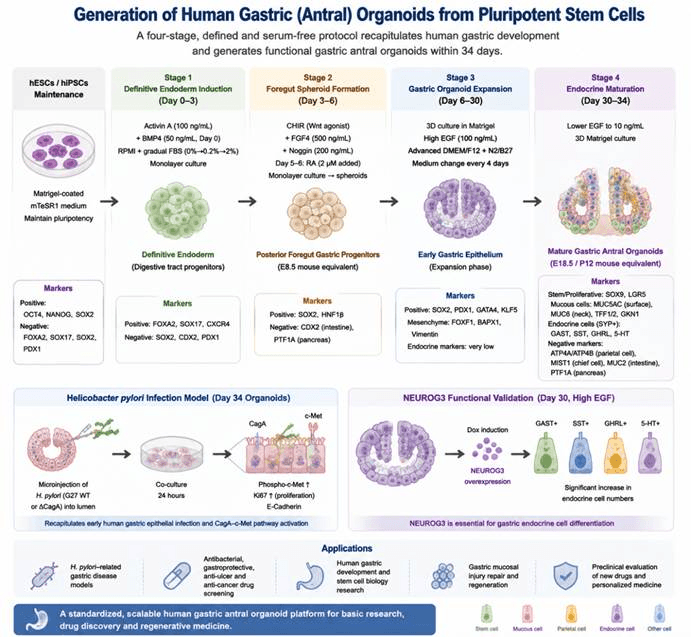
The differentiation process of pluripotent stem cell-derived gastric lineage. Through a four-stage serum-free directed induction system, pluripotent stem cells sequentially undergo definitive endoderm, foregut gastric progenitor, gastric organoid expansion, and endocrine maturation stages, forming human gastric antrum organoids with gastric gland-like structures, multiple gastric epithelial cell types, and endocrine cells within 34 days. This platform can simulate Helicobacter pylori infection and gastric development processes, providing a high-fidelity humanized model for gastric disease mechanism studies, drug screening, gastric mucosal repair, and regenerative medicine research.
Differentiation Stage | Added Factors / Culture Conditions | Core Biological Functions | Corresponding Cell Type / Developmental Stage | Stage-Specific Identification Markers |
Stage 0: Human pluripotent stem cell maintenance (hES/hiPS) | Matrigel-coated plates; feeder-free mTeSR1 medium; routine passaging to maintain pluripotent colonies | Maintains full differentiation potential and provides homogeneous starting cells | Undifferentiated human embryonic stem cells / induced pluripotent stem cells | Positive: OCT4, NANOG, SOX2 Negative: FOXA2, SOX17, SOX2, PDX1 |
Stage 1: Definitive endoderm induction (D0–3) | Basic RPMI medium with gradually increased defined fetal bovine serum (0% → 0.2% → 2%); 100 ng/mL Activin A; 50 ng/mL BMP4 added on day 1; monolayer adherent culture | Activates gastrulation developmental pathways, efficiently enriches definitive endoderm, and eliminates ectodermal and mesodermal contaminants | Embryonic definitive endoderm (common upstream progenitor of digestive system lineages) | Positive: FOXA2, SOX17, CXCR4 Negative: SOX2, CDX2, PDX1 |
Stage 2: Foregut spheroid formation (D3–6) | RPMI + 2% dFBS; CHIR (Wnt agonist) + 500 ng/mL FGF4 + 200 ng/mL Noggin; additional 2 μM retinoic acid (RA) added on D5–6; spontaneous formation of suspended 3D spheroids from monolayer culture | Wnt/FGF signaling promotes gut tube morphogenesis; Noggin inhibits endogenous BMP signaling and blocks hindgut CDX2 expression; RA induces gastric-specific transcription factors and establishes posterior foregut (gastric) fate | Embryonic posterior foregut gastric progenitors (equivalent to mouse E8.5 gastric progenitors) | Broad positive: SOX2 Characteristic marker: HNF1β Negative: CDX2 (intestinal lineage), PTF1A (pancreatic lineage) |
Stage 3: Gastric organoid expansion (D6–30) | Foregut spheroids embedded in Matrigel; Advanced DMEM/F12 medium supplemented with N2/B27; continuous high concentration EGF (100 ng/mL); medium replacement every 4 days | Promotes rapid gastric organoid expansion, epithelial folding, and formation of primitive gastric gland structures; high EGF maintains progenitor expansion by suppressing NEUROG3-mediated endocrine differentiation | Early fetal gastric antral epithelial progenitor cells | Epithelial markers: SOX2, PDX1, GATA4, KLF5 Mesenchymal markers: FOXF1, BAPX1, Vimentin Endocrine markers: Very low expression |
Stage 4: Gastric endocrine terminal maturation (D30–34) | 3D Matrigel culture; EGF concentration reduced to 10 ng/mL for maintenance | Releases EGF-mediated inhibition of NEUROG3, initiates differentiation of gastric endocrine cell lineages, and establishes mature gastric gland stem cell niches | Mature human gastric antral epithelium (corresponding to E18.5/P12 mouse fetal gastric antrum) | Stem cell / proliferative zone: SOX9, LGR5 Mucous cells: MUC5AC (surface mucous cells), MUC6 (neck mucous cells), TFF1/TFF2/GKN1 Endocrine cells: SYP, GAST (gastrin), SST (somatostatin), GHRL (ghrelin), 5-HT Negative: ATP4A/ATP4B (parietal cells), MIST1 (chief cells), MUC2 (intestinal lineage), PTF1A (pancreatic lineage) |
Functional validation: Helicobacter pylori infection model | Mature D34 gastric organoids; microinjection of G27 wild-type or ΔCagA-deficient Helicobacter pylori into the lumen; 24 h in vitro co-culture | Recapitulates early pathological responses of human gastric antral epithelial infection and validates the pathogenic mechanism of CagA toxin | Infected human gastric antral epithelial cells | Bacterial marker: CagA Cellular markers: phosphorylated c-Met, Ki67 (proliferation marker), E-Cadherin (epithelial integrity) |
NEUROG3 regulatory validation experiment | High-EGF system at D30; doxycycline-inducible NEUROG3 overexpression | Demonstrates that NEUROG3 is a key master regulator required for gastric endocrine cell differentiation | Gastric endocrine progenitor cells | Overexpression group: Significant increase in GAST-, SST-, and GHRL-positive endocrine cells |