
info@ucallmlabs.com
Introduction
Blood disease research, transfusion product development, and hematopoietic stem cell transplantation have long faced major technical challenges. Traditional hematopoietic studies rely primarily on bone marrow and umbilical cord blood‑derived primary hematopoietic cells as experimental materials. However, these samples have limited donor availability, poor in vitro expansion capacity, and heterogeneous cellular compositions, making it difficult to establish standardized systems for studying early human hematopoietic development. In addition, mouse hematopoietic differentiation models exhibit significant differences from human developmental regulatory pathways, limiting the direct translation of experimental findings into human applications.
The successful establishment of human embryonic stem cells (hESCs) in 1998 provided a novel source of homogeneous and infinitely expandable human cells for constructing in vitro hematopoietic models. In 2001, the landmark study by the Kaufman and Thomson teams established the first mature human embryonic stem cell‑based hematopoietic induction system, filling a critical gap in the study of early human hematopoiesis in vitro. This study utilized co‑culture systems containing mouse bone marrow stromal S17 cells and yolk sac endothelial C166 cells, where endogenous signals from fetal bovine serum were sufficient to drive directed differentiation of human embryonic stem cell lines such as H1 and H9 without the need for supplementation with multiple recombinant cytokines.
The study demonstrated that hematopoietic‑specific transcription factors, including TAL1 and GATA2, were activated by day 7 of differentiation. By days 14–18, large numbers of CD34‑positive hematopoietic colony‑forming progenitor cells could be obtained. Purified and enriched CD34⁺ cells were capable of differentiating into complete mature blood cell lineages, including erythroid, myeloid, and megakaryocytic cells, in semi‑solid culture systems. The cellular phenotypes, gene expression profiles, and colony‑forming functions closely resembled those of primary human bone marrow hematopoietic cells. The study also confirmed CD34, glycophorin A, CD15, and CD41 as standardized identification markers for different stages of hematopoietic differentiation.
This system faithfully recapitulates the developmental sequence of primitive hematopoiesis in the human yolk sac and establishes a standardized in vitro hematopoietic platform independent of human primary tissues. It provides reliable tools for investigating fundamental developmental biology questions, including the origin of human hematopoiesis and hemogenic endothelial development. Furthermore, it establishes a critical technological foundation for in vitro blood disease modeling, hematopoietic toxicity screening for new drugs, large‑scale production of erythrocytes and platelets, and development of hematopoietic cell transplantation strategies.
Derived from this classical induction strategy, human pluripotent stem cell‑based hematopoietic differentiation technologies are now widely applied in pharmaceutical drug evaluation, developmental biology research, and regenerative medicine cell product development. These approaches overcome limitations associated with primary cell availability and batch‑to‑batch variability, enabling stable, reproducible, and scalable production of human hematopoietic lineage cells.
Workflow Overview
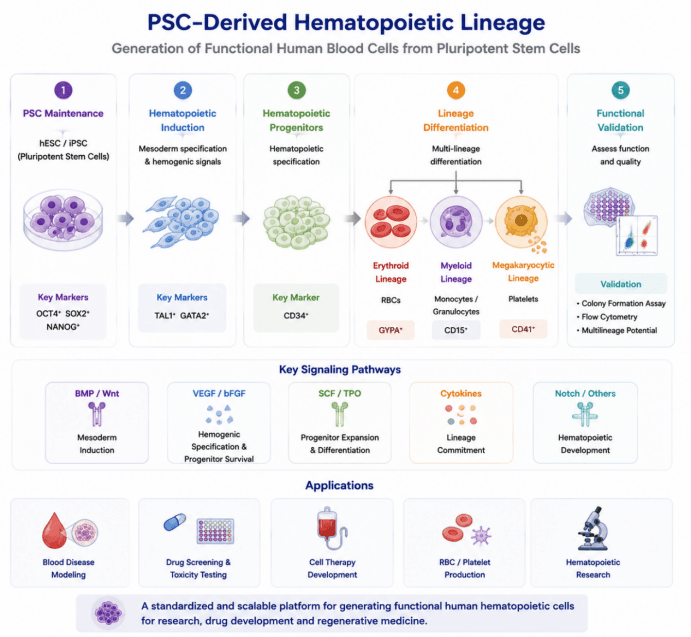
Using hESCs/iPSCs, functional blood cells including erythrocytes, myeloid cells, and megakaryocytes can be generated through an in vitro hematopoietic induction system involving mesoderm formation, hematopoietic progenitor establishment, and multi‑lineage differentiation processes. The PSC‑derived hematopoietic cell platform provides standardized and expandable human cellular resources for blood disease modeling, drug screening, cell therapy, and blood product development.
Differentiation Protocol
| Differentiation Stage | Added Factors / Culture Conditions | Core Biological Function | Corresponding Cell Type / Developmental Stage | Stage‑Specific Identification Markers |
|---|---|---|---|---|
| hESC Maintenance Stage (Undifferentiated State) | 1. Feeder layer: 25 Gy irradiated mouse embryonic fibroblasts (MEFs) 2. Culture medium: DMEM/F12, 15% KnockOut Serum Replacement (KSR), 2 mM glutamine, 0.1 mM β‑mercaptoethanol, 1% non‑essential amino acids, 4 ng/mL bFGF 3. Weekly passaging to prevent spontaneous differentiation | Maintains human embryonic stem cell pluripotency, enables homogeneous long‑term expansion, and prevents spontaneous differentiation | Primitive human embryonic stem cells derived from blastocysts (hESCs) | Positive: SSEA4⁺, CD90⁺, CD133⁺, CD117 (c‑kit)⁺ Negative: SSEA1⁻, CD34⁻, CD31⁻, CD45⁻, CD38⁻ |
| Initiation of Hematopoietic Differentiation by Co‑culture (D0–D14) | 1. Stromal layer: 30 Gy irradiated S17 mouse bone marrow stromal cells (optimal) / C166 mouse yolk sac endothelial cells 2. Differentiation medium: DMEM + 20% fetal bovine serum (FBS), without exogenous recombinant cytokines 3. Medium replacement every 2–3 days; adherent co‑culture system | Stromal cells provide endogenous signals to induce mesoderm differentiation and initiate early hematopoiesis; hematopoietic cells cannot be generated without stromal support or serum‑free conditions | Early mesoderm; hemangioblasts (hematovascular progenitors) | Hematopoietic transcription markers: TAL1, GATA2 (detectable from D7) Surface markers: small population of CD34⁺CD31⁺ double‑positive cells; low CD45 expression |
| Peak Hematopoietic Progenitor Stage (D14–D18) | Continued co‑culture with the above stromal system without additional cytokine supplementation | Hematopoietic colony‑forming cell (CFC) production reaches peak levels; D14 mainly generates erythroid progenitors, while D18 shows increased myeloid progenitor proportion | Short‑term hematopoietic colony‑forming progenitor cells (CFCs, without long‑term hematopoietic reconstitution capacity) | 1. Flow cytometry: CD34⁺CD38⁻ primitive hematopoietic progenitors 2. Transcriptional markers: high TAL1 and GATA2 expression 3. Functional assay: generation of multilineage hematopoietic colonies in semi‑solid culture |
| Hematopoietic Decline Stage (D21–D28) | Maintain the same co‑culture conditions without medium changes | Hematopoietic progenitors gradually lose colony‑forming capacity, and hematopoietic‑specific transcription factors are progressively downregulated | Committed late‑stage hematopoietic progenitor cells without multilineage differentiation potential | Loss of GATA2 and TAL1 expression; significant reduction of CD34⁺ cells; increased proportion of mature CD45⁺ cells |
| Hematopoietic Colony Functional Validation (Post‑sorting Semi‑solid Culture) | 1. General methylcellulose hematopoietic medium: SCF, GM‑CSF, IL‑3, IL‑6, G‑CSF, erythropoietin, BSA, fetal bovine serum 2. Megakaryocyte‑specific collagen medium: TPO, IL‑6, IL‑3, low‑density lipoprotein (LDL) | Validates hematopoietic colony‑forming potential and induces terminal differentiation of progenitors into mature blood cell types | Mature erythrocytes, granulocytes, macrophages, megakaryocytes, and mixed multilineage hematopoietic cells | Erythroid lineage: Glycophorin A⁺, expression of adult α/β globins Myeloid lineage: CD15⁺, CD45⁺, intracellular esterase positive Megakaryocyte lineage: CD41 (GPIIb)⁺ General mature hematopoietic markers: CD45⁺, HLA‑I⁺ |
| Negative Control (MEF‑only Co‑culture) | hESCs co‑cultured only with MEF feeder cells without S17/C166 stromal cells; same differentiation medium conditions | Causes only nonspecific spontaneous differentiation; lacks hematopoietic induction signals and does not generate hematopoietic colonies | Non‑hematopoietic differentiated cells without hematopoietic mesoderm specification | No expression of hematopoietic transcription factors TAL1 and GATA2; nearly no CD34‑positive cells; no hematopoietic colony formation |