
info@ucallmlabs.com
Reproductive disorders, infertility, and diseases associated with germ cell development represent major unmet clinical needs. However, germ cell research has long faced significant technical barriers. Primordial germ cells (PGCs), the common developmental origin of sperm and oocytes, are extremely rare in embryos and cannot be obtained in large quantities. Traditional in vitro generation approaches rely on spontaneous differentiation from embryoid bodies, resulting in germ cell induction efficiencies of less than 1%. The resulting cell populations contain large numbers of somatic cells and undifferentiated pluripotent stem cells, leading to a high risk of teratoma formation after transplantation. In addition, the lack of universal sorting markers requires the use of genetic fluorescent reporter systems to isolate germ cell progenitors, making standardized expansion difficult. These limitations have significantly restricted advances in reproductive development studies, in vitro infertility disease modeling, germ cell replacement therapies, and gene-edited gamete development.
In 2011, a landmark study published in Cell established the first two-step, chemically defined, serum-free, and scalable in vitro reconstruction system for primordial germ cell-like cells (PGCLCs). Using mouse ground-state pluripotent stem cells (ES/iPS) as the starting material, the system first employs Activin A and bFGF to induce transient epiblast-like cells (EpiLCs), accurately recapitulating the physiological state of embryonic day 5.5 (E5.5) epiblasts before gastrulation. Only EpiLCs at the second day of differentiation exhibit high competence for germ cell generation. Subsequently, suspension culture with combined BMP4/BMP8b/LIF/SCF/EGF signaling mimics the in vivo extraembryonic induction microenvironment, activating key germ cell fate regulators such as Blimp1 and Prdm14, and generating PGCLCs with transcriptomic and epigenetic characteristics highly similar to in vivo primordial germ cells.
This standardized reproductive cell differentiation platform is compatible with both embryonic stem cells and induced pluripotent stem cells, featuring chemically defined components and high reproducibility. It provides a powerful research tool for studying epigenetic reprogramming of primordial germ cells, establishing in vitro models of genetic infertility, developing male infertility cell therapies, performing reproductive toxicity screening, and generating gene-edited gametes. This technology offers a safe, efficient, and traceable standardized humanized reproductive progenitor cell platform for reproductive medicine research.
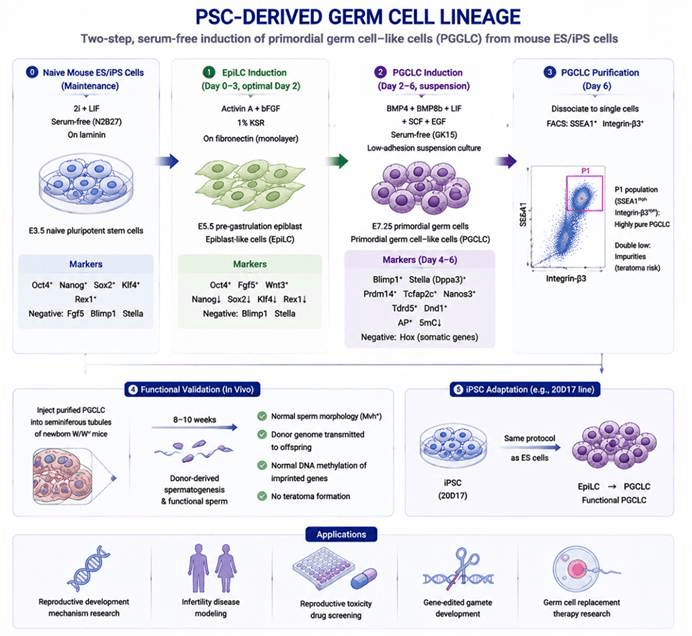
The differentiation process of pluripotent stem cells into primordial germ cell-like cells (PGCLCs). Pluripotent stem cells first form epiblast-like cells (EpiLCs) under the induction of Activin A/bFGF, followed by stimulation with BMP4/BMP8b, LIF, SCF, and other signaling factors to activate germ cell-related genes and generate PGCLCs. After marker-based sorting and purification, high-quality germ cell progenitor cells can be obtained for applications in reproductive development research, infertility disease modeling, and drug screening.
Differentiation Stage | Added Factors / Culture Conditions | Core Biological Function | Corresponding Cell Type / Developmental Stage | Stage-Specific Identification Markers |
Stage 0: Maintenance of naive mouse ES cells (starting material) | Feeder-free N2B27 medium; supplemented with 2i (PD0325901 + CHIR99021) + LIF; plates coated with polyornithine + laminin | Maintains the primitive naive pluripotent state of embryonic stem cells and preserves the potential for differentiation into epiblast and germline lineages | Naive embryonic stem cells derived from E3.5 blastocyst inner cell mass (naive PSCs) | Positive: Oct4, Nanog, Sox2, Klf4, Rex1 Negative: Fgf5, Blimp1, Stella, germline lineage genes |
Stage 1: EpiLC induction (Day 0–3, optimal Day 2) | N2B27 basal medium; 20 ng/mL Activin A + 12 ng/mL bFGF + 1% KSR; fibronectin-coated plates for adherent monolayer culture with daily medium replacement | Mimics embryonic E5.5 pre-gastrulation epiblast signaling and directs naive ES cells into transient epiblast-like cells; D2 EpiLCs exhibit the highest potential for PGC induction | In vivo equivalent: E5.5 pre-gastrulation epiblast In vitro: transient epiblast-like cells (EpiLCs) | Positive: Oct4, Fgf5, Wnt3 Downregulated: Nanog, Sox2, Klf4, Rex1 Negative: Blimp1, Stella, mesoderm/endoderm markers |
Stage 2: PGCLC suspension induction (D2 EpiLC aggregate culture, Day 2–6) | GK15 basal medium (GMEM + 15% KSR); cytokine combination: BMP4, BMP8b, LIF, SCF, EGF; suspension aggregate culture in low-attachment U-bottom plates | Recapitulates embryonic E7.25 extraembryonic BMP-mediated germline induction signals, activates Blimp1/Prdm14 germ cell regulatory pathways, and progressively generates primordial germ cell-like cells (PGCLCs) | In vivo equivalent: E7.25 primordial germ cells (PGCs) In vitro: primordial germ cell-like cells (PGCLCs) | Early PGCLC (Day 2): high Blimp1 (BV) expression Mature PGCLC (Day 4–6): Blimp1⁺ Stella (Dppa3)⁺ Upregulated: Prdm14, Tcfap2c, Nanos3, Tdrd5 Epigenetic features: H3K9me2↓, H3K27me3↑, global 5mC reduction Positive: alkaline phosphatase (AP) staining Negative: Hox somatic lineage genes |
PGCLC Flow Cytometry Purification (Day 6 of induction) | Dissociate aggregates into single cells; sort SSEA1 and Integrin-β3 double-positive cells by flow cytometry; collect double-positive P1 population | Removes contaminating undifferentiated ES cells and somatic cells to obtain purified, non-tumorigenic germ cell progenitors | High-purity functional PGCLCs (suitable for in vivo transplantation) | Sorting criteria: SSEA1^high Integrin-β3^high (P1 population) Double-low population represents contaminating cells, including undifferentiated tumorigenic stem cells |
In vivo transplantation functional validation | Purified PGCLCs are resuspended and injected into seminiferous tubules of neonatal W/Wv infertile mice; cultured for 8–10 weeks | Evaluates the complete spermatogenic potential of PGCLCs in vivo and validates their developmental competence | PGCLC-derived germ cells at different spermatogenic stages and mature sperm | Tissue markers: Mvh expression, normal sperm morphology; offspring genomes contain donor-derived transgenes; normal imprinting methylation patterns; no teratoma formation |
iPSC homologous differentiation (20D17 line-specific) | Maintenance, EpiLC induction, and PGCLC induction factors are identical to mouse ES cell differentiation conditions | Validates the germline differentiation potential of iPSCs; only the 20D17 line produces functional PGCLCs | iPSC-derived EpiLCs and PGCLCs | Same marker profile as ES cell differentiation; Nanog-EGFP reporter fluorescence can assist lineage tracing |