
info@mail.ucallm.com
1 Protein Interaction and Binding Studies ( Explore our Protein Interaction Topic Page)
Build sensitive and high-throughput protein interaction assays, ranging from molecular interaction validation to drug screening.
Specific protein-protein interactions serve as key molecular foundations for cellular signal transduction, enzyme activity regulation, immune recognition, and disease initiation and progression. Binding studies of protein–protein, protein–antibody, protein–peptide and protein–small molecule pairs are essential in target mechanism research, antibody development and drug discovery.
Traditional protein interaction studies commonly rely on immunoprecipitation, Western Blot, ELISA, SPR, BLI and other technologies. Each method differs in sensitivity, throughput, sample handling, operational complexity and immobilization requirements. For experiments requiring screening of large candidate libraries, comparison of binding affinity or condition optimization, homogeneous high-throughput assays can greatly boost experimental efficiency.
TR-FRET protein interaction assays utilize time-resolved fluorescence resonance energy transfer technology. Molecular binding events are quantified via distance-dependent signal changes between Donor and Acceptor. The system requires no plate washing; reactions and detection can be performed directly in microplates. It supports research on protein–protein, protein–antibody, protein–tag and other biomolecular interactions.
1.1 How does TR-FRET work in protein interaction assays?
In a typical protein interaction assay, the TR-FRET Donor and Acceptor are separately conjugated to two interacting molecules or their recognition tags. When the two molecules bind, the spatial distance between Donor and Acceptor decreases. Excitation of the Donor triggers energy transfer and generates measurable time-resolved fluorescence signals.
Our TR-FRET platform applies time-resolved detection to effectively mitigate interference from sample autofluorescence and short-lived background fluorescence, achieving superior signal-to-noise ratio. The homogeneous format removes the need to separate bound and unbound fractions, cutting down washing, transfer and other manual steps. It is well suited for batch testing and automated screening in 96/384-well plate formats.
Assay systems can be customized for different analytes by modifying labeling strategies and Donor/Acceptor combinations. For instance, tags including His, GST, FLAG, MYC and HA are available for the detection of recombinant proteins and fusion proteins. Streptavidin recognizes biotin-labeled molecules; Protein A and IgG antibody systems from various species are applicable to studies of antibodies, Fc fusion proteins and antibody binding.
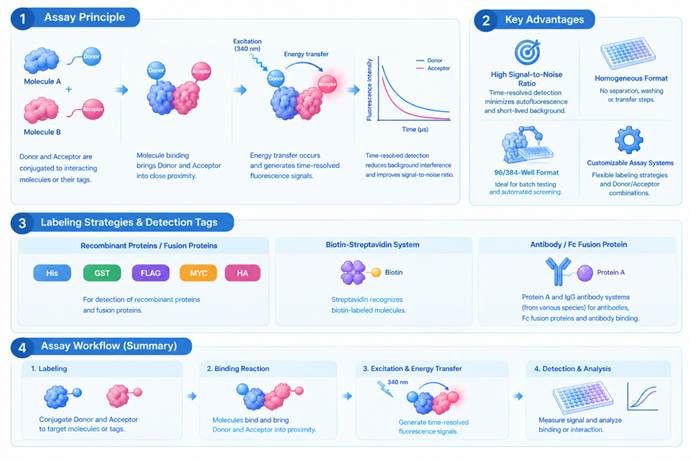
Principle and Versatile Design of KeyTec® TR-FRET Assays. In a typical protein interaction assay, Donor and Acceptor labels are conjugated to interacting molecules or recognition tags. Target binding brings the fluorophores into close proximity, enabling energy transfer and generation of a time-resolved fluorescence signal. Time-resolved detection reduces interference from autofluorescence and short-lived background signals, while the homogeneous format supports efficient 96-/384-well screening without separation or washing steps. Flexible labeling strategies, including His, GST, FLAG, MYC, HA, biotin–streptavidin, and Protein A/IgG systems, enable adaptation to diverse protein and antibody-based assay formats.
1.2 Typical Application Scenarios
- Protein–protein interaction studies
Suitable for investigating direct binding between receptor–ligand pairs, signaling proteins, transcription factors and other functional proteins. By selecting appropriate tag antibodies or streptavidin systems, different proteins can be conjugated separately to TR-FRET Donor and Acceptor, enabling quantitative measurement of protein binding.
This format supports protein interaction validation, binding condition optimization, competitive binding assays and screening of candidate inhibitors. For studies comparing binding capacity across multiple protein mutants or candidate molecules, parallel detection can be performed in microplate formats.
- Tagged protein and fusion protein detection
Tags such as His, Biotin, GST, FLAG, MYC and HA are widely used in recombinant protein expression, purification and functional research. The KeyTec® TR-FRET Tag Check series enables rapid validation of tagged protein expression and assay performance, facilitating the establishment of robust assay systems for subsequent protein interaction experiments.
For assay systems with pre-existing His-tag or Biotin-tag proteins, corresponding Tag Check Kits can be directly adopted. For tags including GST, FLAG, MYC, HA and Human Fc, users may select available detection solutions according to product release schedules or build custom assay systems via custom development services.
- Protein–antibody binding studies
Protein–antibody binding represents one of the core applications in antibody screening, antibody affinity evaluation and biotherapeutic discovery. Our TR-FRET platform enables detection of binding between antibodies and target proteins via Protein A, species-specific anti-IgG antibodies or specific tag recognition systems.
Compared with conventional methods requiring immobilization and washing, the homogeneous TR-FRET system allows reactions to proceed directly in microplates, facilitating parallel comparison and primary screening of antibody candidates.
- Competitive Binding and Binding Inhibitor Screening
By adding candidate small molecules, antibodies, peptides or other competing molecules into the protein interaction assay system, TR-FRET signal changes can be used to evaluate their capacity to disrupt target protein interactions.
Therefore, this assay system can not only determine whether two molecules bind to each other, but also be further applied to binding inhibitor screening, competitive binding studies and Structure–Activity Relationship (SAR) studies. It assists researchers in screening and comparing candidate molecules at the level of target binding.
1.3 Protein Interaction Product Solutions
We offer comprehensive solutions for protein interaction research, ranging from tag detection and Donor/Acceptor recognition systems to custom labeling and PPI Assay Development.
Customers with established tag systems may directly select the corresponding Tag Check Kits or TR-FRET recognition reagents according to protein tags. For users who need to build PPI assay systems in-house, available recognition systems include Streptavidin, Anti-6His, Anti-GST, Anti-FLAG, Anti-MYC, Anti-HA, Protein A and species-specific IgG reagents. These can be paired with various TR-FRET combinations such as Solar Eu, Solar Tb, Bright Eu, Bright Tb, LA, HX and Green.
For projects where the optimal labeling strategy has not yet been determined or customized assays are required, we also provide custom labeling services and PPI Assay Development services to support customers through the full workflow from molecular labeling to assay establishment.
1.4 Protein Interaction Related Products
Product Category | Product Name | Main Application | Cat. No. |
Tag Check | KeyTec® TR-FRET His Tag Check Kit | Detection of His-tagged protein expression | A1010052D/S/L |
Tag Check | KeyTec® TR-FRET Biotin Tag Check Kit | Detection of Biotin-labeled proteins/molecules | A1010051D/S/L |
TR-FRET Recognition Reagent | Streptavidin TR-FRET | Detection of Biotin-labeled proteins, antibodies, peptides and small molecules | A1020021/A1020022/A1020059/A1020065/A1020023/A1020024/A1020048 |
TR-FRET Recognition Reagent | Anti-6His TR-FRET | Detection and interaction study of His-tagged proteins | A1020001/A1020002/A1020054/A1020066/A1020003/A1020004/A1020043 |
TR-FRET Recognition Reagent | Anti-GST TR-FRET | Detection and interaction study of GST-tagged proteins | A1020005/A1020006/A1020055/A1020067/A1020007/A1020008/A1020044 |
TR-FRET Recognition Reagent | Anti-FLAG TR-FRET | Detection and interaction study of FLAG-tagged proteins | A1020009/A1020010/A1020056/A1020068/A1020011/A1020012/A1020045 |
TR-FRET Recognition Reagent | Anti-MYC TR-FRET | Detection and interaction study of MYC-tagged proteins | A1020013/A1020014/A1020057/A1020069/A1020015/A1020016/A1020046 |
TR-FRET Recognition Reagent | Anti-HA TR-FRET | Detection and interaction study of HA-tagged proteins | A1020017/A1020018/A1020058/A1020070/A1020019/A1020020/A1020047 |
Antibody / Fc Detection | Protein A TR-FRET | Detection of antibodies and Fc fusion proteins | A1020041/A1020077/A1020064/A1020075/A1020042/A1020078/A1020053 |
Antibody Detection | Anti-Human IgG TR-FRET | Detection of Human IgG antibodies | A1020025/A1020026/A1020060/A1020071/A1020027/A1020028/A1020049 |
Antibody Detection | Anti-Mouse IgG TR-FRET | Detection of Mouse IgG antibodies | A1020029/A1020030/A1020061/A1020072/A1020031/A1020032/A1020050 |
Antibody Detection | Anti-Rat IgG TR-FRET | Detection of Rat IgG antibodies | A1020037/A1020038/A1020063/A1020074/A1020039/A1020040/A1020052 |
Antibody Detection | Anti-Rabbit IgG TR-FRET | Detection of Rabbit IgG antibodies | A1020033/A1020034/A1020062/A1020073/A1020035/A1020036/A1020051 |
Note: The same recognition molecule is available with different Donor/Acceptor combinations. Users may select the appropriate TR-FRET combination according to the assay system, detection platform and fluorescence background.
1.5 From Standard Reagents to Custom PPI Assay Systems
Protein interaction projects vary in protein size, tag position, binding mode, detection background and other parameters, and no single labeling protocol fits all systems. We provide assay development support tailored to customers’ target proteins and experimental requirements.
Custom labeling services enable TR-FRET labeling of diverse molecules including proteins, antibodies, peptides and small molecules. Receptor fluorophore systems such as HX, LA and Green are supported to build customer-specific Donor/Acceptor combinations.
PPI Assay Development delivers assay method development for specific protein interaction projects, including selection of labeling strategies, optimization of Donor/Acceptor combinations, tuning of reaction conditions and establishment of assay systems. It helps customers convert existing protein interaction studies into robust and reproducible TR-FRET assays.
1.6 Research Advantages of Protein Interaction Products
l High sensitivity: Time-resolved detection suppresses interference from short-lived background fluorescence and improves assay signal-to-noise ratio.
l Homogeneous assay: No plate washing or separation steps, reducing manual handling and improving assay throughput.
l High-throughput compatible: Supports microplate formats, suitable for bulk screening of candidate molecules and automated experiments.
l Multi-tag compatibility: Covers common assay systems including His, Biotin, GST, FLAG, MYC, HA, antibody and Fc detection.
l Flexible combinations: Multiple TR-FRET Donor and Acceptor pairs are available for selection based on different experimental systems.
l Custom development available: From molecular labeling to PPI assay setup, customized solutions are offered for special targets and complex assay systems.
1.7 Select the Right TR-FRET Solution for Your Protein Interaction Research
Whether you aim to verify protein-protein interactions, compare binding affinity of different proteins or antibodies, or build high-throughput inhibitor screening assays, KeyTec® provides full support ranging from standard TR-FRET reagents to custom assay development.
From tag detection to protein interaction analysis, from off-the-shelf reagents to custom Assay Development, we help rapidly establish stable and efficient assay systems for protein interaction research.
Contact us for a TR-FRET solution tailored to your target and assay system.
Explore Products | Get Technical Support | Custom TR-FRET Assay