
info@ucallmlabs.com
Decoding Neuroimmune Dysfunction and CNS Demyelination with Validated Research Antibody Solutions
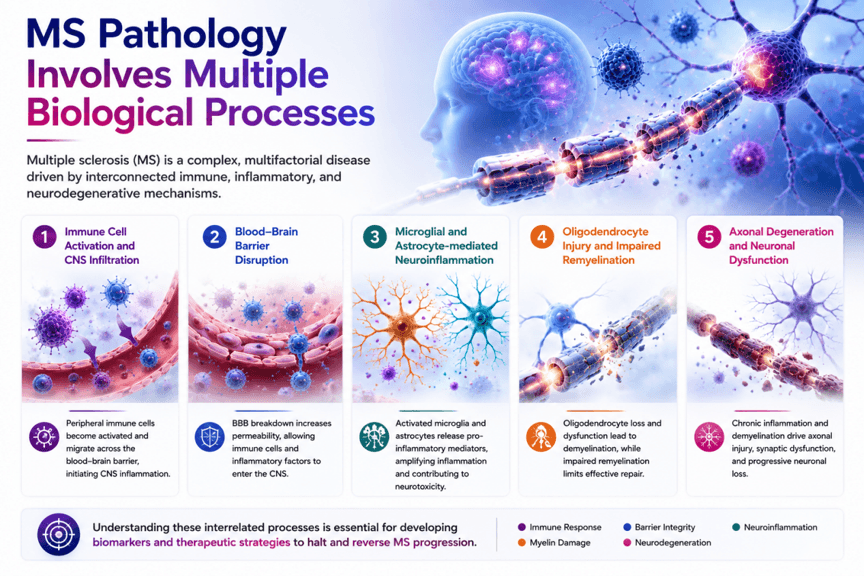
Multiple sclerosis (MS) is a chronic immune-mediated disorder of the central nervous system (CNS) characterized by inflammatory infiltration, autoimmune-mediated myelin destruction, oligodendrocyte dysfunction, and progressive neurodegeneration. Complex interactions between immune cells, glial populations, and neuronal networks drive disease initiation, relapse, and progression.
MS pathology involves multiple biological processes including:
Immune cell activation and CNS infiltration
Blood–brain barrier disruption
Microglial and astrocyte-mediated neuroinflammation
Oligodendrocyte injury and impaired remyelination
Axonal degeneration and neuronal dysfunction
Our Multiple Sclerosis Research Solutions provide highly validated antibodies targeting immune regulators, inflammatory pathways, glial markers, myelin-associated proteins, and neurodegenerative signaling molecules.
Multiple Sclerosis Biomarker Portfolio
——Comprehensive Solutions for Neuroinflammation, Demyelination and CNS Disease Mechanisms
Accurate MS research requires integrated analysis of immune responses, glial activation, myelin integrity, and neuronal damage. Our antibody portfolio supports multiple aspects of MS biology from inflammatory initiation to neurodegenerative progression.
Research Category | Representative Targets | Research Applications | Biological Significance |
Immune Cell Activation Profiling | CD3, CD4, CD8, CD19, CD68, CD11b, CD20, CD138 | Immune infiltration analysis; T cell and macrophage characterization | Defines adaptive and innate immune responses contributing to CNS inflammation |
Microglia & Neuroinflammation Research | Iba1, TMEM119, CD68, GFAP, TREM2, NLRP3, ASC, GSDMD, P2RY12 | Microglial activation; inflammatory state profiling | Reveals immune-mediated damage and CNS inflammatory pathways |
Astrocyte Activation Analysis | GFAP, EAAT2, Connexin 43, ALDH1L1, AQP4 | Reactive gliosis studies; CNS inflammatory response | Characterizes astrocyte-mediated neurotoxicity and repair mechanisms |
Oligodendrocyte & Myelin Biology | MBP, MOG, PLP1, OLIG2, SOX10,NG2, PDGFRα | Demyelination and remyelination studies | Evaluates myelin loss, oligodendrocyte survival, and regeneration |
Blood–Brain Barrier Integrity | Claudin-5, Occludin, ZO-1, ICAM1, VCAM1, LFA-1 , VLA-4 | BBB permeability and immune trafficking studies | Defines vascular dysfunction during inflammatory CNS injury |
Neurodegeneration & Axonal Injury | NF-L/NF-H, MAP2, βIII-Tubulin, Synaptophysin, C1q、C3 | Axonal damage; neuronal loss assessment | Links inflammatory injury with progressive neurological decline |
Featured Multiple Sclerosis Research Panels
——Integrated Antibody Solutions for Comprehensive MS Pathology Analysis
n Neuroinflammation Initiation & Maintenance Panel—CNS Infiltration and Immune Cell Trafficking
Key Markers
CD3 | CD4 | CD68 | Iba1 | MHC‑II | VCAM‑1 |
n Remyelination Fate Decision Panel—Evaluating Oligodendrocyte Precursor Cell Activation and Repair Success
Key Markers
MBP | NG2 | OLIG2 | Ki67 |
|
n Glial Pathological Synapse Panel——Astrocyte–Microglia Interactions in Synaptic Pruning
Key Markers
GFAP | C1q | PSD95 | Synaptophysin | Iba1 |
n Neurodegeneration & Axonal Injury Panel—Evaluating progressive CNS damage
Key Markers
NF-L | NF-H | MAP2 | βIII-Tubulin | Synaptophysin |
Multiple Sclerosis Research
——From Immune Activation Profiling to CNS Repair Discovery
Research Stage | Representative Markers | Scientific Objective |
Immune Cell Characterization | CD3, CD4, CD8, CD19 | Identify immune populations involved in CNS inflammation |
Neuroinflammation Assessment | Iba1, CD68, GFAP, TREM2 | Evaluate glial activation and inflammatory responses |
Demyelination Analysis | MBP, MOG, PLP1 | Quantify myelin damage and structural changes |
Oligodendrocyte Biology | OLIG2, SOX10 | Study oligodendrocyte development and repair capacity |
BBB Dysfunction Analysis | Claudin-5, Occludin, ZO-1 | Investigate immune trafficking and vascular disruption |
Neurodegeneration Evaluation | NF-L, NF-H, MAP2 | Monitor axonal injury and neuronal loss |
Therapeutic Response Validation | Immune + neural marker panels | Assess treatment efficacy and disease modification |
Our Multiple Sclerosis research workflow provides a comprehensive framework for dissecting disease mechanisms from immune activation to neural repair. By integrating validated markers for immune cell characterization (CD3, CD4, CD8, CD19), neuroinflammation (Iba1, CD68, GFAP, TREM2), demyelination (MBP, MOG, PLP1), oligodendrocyte biology (OLIG2, SOX10), blood–brain barrier dysfunction (Claudin-5, Occludin, ZO-1), and neurodegeneration (NF-L, NF-H, MAP2), researchers can systematically investigate CNS inflammation, myelin loss, neuronal injury, and therapeutic responses. This integrated antibody-based approach supports advanced MS studies, from disease mechanism discovery and biomarker identification to treatment evaluation and translational neuroscience applications.
Research Frontiers Driving Multiple Sclerosis Discovery
——Advancing Understanding of Neuroimmune Interactions and CNS Repair
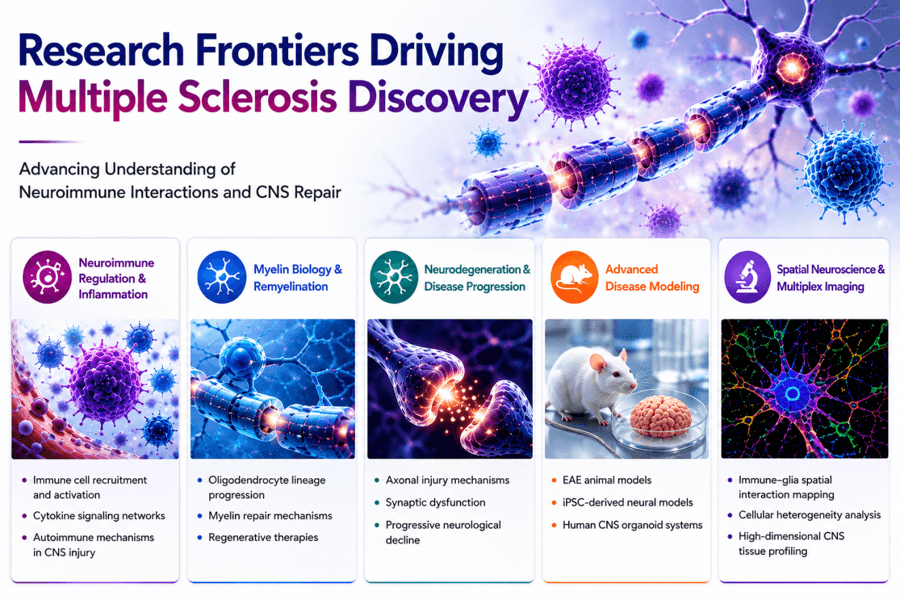
Multiple Sclerosis research is rapidly evolving through integrated investigation of immune regulation, myelin biology, neurodegeneration, and advanced disease modeling approaches. Current research focuses on deciphering immune cell activation, cytokine signaling, and autoimmune mechanisms driving CNS injury, while exploring oligodendrocyte-mediated remyelination and regenerative strategies. Emerging models, including EAE systems, iPSC-derived neural models, and human CNS organoids, enable deeper mechanistic understanding and therapeutic discovery. Combined with spatial neuroscience and multiplex imaging technologies, researchers can map immune–glia interactions, resolve cellular heterogeneity, and achieve high-dimensional profiling of CNS pathology to accelerate precision MS research.
Why Researchers Choose Our Multiple Sclerosis Research Solutions
Validated Targets. Comprehensive Coverage. Reliable Neuroimmune Insights.
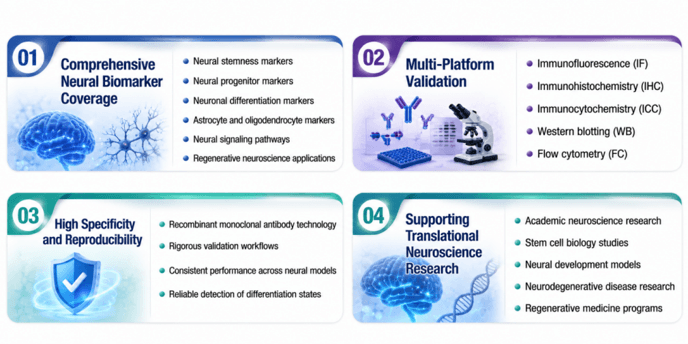
Our Multiple Sclerosis research portfolio provides a complete antibody-based solution for investigating immune dysregulation, CNS inflammation, demyelination, and neurodegenerative progression. From disease mechanism discovery to translational validation, We enable accurate and reproducible characterization of MS-associated molecular changes.
Key Research Challenge | Our Research Solution |
How can I define immune cell infiltration and activation within the CNS? | Comprehensive immune profiling markers including CD3, CD4, CD8, CD19, CD68, and Iba1 for characterization of lymphocytes, macrophages, and microglial populations |
How can I evaluate myelin loss and remyelination processes? | Validated myelin and oligodendrocyte markers including MBP, MOG, PLP1, OLIG2, and SOX10 to monitor myelin integrity and repair responses |
How can I investigate neuroinflammatory pathways and glial responses? | Targeted antibodies against activated microglia and reactive astrocytes including Iba1, TMEM119, GFAP, CD68, and TREM2 |
How can I assess neuronal injury and disease progression? | Neurodegeneration-focused markers including NF-L, NF-H, MAP2, βIII-Tubulin, and Synaptophysin for evaluating axonal and neuronal alterations |
How can I improve experimental consistency across MS studies? | Highly validated antibodies optimized for WB, IHC, ICC/IF, Flow Cytometry, and multiplex imaging applications |
Key References
1. Woo M.S., Engler J.B., Friese M.A. (2024)The neuropathobiology of multiple sclerosis.Nature Reviews Neuroscience. 25:493–513.
2. Oh J., Bar-Or A. (2024) Precision neuroimmunology in multiple sclerosis — the horizon is near.Nature Reviews Neurology. 20:507–508.
3. Klotz L., Antel J., Kuhlmann T. (2023) Inflammation in multiple sclerosis: consequences for remyelination and disease progression.Nature Reviews Neurology. 19:305–320.
4. Distéfano-Gagné F., Bitarafan S., Lacroix S. et al. (2023)Roles and regulation of microglia activity in multiple sclerosis: insights from animal models.Nature Reviews Neuroscience. 24:397–415.