
info@ucallmlabs.com
From Neural Stem Cells to Functional Neural Networks — Empowering Precise Neural Differentiation Profiling with Validated Antibody Solutions
Neural lineage development is a highly orchestrated biological process involving the progressive transition of neural stem cells (NSCs) into specialized neuronal and glial populations, including neurons, astrocytes, and oligodendrocytes. This complex developmental trajectory is regulated by coordinated networks of transcription factors, signaling pathways, epigenetic regulators, and lineage-specific proteins that establish neural identity, maturation status, and functional specialization.
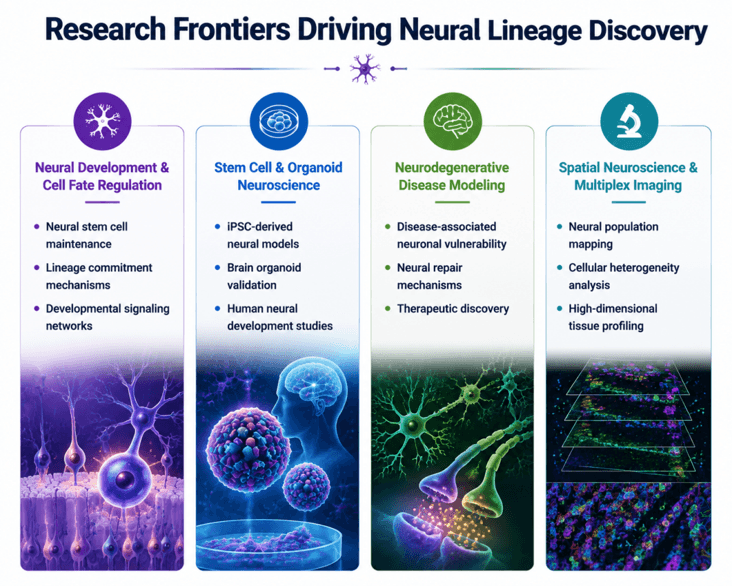
We enable comprehensive neural lineage research by supporting investigation across key biological frontiers, from neural stem cell maintenance and lineage commitment to developmental signaling, neuronal specialization, and disease modeling. Validated research tools facilitate the study of neural identity markers, differentiation pathways, transcriptional regulation, and molecular mechanisms governing nervous system development.
Emerging stem cell and organoid-based neuroscience platforms, including iPSC-derived neural models and brain organoids, further provide powerful systems for investigating human neural development and disease mechanisms. Advanced spatial neuroscience, multiplex imaging, and cellular profiling technologies reveal neural heterogeneity, intercellular interactions, and complex tissue architectures.
Neural Lineage Development Biomarker Portfolio
——Comprehensive Marker Solutions for Neural Identity, Differentiation, and Functional Maturation
Neural lineage development involves a highly dynamic transition from neural stem cells (NSCs) to committed progenitors, mature neurons, and specialized glial populations. Accurate characterization of these developmental stages requires integrated biomarker analysis across multiple lineage-defining pathways.
Our validated antibody portfolio provides comprehensive coverage of key neural development markers, enabling researchers to monitor stemness maintenance, lineage commitment, neuronal maturation, and glial differentiation across diverse models including neural stem cell cultures, iPSC-derived neural systems, brain organoids, and developmental neuroscience studies.
Biomarker Category | Representative Markers | Research Applications | Biological Significance |
Neural Stem Cell & Neural Progenitor Markers | SOX2, NES (Nestin), PROM1/CD133, PAX6, FABP7/BLBP, NOTCH1, GFAP | Identification and validation of neural stem/progenitor populations | Define neural stemness, self-renewal capacity, and early neural lineage identity |
Radial Glial Cell Markers | SOX2, PAX6, HES5, VIM, GFAP, FABP7/BLBP, SLC1A3/GLAST | Analysis of neural progenitor expansion and developmental transitions | Characterize radial glial populations as key intermediate neural progenitors |
Neuronal Commitment & Immature Neuron Markers | ASCL1, NEUROD1, DCX, TBR2/EOMES, TBR1, TUBB3, MAP2, L1CAM | Monitoring neural differentiation and early neuronal specification | Identify neuronal lineage commitment and maturation progression |
Mature Neuronal Markers | RBFOX3/NeuN, MAP2, NEFL, NEFM, SYN/SYP, DLG4/PSD-95 | Evaluation of neuronal maturation and functional identity | Confirm mature neuronal phenotype and synaptic development |
Neuronal Subtype Markers | TH, NURR1/NR4A2, FOXA2, GAD1/GAD67, GAD2/GAD65, VGLUT1/2, CHAT, SLC6A4 | Characterization of specialized neuronal populations | Define neurotransmitter-specific neuronal identities including dopaminergic, GABAergic, glutamatergic, serotonergic, and cholinergic neurons |
Astrocyte Differentiation Markers | GFAP, S100B, AQP4, ALDH1L1, SLC1A2/GLT-1, SLC1A3/GLAST | Astrocyte generation and functional characterization | Identify mature astrocyte populations and glial maturation states |
Oligodendrocyte Lineage Markers | OLIG2, SOX10, OLIG3, MBP, MOG, PDGFRA | Oligodendrocyte development and myelination studies | Track oligodendrocyte precursor differentiation and myelin formation |
Neural Lineage Development Biomarker Panel
——Key Targets for Neural Stem Cell Identity, Differentiation, and Functional Maturation
Marker | Biological Function | Research Value | Associated Neural Lineage Applications |
SOX2 | Master transcription factor maintaining neural stem/progenitor cell identity and self-renewal capacity | Essential marker for neural stemness evaluation and progenitor characterization | Neural stem cells, iPSC neural induction, brain organoid models, neurogenesis research |
Nestin | Intermediate filament protein expressed in neural progenitor and immature stem cell populations | Enables identification and monitoring of neural precursor states | Neural progenitor characterization, neural differentiation studies, regenerative medicine |
PAX6 | Developmental transcription factor regulating neural patterning and progenitor specification | Defines early neural lineage commitment and developmental progression | Cortical development, neural differentiation, brain development studies |
SOX3 | Regulates early neural development and maintenance of neural progenitor populations | Supports analysis of embryonic neurogenesis and neural fate decisions | CNS development, neural stem cell biology |
DCX (Doublecortin) | Microtubule-associated protein involved in neuronal migration and immature neuron development | Marker for early neuronal differentiation and neurogenesis progression | Developing neurons, neuronal migration studies, brain development |
TUBB3 (βIII-Tubulin) | Neuron-specific cytoskeletal protein expressed during neuronal commitment | Evaluates neuronal lineage specification and immature neuron formation | Neural differentiation, iPSC-derived neuron models, neurodevelopment research |
MAP2 | Neuronal cytoskeletal protein involved in dendritic development and neuronal maturation | Confirms neuronal maturation and structural development | Mature neuron characterization, neural network formation |
NeuN (RBFOX3) | Nuclear neuronal marker expressed in mature post-mitotic neurons | Reliable indicator of mature neuronal identity and functional maturation | Mature neuron identification, neurobiology research |
GFAP | Intermediate filament protein defining astrocyte identity and reactive gliosis | Enables evaluation of astrocyte differentiation and activation status | Astrocyte development, neuroinflammation, CNS disease models |
S100β | Calcium-binding protein associated with astrocyte maturation and glial function | Supports astrocyte population identification and characterization | Astrocyte biology, glial development, neural regeneration |
ALDH1L1 | Astrocyte-enriched metabolic enzyme maintaining mature astrocyte identity | Provides specific assessment of mature astrocyte populations | Astrocyte differentiation, CNS microenvironment studies |
OLIG2 | Transcription factor controlling oligodendrocyte lineage specification | Identifies oligodendrocyte progenitors and glial lineage commitment | Oligodendrocyte development, neural repair research |
SOX10 | Master regulator of neural crest, oligodendrocyte, and glial lineage differentiation | Defines glial lineage specification and developmental programs | Schwann cell biology, oligodendrocyte differentiation, neural crest research |
PDGFRα | Cell surface receptor expressed in oligodendrocyte precursor cells | Enables tracking of OPC formation and maturation | Oligodendrocyte lineage studies, myelination research |
MBP | Major structural protein of myelin sheath produced by mature oligodendrocytes | Evaluates myelin formation and oligodendrocyte maturation | CNS myelination, neural regeneration, demyelination studies |
PAX3 | Transcription factor regulating neural crest specification and migration | Defines neural crest progenitor identity and lineage commitment | Peripheral nervous system development, neural crest biology |
FOXD3 | Neural crest transcription factor maintaining progenitor characteristics | Investigates neural crest maintenance and differentiation mechanisms | Neural crest stem cells, developmental biology |
Synapsin I | Synaptic vesicle-associated protein regulating neurotransmitter release | Evaluates synapse formation and neuronal functional maturation | Neural network development, synaptic biology |
PSD95 (DLG4) | Postsynaptic scaffold protein organizing synaptic signaling complexes | Assesses synaptic connectivity and neuronal communication | Functional neuron studies, synaptic maturation |
Synaptophysin | Synaptic vesicle membrane protein associated with neuronal terminals | Quantifies synaptic density and neuronal maturation | Neural circuit formation, neurodevelopment research |
Iba1 (AIF1) | Microglial marker associated with immune surveillance and activation | Enables analysis of neuroimmune interactions and inflammation | Neurodegeneration models, CNS injury, brain immune microenvironment |
Featured Neural Lineage Research Panels
——Integrated Biomarker Solutions for Comprehensive Neural Development Profiling
n Neuronal Differentiation Panel
Key Markers:
ASCL1 | DCX | NEUROD1 | TUBB3 | MAP2 |
n Mature Neuron Function Panel
Key Markers:
NeuN | SYP | PSD95 | NEFL | MAP2 |
n Neural -Glial Differentiation Panel
Key Markers:
GFAP | AQP4 | NeuN | OLIG2 | MBP | SOX10 |
Neural Lineage Research
——From Neural Identity Confirmation to Functional Maturation
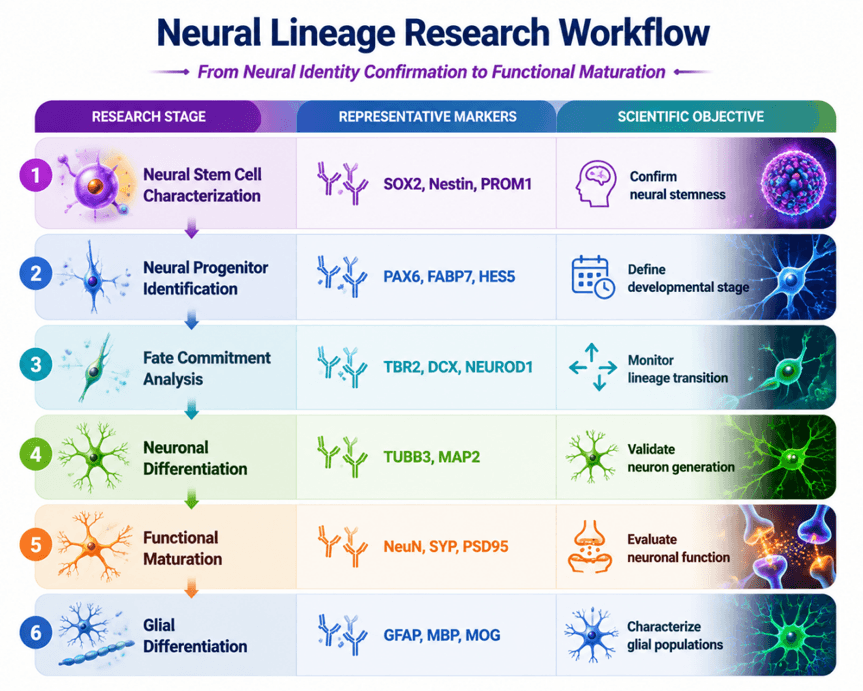
Our comprehensive neural lineage marker panels enable precise characterization of neural development across the entire differentiation continuum, from early neural stem cell states to functionally mature neuronal and glial populations. SOX2, Nestin, and PROM1 support neural stem cell identification and maintenance analysis, while PAX6, FABP7, and HES5 define neural progenitor populations and developmental progression. Commitment toward specific neural fates is evaluated through TBR2, DCX, and NEUROD1, followed by neuronal differentiation and maturation assessment using TUBB3, MAP2, NeuN, SYP, and PSD95. Glial lineage specification is monitored with GFAP, MBP, and MOG. Together, these validated biomarkers empower studies in neurodevelopment, neural regeneration, neurodegenerative disease modeling, and iPSC-derived brain organoid research, providing reliable tools for dissecting neural identity, lineage commitment, and functional maturation.
Why Researchers Choose Our Neural Lineage Development Solutions
Validated Biomarkers. Comprehensive Lineage Coverage. Reliable Neural Differentiation Analysis.
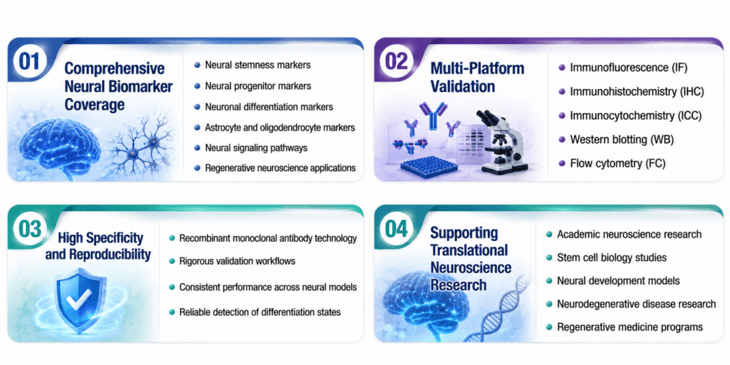
Our neural lineage antibody portfolio supports the complete research workflow — from neural stem cell identification and lineage commitment analysis to mature neuronal and glial characterization. Highly validated antibodies enable accurate, reproducible profiling across stem cell models, brain organoids, developmental neuroscience studies, and regenerative medicine applications.
Research Challenge | Our Solution |
How can I accurately identify neural stem and progenitor populations? | Comprehensive neural stem cell marker panels including SOX2, Nestin, PROM1/CD133, PAX6, FABP7/BLBP, and NOTCH pathway markers |
How can I monitor neural differentiation progression? | Stage-specific biomarker panels covering neural progenitors, immature neurons, mature neurons, and glial lineages |
How can I validate iPSC-derived neural models and organoid systems? | Integrated lineage characterization panels for neuronal, astrocytic, and oligodendrocyte differentiation |
How can I resolve neural cellular heterogeneity? | Multiplex immunofluorescence-compatible antibody combinations enabling simultaneous detection of multiple neural populations |
How can I improve experimental consistency and reproducibility? | Highly validated antibodies optimized for IHC, ICC/IF, Western blot, and multiplex imaging applications |
Key References
1. Sagner A., Briscoe J. (2022).Establishing neuronal diversity in the vertebrate central nervous system.Nature Reviews Neuroscience. 23: 421–437.
2. Kanton S., Boyle M.J., He Z., et al. (2022).Organoid and single-cell approaches reveal principles of human cortical development.Nature Neuroscience. 25: 1190–1204.
3. Kelley K.W., Pașca S.P. (2023).Human brain organogenesis: toward a cellular understanding of neurodevelopment and disease.Nature Reviews Neuroscience. 24: 673–689.
4. Shen Y., Wang X., et al. (2023).Transcriptional control of neural progenitor differentiation and neuronal identity.Development. 150: dev201900.
5. Guillemot F. (2022).Spatial and temporal control of neuronal differentiation in the developing brain.Developmental Cell. 57: 1870–1884.