
info@ucallmlabs.com
From Tumor Identification to Molecular Classification — Empowering Accurate Neuroendocrine Neoplasm Characterization with Validated Biomarker Antibodies
Neuroendocrine neoplasms (NENs) represent a highly heterogeneous group of tumors originating from neuroendocrine cells and occurring throughout the gastrointestinal tract, pancreas, lung, adrenal gland, and other organs.
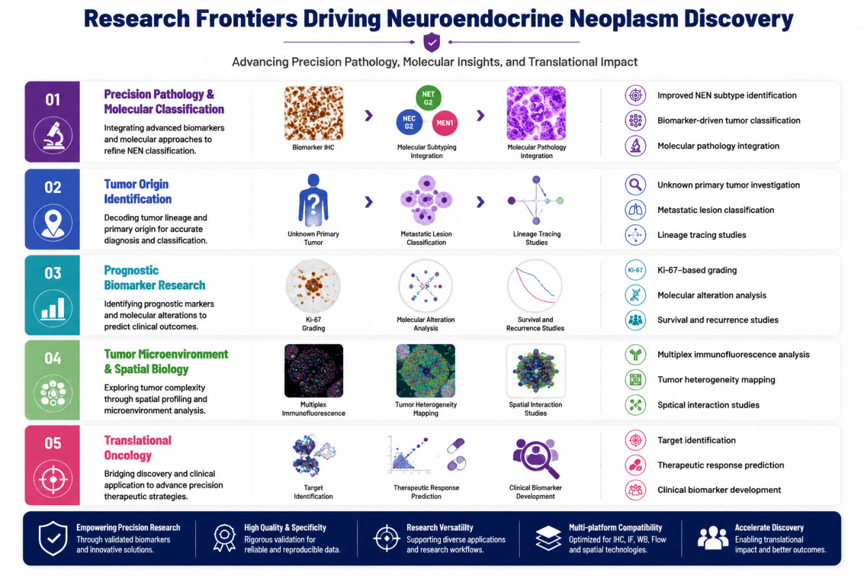
We enable comprehensive neuroendocrine neoplasm (NEN) research by supporting investigation across key biological frontiers, from precision pathology and molecular classification to tumor origin identification, prognostic biomarker discovery, and translational oncology. Validated research tools facilitate accurate NEN subtype characterization, lineage tracing of metastatic and unknown primary tumors, and molecular profiling approaches for improved diagnosis and patient stratification. Advanced biomarker analysis, spatial profiling, and tumor microenvironment studies further reveal cellular heterogeneity, tumor evolution, and complex interactions within the NEN ecosystem. Together, these integrated approaches empower researchers to decode NEN molecular mechanisms, identify disease-associated biomarkers, and accelerate the development of precision therapeutic strategies for personalized neuroendocrine cancer management.
Neuroendocrine Neoplasm Biomarker Portfolio
——Comprehensive Solutions for NEN Identification, Classification and Origin Tracing
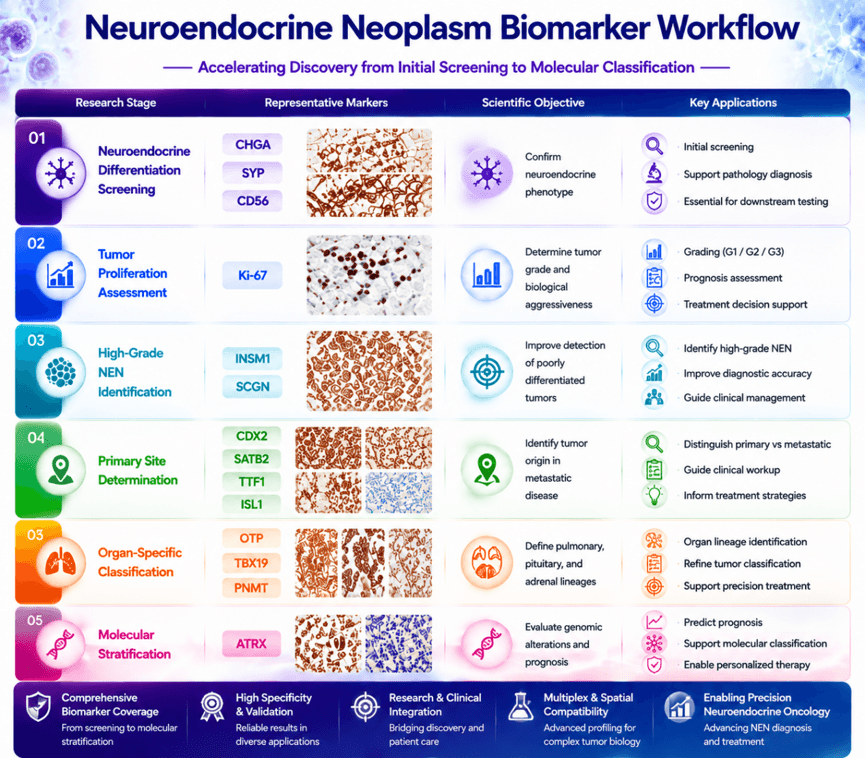
Accurate NEN characterization requires integrated analysis of neuroendocrine differentiation markers, proliferation status, tumor lineage markers, and organ-specific transcription factors. Our antibody portfolio covers the complete biomarker workflow from initial screening to advanced molecular classification.
Biomarker Category | Representative Markers | Research Applications | Biological Significance |
Core Neuroendocrine Differentiation Markers | Chromogranin A (CHGA), Synaptophysin (SYP), CD56 (NCAM1) | Confirmation of neuroendocrine phenotype, tumor screening | Identify neuroendocrine differentiation and neural lineage characteristics |
Proliferation and Grading Markers | Ki-67 (MKI67) | WHO grading, prognosis evaluation, tumor classification | Quantify proliferative activity and tumor aggressiveness |
Broad Epithelial Markers | Pan-Cytokeratin (CK) | Differential diagnosis of epithelial-origin tumors | Confirm epithelial differentiation and exclude non-epithelial malignancies |
Second-Generation Neuroendocrine Transcription Factors | INSM1, ISL1, SCGN, OTP | High-grade NEN identification and molecular classification | Provide improved sensitivity in poorly differentiated tumors |
Organ-Origin Tracing Markers | CDX2, SATB2, TTF1, ISL1, TBX19, PNMT | Metastatic lesion origin identification | Determine primary tumor site and lineage specification |
Molecular Stratification Markers | ATRX | Pancreatic NEN research and prognosis evaluation | Associated with genomic alterations and tumor progression |
Core Neuroendocrine Neoplasm Biomarker Targets
Marker | Biological Function | Research Value | Research Application |
Chromogranin A (CHGA) | Secretory granule protein involved in neuroendocrine vesicle formation, peptide hormone storage, and regulated secretion | A classical and widely used indicator of neuroendocrine differentiation and secretory phenotype | Confirmation of neuroendocrine lineage and identification of neuroendocrine neoplasms (NENs) |
Synaptophysin (SYP) | Synaptic vesicle membrane protein involved in vesicle formation, neurotransmitter release, and neuroendocrine secretion | Highly sensitive pan-neuroendocrine marker for detecting neuroendocrine differentiation | High-sensitivity screening and diagnosis of NENs |
CD56 (NCAM1) | Neural cell adhesion molecule involved in cell–cell adhesion, neuronal development, and neuroendocrine signaling | Supports neuroendocrine phenotype identification, particularly in poorly differentiated tumors | Auxiliary neuroendocrine identification and tumor classification |
Ki-67 (MKI67) | Nuclear proliferation-associated protein expressed during active phases of the cell cycle | Essential indicator of tumor proliferative activity and WHO grading stratification | Tumor grading, proliferation assessment, and prognosis evaluation |
Pan-Cytokeratin (KRT family) | Structural epithelial proteins maintaining cytoskeletal organization and epithelial cell integrity | Helps distinguish epithelial-derived neuroendocrine tumors from non-epithelial malignancies | Differential diagnosis of NENs and other epithelial tumors |
INSM1 | Neuroendocrine transcription factor regulating endocrine and neuronal lineage differentiation programs | Highly specific emerging marker for neuroendocrine lineage commitment, especially in high-grade tumors | Detection of poorly differentiated NENs and neuroendocrine differentiation assessment |
ISL1 | Transcription factor involved in pancreatic endocrine development and endocrine cell lineage specification | Provides lineage information for pancreatic neuroendocrine tumor identification | Pancreatic NEN classification and origin determination |
SCGN | Calcium-binding secretory protein regulating endocrine vesicle function and hormone secretion | Useful marker for characterizing neuroendocrine secretory phenotype and tumor differentiation status | Neuroendocrine tumor characterization and subtype profiling |
OTP | Transcription factor controlling pulmonary neuroendocrine cell differentiation and lineage maintenance | Enables molecular classification of pulmonary carcinoids and neuroendocrine tumor subtypes | Pulmonary neuroendocrine tumor classification and lineage analysis |
CDX2 | Intestinal transcription factor controlling gastrointestinal epithelial differentiation and identity | Provides clues for determining gastrointestinal origin of metastatic neuroendocrine tumors | Gastrointestinal NEN origin tracing and lineage assignment |
SATB2 | Nuclear transcriptional regulator associated with lower gastrointestinal epithelial differentiation | Valuable marker for identifying colorectal/rectal lineage in metastatic tumors | Lower gastrointestinal neuroendocrine tumor identification |
TTF-1 (NKX2-1) | Lung lineage transcription factor regulating pulmonary epithelial development and differentiation | Supports determination of pulmonary origin in neuroendocrine malignancies | Pulmonary NEN identification and differential diagnosis |
TBX19 (T-Pit) | Pituitary-specific transcription factor controlling corticotroph cell differentiation | Enables precise classification of pituitary neuroendocrine tumor subtypes | Pituitary neuroendocrine tumor classification and lineage confirmation |
ATRX | Chromatin remodeling protein involved in epigenetic regulation, DNA repair, and genomic stability | Loss of ATRX expression reflects molecular alterations associated with pancreatic NEN progression | Molecular stratification and genomic characterization of pancreatic NENs |
PNMT | Catecholamine biosynthesis enzyme converting norepinephrine to epinephrine | Defines adrenergic differentiation and supports classification of catecholamine-producing tumors | Identification and characterization of pheochromocytoma and paraganglioma |
Featured Research Solutions
——Comprehensive Biomarker Panels for Neuroendocrine Neoplasm Research
n Basic NEN Identification Panel—Confirming Neuroendocrine Differentiation and Tumor Classification
Key Markers
Chromogranin A
| Synaptophysin (SYP)
| INSM1
| Ki-67
|
n NEN Origin Tracing Panel—Identifying Primary Sites in Metastatic Neuroendocrine Tumors
Key Markers
CDX2 | SATB2 | ISL1 | TTF1 |
Pulmonary Neuroendocrine Tumor Panel—Distinguishing Pulmonary Carcinoid and High-Grade Neuroendocrine Carcinoma
Key Markers
OTP | TTF1 | INSM1 | Ki-67 |
n Pancreatic Neuroendocrine Tumor Panel—Molecular Characterization of Pancreatic NENs
Key Markers
ISL1 | INSM1 | ATRX | Ki-67 |
Neuroendocrine Neoplasm Biomarker Research
——Accelerating Discovery from Initial Screening to Molecular Classification
We provide comprehensive neuroendocrine neoplasm (NEN) biomarker research solutions supporting systematic tumor characterization from initial lineage confirmation to advanced molecular classification and translational discovery. By integrating validated markers for neuroendocrine differentiation, proliferation assessment, tumor grading, site-of-origin identification, and genomic profiling, researchers can establish robust molecular frameworks for NEN diagnosis and stratification. Advanced biomarker panels further enable characterization of tumor heterogeneity, biological behavior, and disease progression, supporting precision pathology, prognostic evaluation, and therapeutic target discovery in neuroendocrine cancer research.
Why Researchers Choose Our Neuroendocrine Neoplasm Biomarker Solutions?
Validated Markers. Comprehensive Coverage. Confident NEN Research.
Our antibody portfolio supports the complete NEN research workflow—from neuroendocrine differentiation confirmation and tumor classification to molecular profiling and translational oncology applications.
Research Challenge | Our Solution |
How can I accurately identify neuroendocrine tumors? | Comprehensive CHGA, SYP, CD56 and INSM1 marker solutions for reliable NEN confirmation |
How can I improve detection of poorly differentiated tumors? | Next-generation transcription factor markers including INSM1, SCGN and OTP |
How can I determine unknown tumor origin? | Tissue lineage markers including CDX2, SATB2, TTF1, ISL1 and TBX19 |
How can I evaluate tumor aggressiveness? | Ki-67 and molecular stratification markers for grading and prognosis studies |
How can I improve experimental reproducibility? | Highly validated monoclonal and polyclonal antibodies optimized for IHC, IF and translational research |

Key References
1. Wang Z., et al. (2024).A Cross-Tissue Molecular Classification of Neuroendocrine Carcinomas Based on Five Master Regulators.Cancer Cell. 42(6):1106–1125.e8.
2. Uccella S. (2024).Molecular Classification of Gastrointestinal and Pancreatic Neuroendocrine Neoplasms: Are We Ready for That?Endocrine Pathology. 35:91–106.
3. Taboada R.G., Riechelmann R.P. (2024).Differentiating High-Grade Neuroendocrine Neoplasms: Challenges and Molecular Insights.Nature Reviews Cancer. 24:233–246.
4. Butz H., Patócs A., Igaz P. (2024).Circulating Non-Coding RNA Biomarkers in Endocrine and Neuroendocrine Tumors.Nature Reviews Endocrinology.20:600–614.
5. Simpson K.L., et al. (2025).Small Cell Lung Cancer Heterogeneity and Phenotypic Plasticity: Implications for Neuroendocrine Tumor Biology.Nature Reviews Cancer.25:447–462.