
info@mail.ucallm.com
From Molecular Interaction Assays to High-Throughput Drug Discovery
Time-Resolved Fluorescence Resonance Energy Transfer (TR-FRET) is a highly sensitive detection technology combining time-resolved fluorescence (TRF) and fluorescence resonance energy transfer (FRET).
TR-FRET takes advantage of the long fluorescence lifetime of lanthanide fluorophores as donors. Fluorescence signals are collected after a time delay following excitation, which efficiently reduces interference from short-lived background fluorescence. Meanwhile, it relies on short-distance energy transfer between donor and acceptor to convert interactions between proteins, antibodies, ligands and other biomolecules into quantitatively analyzable fluorescence readouts.
Compared with conventional assays requiring repeated washing steps, TR-FRET enables homogeneous, no-wash detection. The assay workflow follows Add → Incubate → Read. It features low background, high signal-to-noise ratio, superior sensitivity, stable signals, and compatibility with high-throughput screening.
Benefiting from these technical strengths, TR-FRET is widely applied in biomolecular interaction analysis, PROTAC drug discovery, kinase activity and inhibitor screening, antibody discovery and development, cytokine quantification, intracellular phosphorylation detection, GPCR signaling assays, and tumor immunity research.
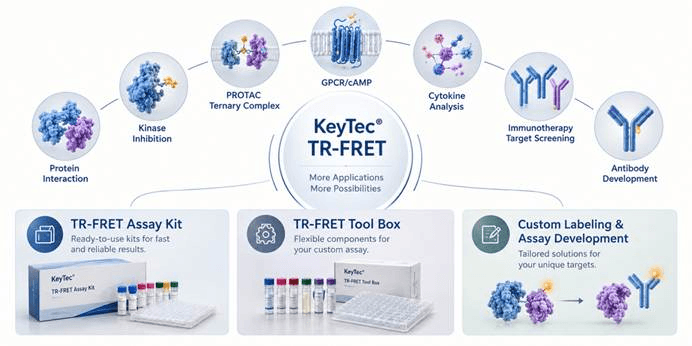
KeyTec® TR-FRET solutions for diverse research applications.
1 TR-FRET Technology
Conventional fluorescence detection acquires signals immediately after excitation. Autofluorescence from samples, culture media and test compounds may fall within the detection window and compromise assay sensitivity.
TR-FRET employs lanthanide elements with long fluorescence lifetimes as fluorescent donors. Lanthanide fluorescence lifetimes are on the millisecond scale, whereas typical background fluorescence decays within nanoseconds. Accordingly, fluorescence acquisition after a defined time delay post-excitation effectively filters out most short-lived background signals.
In the FRET process, when donor and acceptor are in sufficiently close proximity, the donor absorbs excitation energy and transfers it non-radiatively to the acceptor, triggering characteristic fluorescence emission from the acceptor.
By combining temporal background rejection and spatial detection of molecular interactions, TR-FRET achieves highly specific measurement of biomolecular interactions.
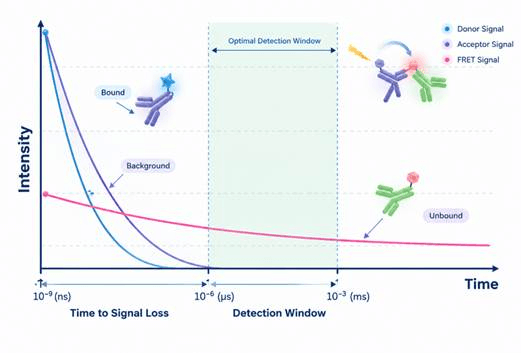
Lanthanide ions among rare earth metals are well known for their long fluorescence lifetimes. When combined with appropriate ligands and irradiated by near-ultraviolet light, they emit intense fluorescence. For example, europium (Eu), terbium (Tb), samarium (Sm) and dysprosium (Dy) exhibit fluorescence lifetimes as long as 1 ms.
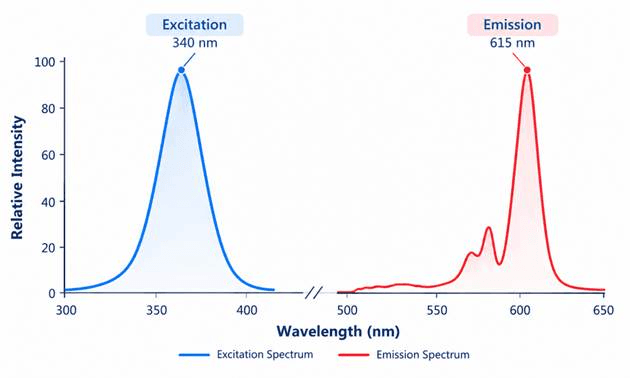
Europium (Eu): exhibits a large Stokes shift (the difference between the maximum excitation wavelength and maximum emission wavelength).
Common assay systems adopt dual-wavelength detection of donor and acceptor signals, e.g., 620 nm for Donor and 665 nm for Acceptor. Results are analyzed using the acceptor/donor signal ratio. TR-FRET Ratio = Signal 665 / Signal 620 × 10⁴. Ratiometric analysis can partly reduce the impacts of well-to-well variation, sample matrix and other factors on assay readouts.
2 Advantages of TR-FRET Technology
- Ultra-low background and high signal-to-noise ratio; time-delayed acquisition effectively suppresses short-lived fluorescence interference.
- High sensitivity and high specificity, suitable for detection of low-abundance targets and weak molecular interactions.
- Stable signals and flexible readout scheduling. Benefiting from the long-lifetime fluorescence of lanthanides, detection time can be arranged according to experimental workflows.
- Homogeneous no-wash format with simple operation. Cumbersome washing steps are eliminated to streamline experimental procedures.
- Compatible with high-throughput screening and automation. Works with 384-well and 1536-well microplate formats for large-scale screening campaigns.
- Broad sample compatibility and robust performance. The assay systems exhibit acceptable tolerance to common experimental components such as DMSO and salt ions.