
info@ucallmlabs.com
1.Overview
Vaccinia virus (VACV) is the prototype species of the genus Orthopoxvirus within the family Poxviridae. It is an enveloped, linear double‑stranded DNA virus. Vaccinia virus is best known as the vaccine strain used to eradicate smallpox, representing the first vaccine vector in human history to successfully eliminate an infectious disease. The virion is brick‑shaped or ovoid, approximately 220–450 nm in length and 140–260 nm in width.
A unique feature of vaccinia virus, as a DNA virus, is that its transcription and DNA replication occur entirely in the cytoplasm of the host cell, without depending on the nucleus. The viral genome is approximately 190 kb of double‑stranded DNA, encoding over 200 proteins, of which approximately 100 are associated with the virion. The genome is flanked by inverted terminal repeat (ITR) sequences, which form covalently closed hairpin termini at each extremity.
Vaccinia virus produces two major infectious forms: intracellular mature virus (IMV) and extracellular enveloped virus (EEV). IMV is the primary infectious form within the cell, released upon cell lysis, while EEV acquires additional membranes and buds from the cell, facilitating long‑range dissemination.
2.Background Information
2.1 What is Vaccinia Virus?
Vaccinia virus is an enveloped, linear double‑stranded DNA virus belonging to the family Poxviridae and genus Orthopoxvirus. The virion is brick‑shaped or ovoid, with surface tubules or filaments on the membrane. Vaccinia virus is the type species of the genus Orthopoxvirus and the vaccine strain used to eradicate smallpox.
The vaccinia virus genome is a linear double‑stranded DNA of approximately 170–250 kb. The genome is flanked by inverted terminal repeat sequences with covalently closed hairpin termini at both ends. The viral genome encodes over 200 proteins, which are divided into three temporal classes based on expression timing: early proteins (synthesized prior to DNA replication), intermediate proteins, and late proteins (synthesized after the onset of replication).
The most distinctive feature of vaccinia virus is its complete replication within the host cell cytoplasm. The virus carries its own DNA‑dependent RNA polymerase and transcription factors, enabling it to initiate early gene transcription almost immediately after entry.
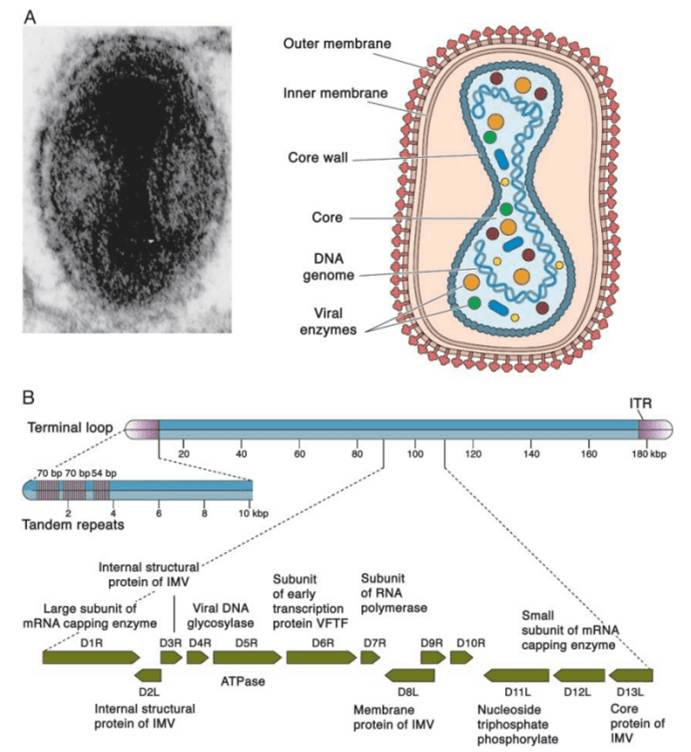
Vaccinia virus, a representative poxvirus: virion structure (A) and genome organization with an expanded view of the HindIII D restriction enzyme fragment (B). The presence of an inner membrane in the IMV form of the virion shown in A is controversial. See Poxvirus replication cycle for a detailed description. (PMID: 15249657)
2.2 Vaccinia Virus Genome & Classification
Vaccinia virus belongs to the genus Orthopoxvirus in the family Poxviridae. Its genome is a linear double‑stranded DNA of approximately 190 kb, containing about 150–200 genes. The genome is flanked by inverted terminal repeats (ITRs) with covalently closed hairpin termini.
Vaccinia virus is the type species of the genus Orthopoxvirus and shares high sequence similarity and cross‑protective immunity with other members of the genus, such as variola virus (smallpox), mpox virus, and cowpox virus. Multiple strains of vaccinia virus exist, including Western Reserve (WR), Tian Tan (VTT), and Modified Vaccinia Ankara (MVA). MVA is a highly attenuated vaccinia virus strain approved for use as a smallpox and mpox vaccine.
2.3 What Are Lyssavirus Rabies Structural Proteins?
Vaccinia virus encodes over 200 proteins, of which approximately 100 are associated with the virion. A total of 73 proteins have been identified in the mature virion. Major structural proteins and their functions include:
| Protein | Localization | Main Function |
| A9, A13, A14, A17 | IMV membrane | Membrane structural proteins |
| A26, A27, D8, H3 | IMV membrane | Cell attachment |
| A16, A21, A28, F9, G3, G9, H2, J5, L1, L5 | IMV membrane | Entry fusion complex (EFC) |
| A3 (P4b), A4, A10 (P4a), A12 | Core | Core structural proteins |
| A15, A30, D2, D3, F10, G7, J1 | Core | 7‑protein complex |
| A56R | EEV/CEV | Envelope protein; haemagglutinin |
| F13L | EEV/CEV | Membrane‑associated protein; phospholipase D superfamily |
| B5R | EEV/CEV | Envelope protein; CD46 homologue; protection from complement lysis |
| A33R | EEV/CEV | Envelope protein; involved in binding to actin cables |
| A34R | EEV/CEV | C‑type lectin similarity; involved in CEV binding to actin cables |
The vaccinia virus Entry Fusion Complex (EFC) consists of at least 11 viral proteins (A16, A21, A28, F9, G3, G9, H2, J5, L1, L5, and O3) responsible for mediating fusion of the viral envelope with the host cell membrane. F9 protein is required for entry but not for assembly, while L1 functions in both assembly and entry.
2.4 Mechanism of Cell Entry and Replication
2.4.1 Viral Attachment and Receptor Recognition
Vaccinia virus infection begins with the binding of viral surface proteins to host cell glycosaminoglycans (GAGs), mediating endocytosis of the virus. The virus can also be taken up via "apoptotic mimicry" – the outer leaflet of the virion envelope is rich in phosphatidylserine, mimicking the "eat‑me" signal of apoptotic cells and triggering macropinocytosis.
2.4.2 Viral Entry
Vaccinia virus enters host cells via two main pathways:
Direct membrane fusion: viral envelope fuses directly with the host plasma membrane, releasing the core into the cytoplasm
Macropinocytosis: after endocytosis, vacuolar acidification triggers low‑pH‑dependent fusion of the viral envelope with endosomal membranes, pore formation, and core release
2.4.3 Viral RNA Replication
After entry, a distinctive feature of vaccinia virus is that it completes its entire replication cycle in the host cell cytoplasm. Replication proceeds through three temporal expression phases:
Early phase (30 minutes post‑infection) : the virus‑encoded RNA polymerase transcribes early genes, encoding immune evasion proteins (e.g., soluble receptors, anti‑apoptotic factors) and enzymes required for DNA replication
Intermediate phase (approximately 100 minutes post‑infection) : intermediate genes are expressed, triggering viral DNA genome replication
Late phase (140 minutes to 48 hours post‑infection) : late genes are expressed, producing all structural proteins
Viral DNA replication occurs in specialized cytoplasmic regions called "viral factories," which are membrane‑enclosed compartments of ER origin resembling mini‑nuclei.
2.4.4 Viral Assembly and Release
Viral assembly begins with crescent‑shaped membranes derived from the ER, seeded with the viral scaffold protein D13 forming a honeycomb lattice. These crescents wrap into spheres, forming immature virions (IV). IVs mature into brick‑shaped intracellular mature virions (IMV).
Vaccinia virus produces four distinct forms of virions:
Intracellular mature virions (IMV) : accumulate in the cytoplasm and are released upon cell lysis
Intracellular enveloped virions (IEV) : IMVs wrapped by double‑layered membranes from the trans‑Golgi network or endosomes
Cell‑associated enveloped virions (CEV) : formed when IEVs fuse with the plasma membrane, enabling direct cell‑to‑cell spread
Extracellular enveloped virions (EEV) : a subset of CEVs released from the cell, facilitating long‑range dissemination
IEV particles are transported along microtubules via kinesin motors to the cell surface. Released IMVs are highly stable in the environment, surviving for 14 days at +4°C on gauze bandages and up to 166 days in storm water at +4.5°C.
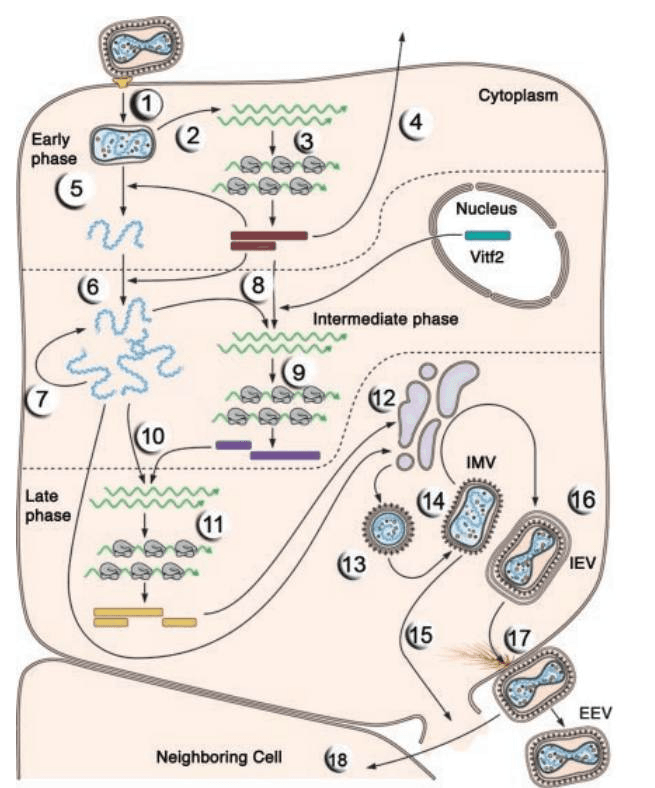
The single-cell reproductive cycle of vaccinia virus. The entry and replication of an EEV are illustrated. RNA molecules are green. See Poxvirus replication cycle for a detailed description of each illustrated step.(PMID: 15249657)
2.5 Symptoms and Treatment
2.5.1 Clinical Symptoms
Vaccinia virus does not typically cause severe disease under natural conditions. However, when used as the smallpox vaccine, a local lesion develops at the site of immunization. Common vaccination‑associated symptoms include:
Fever
Fatigue
Rash
Headache
Nausea
Body aches
Lymphadenopathy
Myalgia
A red papule appears 3–5 days post‑vaccination, followed by vesiculation at 5–6 days. In immunocompromised individuals, live vaccinia virus vaccines can cause severe adverse reactions, including encephalitis and myocarditis.
2.5.2 Treatment
Treatment for vaccinia virus infection depends on severity and may include:
Antivirals: Cidofovir
Vaccinia immune globulin (VIG) : intramuscular injection at 0.6 ml/kg, started as soon as possible after symptom onset
Local lesion care and symptomatic treatment
Severe cases may require hospital admission, supportive care, and aggressive hydration
For laboratory workers, healthcare personnel, and emergency responders, vaccination with ACAM2000 or Jynneos (MVA-BN) is generally recommended for prevention.
2.6 Targets for Intervention
2.6.1 Viral Targets
| Target | Protein | Biological Role |
| Entry Fusion Complex (EFC) | A16, A21, A28, F9, etc. | Viral entry and membrane fusion |
| p37 protein | Envelope formation | Viral envelopment |
| DNA polymerase | Viral DNA replication | DNA replication |
| Late replication proteins | A39R, C8L | Late‑stage replication |
2.6.2 Host Receptors & Entry Factors
| Host Target | Type | Role in Infection |
| Glycosaminoglycans | Receptor | Viral attachment |
| Phosphatidylserine | Membrane lipid | Apoptotic mimicry‑mediated macropinocytosis |
| CCR5 | Chemokine receptor | Signaling supporting virus replication |
2.6.3 Host Signaling Pathways
| Pathway | Key Targets | Biological Role |
| Apoptosis pathway | Bcl‑2 family, caspase‑9 | Inhibited by viral F1L protein |
| Autophagy pathway | LC3, ATG12‑ATG3 | Actively disrupted by virus |
| NF‑κB pathway | IKK complex | Inhibited by viral B14 protein |
| Interferon pathway | IRF3 | Suppressed by poxviruses |
2.7 Vaccine Types and Development Progress
Vaccinia virus, as the smallpox vaccine, played a pivotal role in the global eradication of smallpox in 1980. Today, vaccinia virus has evolved into a versatile vaccine platform widely used for vaccine development against various diseases.
2.7.1 Traditional Smallpox Vaccines
ACAM2000: a replication-competent vaccinia virus vaccine approved for smallpox and mpox prevention, but can cause severe adverse reactions in immunocompromised individuals
MVA-BN (Jynneos/Imvamune/Imvanex) : a highly attenuated Modified Vaccinia Ankara virus approved as a smallpox and mpox vaccine
2.7.2 Next-Generation Attenuated Vaccinia Virus Vaccines
In 2025, researchers developed a new generation of attenuated and highly immunogenic vaccinia virus named dBTF based on the vaccinia Tiantan strain, a replication‑competent smallpox vaccine widely used in China. dBTF is impaired in replication and low in virulence, inducing strong vaccinia virus‑specific humoral and cellular immune responses. A single dose effectively protects mice and cynomolgus macaques from mpox virus challenge.
2.7.3 Vaccinia Virus-Vectored Vaccines
Vaccinia virus is a highly promising vaccine vector due to its large foreign DNA carrying capacity (>25 kb). Recent studies include:
Recombinant vaccinia SARS‑CoV‑2 vaccine: based on the highly attenuated Dairen I strain (r‑DIs‑S), expressing the SARS‑CoV‑2 spike protein, inducing robust humoral and cellular immune responses in mice and macaques, with durable immunity lasting at least 6 months. Intradermal delivery via microneedle patches enables precise dosing and stable immunization
Recombinant vaccinia Toxoplasma vaccine: expressing MIC8 and AMA1 antigens, achieving 89.6% reduction in brain cyst count with significantly improved survival
2.7.4 Vaccinia Virus Vector Modification Strategies
Common strategies for vaccinia virus vector modification include targeting specific viral genes for attenuation to enhance vector safety and immunogenicity.
2.8 Drugs
The most studied antiviral drugs for orthopoxvirus infections currently include Tecovirimat, NIOCH‑14, Cidofovir, and Brincidofovir.
2.8.1 Virus-Targeted Drugs
| Target | Drug/candidate | Mechanism |
| p37 envelope protein | Tecovirimat (ST‑246/TROXX) | Inhibits viral envelopment |
| DNA polymerase | Cidofovir | DNA polymerase inhibition |
| Brincidofovir | DNA polymerase inhibition | |
| Envelopment | NIOCH‑14 | Envelopment inhibition |
| Unknown (late replication) | N‑arylated 1,2,4‑oxadiazol‑5(4H)‑ones | Potential multi‑target effect, targeting p37, A39R, C8L |
| PLK1 | HMN‑214, ON‑01910 | PLK1 inhibition, dampens VACV replication |
| Iron metabolism | Ciclopirox (CPX) | Targets iron metabolism to suppress viral replication |
A 2025 study discovered a novel class of N-arylated 1,2,4-oxadiazol-5(4H)-ones with submicromolar antiviral activity against vaccinia virus, cowpox virus, ectromelia virus, and variola virus, with selectivity indices up to 13738. These compounds target the conserved p37 protein, which plays a key role in viral envelopment. Their activity is higher than that of Cidofovir.
2.8.2 Host-Targeted Drugs
| Target | Drug/candidate | Mechanism |
| Immune modulation | Vaccinia immune globulin (VIG) | Passive immunization |
2.9 Oncolytic Virus Therapy
Vaccinia virus has emerged as a leading candidate for oncolytic virotherapy. Due to its broad cytophilicity and robust capacity to express exogenous genes, oncolytic vaccinia virus (OVV) has entered clinical trials.
2.9.1 Advantages of Oncolytic Vaccinia Virus
Large foreign DNA carrying capacity (>25 kb), enabling simultaneous expression of multiple therapeutic genes
Natural tumor tropism and efficient tumor cell lysis
Viral genome does not integrate into the host genome, ensuring safety
Dual mechanism of tumor killing through oncolysis and immune activation
2.9.2 Latest Research Advances (2025)
Combination therapy: oncolytic vaccinia virus combined with the MET inhibitor Tepotinib for lung cancer demonstrated superior antitumor effects compared to monotherapy, effective against both injected and untreated distant tumors
Immune activation: recombinant vaccinia virus expressing IL2 and tumor‑associated antigen epitopes significantly enhanced CD4+ and antigen‑specific CD8+ T cell responses in the 4T1 breast cancer model
Microenvironment modulation: TIM‑3 blockade reverses oncolytic vaccinia virus‑induced DC inactivation and T cell exhaustion, improving antitumor immunity and therapeutic efficacy
Multiple gene modifications: a 2025 study reported a novel oncolytic vaccinia virus with multiple gene modifications, improving safety for intravenous administration while maintaining proliferative potential in cancer cells
3.Related Products & Services
Recombinant Antigens & Receptors
Antibodies
Detection Kits
Recombinant Protein Expression Services
Antibody Development Services
4.Resources
5.References
Condit, R. C., Moussatche, N., Traktman, P. (2006). In a nutshell: structure and assembly of the vaccinia virion. Advances in Virus Research, 66, 31–124.
Mercer, J., Helenius, A. (2008). Vaccinia virus uses macropinocytosis and apoptotic mimicry to enter host cells. Science, 320(5875), 531–535.
Moss, B. (2013). Poxvirus DNA replication. Cold Spring Harbor Perspectives in Biology, 5(9), a010199.
Greseth, M. D., Traktman, P. (2022). The life cycle of the vaccinia virus genome. Annual Review of Virology, 9, 239–259.
Yao, X., et al. (2019). The Vaccinia virion: Filling the gap between atomic and ultrastructure. PLOS Pathogens, 15(5), e1007508.
Moss, B. (2012). Poxvirus cell entry: how many proteins does it take? Viruses, 4(11), 2751–2765.
Moss, B. (2015). Poxvirus membrane biogenesis. Virology, 479–480, 2–11.
Suárez, C., et al. (2023). A succession of two viral lattices drives vaccinia virus assembly. PLOS Biology, 21(4), e3002005.
Smith, G. L., Benfield, C. T. O., Maluquer de Motes, C., et al. (2013). Vaccinia virus immune evasion: mechanisms, virulence and immunogenicity. Journal of General Virology, 94, 2367–2392.
Pittman, P. R., Hahn, M., Lee, H. S., et al. (2019). Phase 3 efficacy trial of modified vaccinia Ankara as a vaccine against smallpox. New England Journal of Medicine, 381(20), 1897–1908.
Yang, G., Pevear, D. C., Davies, M. H., et al. (2005). An orally bioavailable antipoxvirus compound targets the intracellular mature form of vaccinia virus and is active against other orthopoxviruses. Journal of Virology, 79(20), 13139–13149.
Duraffour, S., Lorenzo, M. M., Zöller, G., et al. (2007). Activity of the anti-orthopoxvirus compound ST-246 against vaccinia virus in cell culture and in vivo. Antimicrobial Agents and Chemotherapy, 51(7), 2559–2565.
Seet, B. T., Johnston, J. B., Brunetti, C. R., et al. (2003). Poxviruses and immune evasion. Annual Review of Immunology, 21, 377–423.
Breitbach, C. J., Burke, J., Jonker, D., et al. (2011). Intravenous delivery of a multi-mechanistic cancer-targeted oncolytic poxvirus in humans. Nature Medicine, 17(7), 855–859.
Shenouda, M. M., Noyce, R. S., Lee, S. Z., et al. (2022). The mismatched nucleotides encoded in vaccinia virus flip-and-flop hairpin telomeres serve an essential role in virion maturation. PLOS Pathogens, 18(3), e1010392.