
info@mail.ucallm.com
```
```
Pyroptosis
1 Mechanism Overview
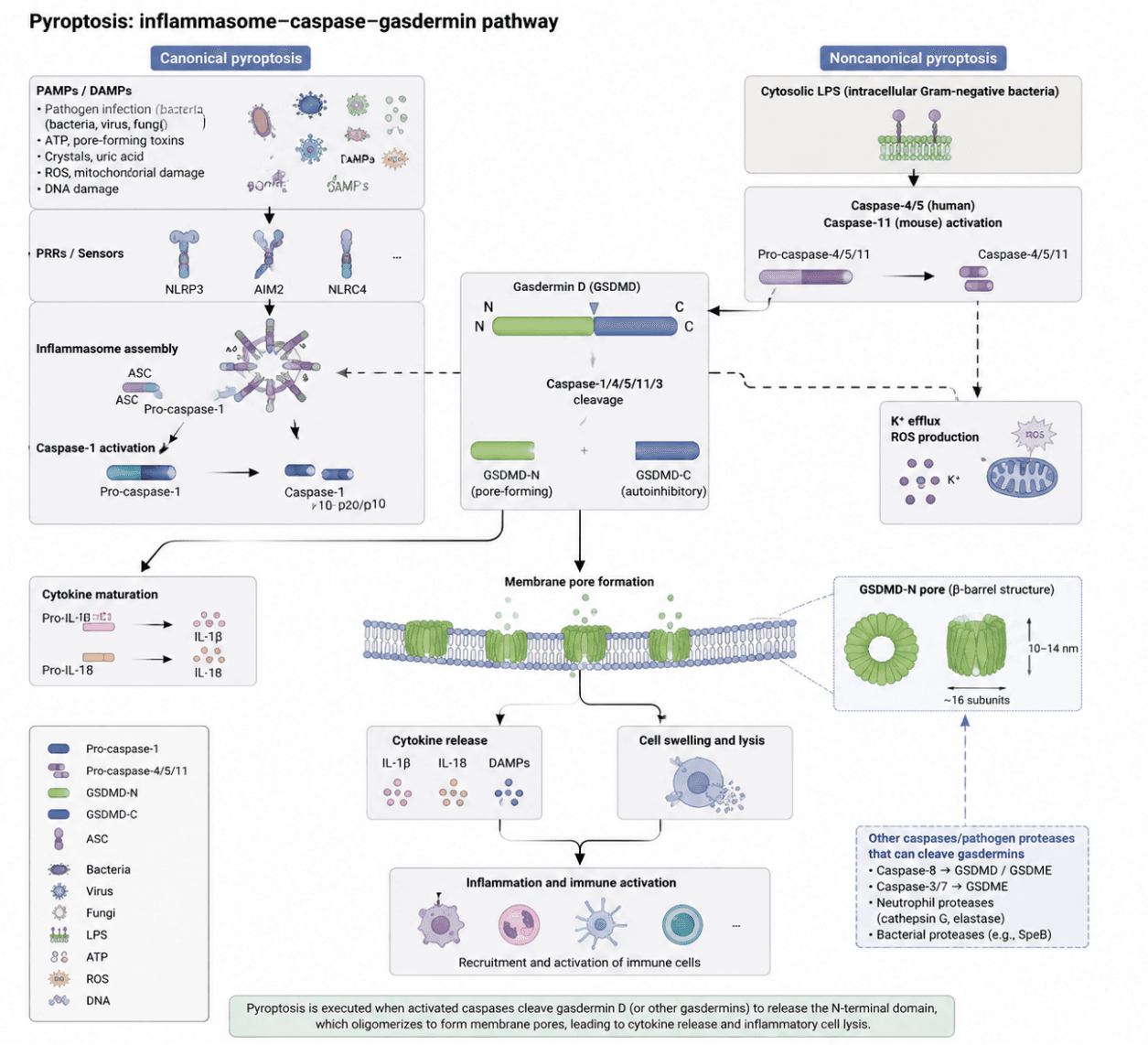
Pyroptosis is a form of programmed inflammatory cell death mediated by inflammatory caspases and gasdermin family proteins, and it is primarily activated through two pathways: the canonical pathway and the non‑canonical pathway. In the canonical pyroptosis pathway, bacterial, viral, and damage‑associated signals induce the assembly of inflammasomes (such as NLRP3, AIM2, and NLRC4), leading to the activation of Caspase‑1. In the non‑canonical pathway, cytosolic lipopolysaccharide (LPS) directly activates human Caspase‑4/5 or mouse Caspase‑11. Activated inflammatory caspases subsequently cleave gasdermin D (GSDMD), releasing the pore‑forming N‑terminal domain of GSDMD (GSDMD‑N). GSDMD‑N oligomerizes on the plasma membrane to form transmembrane pores, resulting in ionic imbalance, cellular swelling, and loss of membrane integrity, ultimately causing cell lysis. Meanwhile, GSDMD‑mediated membrane pore formation facilitates the release of leaderless inflammatory cytokines, including IL‑1β and IL‑18, further amplifying local inflammatory responses and immune cell recruitment. In addition, Caspase‑8, Caspase‑3, and other pathogen‑associated proteases can also induce pyroptosis‑like cell death through cleavage of gasdermin family members. Overall, the core molecular axis of pyroptosis can be summarized as: Inflammatory signal activation → Inflammasome assembly → Caspase activation → GSDMD cleavage → Membrane pore formation → Inflammatory cytokine release and cell lysis Pyroptosis plays essential roles in antimicrobial immunity, inflammatory diseases, and tissue injury by regulating immune responses and inflammation.
Pyroptosis pathway schematic. Extracellular pathogen‑associated molecular patterns (PAMPs) or damage‑associated molecular patterns (DAMPs) activate inflammasomes (such as NLRP3, AIM2, and NLRC4), leading to the activation of Caspase‑1. Meanwhile, cytosolic LPS activates Caspase‑4/5 in humans or Caspase‑11 in mice through the non‑canonical pyroptosis pathway. Activated inflammatory caspases cleave gasdermin D (GSDMD), releasing the pore‑forming N‑terminal domain of GSDMD (GSDMD‑N). GSDMD‑N subsequently oligomerizes on the plasma membrane to form membrane pores, resulting in cell swelling, membrane rupture, and the release of inflammatory cytokines such as IL‑1β and IL‑18, ultimately leading to inflammatory cell death.
2 Target List
| Mechanism Module | Target / Detection Marker | Full Name | Biological Function / Mechanistic Significance | Recommended Detection Method |
|---|---|---|---|---|
| Inflammasome Assembly | NLRP3 | NOD‑like receptor family pyrin domain‑containing 3 | Senses danger signals such as ROS, K⁺ efflux, and crystals to form the NLRP3 inflammasome | WB / IF / qPCR |
| AIM2 | Absent in melanoma 2 | Recognizes cytosolic DNA and activates inflammasome signaling | WB / IF | |
| NLRC4 | NOD‑like receptor family CARD domain‑containing 4 | Detects bacterial flagellin and type III secretion system components | WB | |
| ASC/PYCARD | Apoptosis‑associated speck‑like protein containing a CARD | Inflammasome adaptor protein linking inflammasome sensors with Caspase‑1 | WB / IF | |
| Canonical Pyroptosis Activation | Caspase‑1 | Cysteine‑dependent aspartate‑directed protease 1 (Caspase‑1) | Inflammatory caspase that cleaves GSDMD and promotes maturation of IL‑1β and IL‑18 | Cleaved‑Caspase‑1 p20 detection (WB) |
| Caspase‑1 p20 | Activated Caspase‑1 p20 fragment | Active form of Caspase‑1 indicating inflammasome activation | WB | |
| Non‑canonical Pyroptosis Pathway | Caspase‑4 (human) | Cysteine‑dependent aspartate‑directed protease 4 | Senses cytosolic LPS and induces GSDMD cleavage | WB |
| Caspase‑5 (human) | Cysteine‑dependent aspartate‑directed protease 5 | Functions similarly to Caspase‑4 in human non‑canonical pyroptosis | WB | |
| Caspase‑11 (mouse) | Cysteine‑dependent aspartate‑directed protease 11 | Key mediator of LPS‑induced pyroptosis in mouse models | WB | |
| Core Execution Phase | GSDMD | Gasdermin D | Major executioner protein of pyroptosis | WB |
| GSDMD‑N | N‑terminal domain of Gasdermin D | Pore‑forming domain generated by caspase‑mediated cleavage; forms membrane pores | WB (priority detection) | |
| Inflammatory Cytokine Release | IL‑1β | Interleukin‑1 beta | Major inflammatory cytokine released during pyroptosis | ELISA / WB |
| Cleaved IL‑1β | Mature active interleukin‑1 beta | Determines functional activation of inflammasome signaling | WB / ELISA | |
| IL‑18 | Interleukin‑18 | Promotes NK cell activation and IFN‑γ responses | ELISA | |
| Membrane Rupture / Cell Death Validation | LDH release | Lactate dehydrogenase release | Indicates plasma membrane integrity loss during pyroptosis | LDH assay |
| PI uptake | Propidium iodide uptake | Indicates increased membrane permeability caused by pore formation | Flow cytometry / fluorescence staining | |
| SYTOX Green | SYTOX Green nucleic acid dye | Enters cells with damaged membranes and labels DNA | IF / Flow cytometry | |
| Auxiliary Regulatory Pathways | Caspase‑8 | Cysteine‑dependent aspartate‑directed protease 8 | Can induce GSDMD/GSDME cleavage under specific inflammatory conditions | WB |
| Caspase‑3 | Cysteine‑dependent aspartate‑directed protease 3 | Can cleave gasdermin family proteins and induce pyroptosis‑like cell death | WB | |
| GSDME | Gasdermin E | Cleaved by Caspase‑3 to generate membrane pore‑forming fragments | WB |
3 Application Scheme
| Analysis Purpose | Recommended Markers |
|---|---|
| Determination of pyroptosis initiation | NLRP3 / AIM2 / NLRC4 |
| Inflammasome activation | ASC, Caspase‑1 p20 |
| Core execution | GSDMD‑N |
| Membrane pore formation | GSDMD cleavage |
| Inflammatory cytokine release | IL‑1β, IL‑18 |
| Non‑canonical pathway activation | Caspase‑4/5 (human), Caspase‑11 (mouse) |
| Plasma membrane rupture | LDH release, PI uptake |
| Exclusion of apoptosis | Cleaved‑Caspase‑3, PARP |
| Exclusion of necroptosis | p‑RIPK3, p‑MLKL |
4 References
- Devant P, Kagan JC. Molecular mechanisms of gasdermin D pore‑forming activity. Nat Immunol. 2023;24(7):1064‑1075. doi:10.1038/s41590‑023‑01526‑w.
- Chen KW, Broz P. Gasdermins as evolutionarily conserved executors of inflammation and cell death. Nat Cell Biol. 2024;26:1394‑1406. doi:10.1038/s41556‑024‑01474‑z.
- Zhang N, Zhang J, Yang Y, et al. A palmitoylation–depalmitoylation relay spatiotemporally controls GSDMD activation in pyroptosis. Nat Cell Biol. 2024;26:757‑769. doi:10.1038/s41556‑024‑01397‑9.
- Pyroptosis inhibiting nanobodies block Gasdermin D pore formation. Nat Commun. 2023;14:7923. doi:10.1038/s41467‑023‑43707‑z.
- Zhou B, Jiang ZH, Dai MR, et al. Full‑length GSDME mediates pyroptosis independent from cleavage. Nat Cell Biol. 2024;26:1545‑1557.